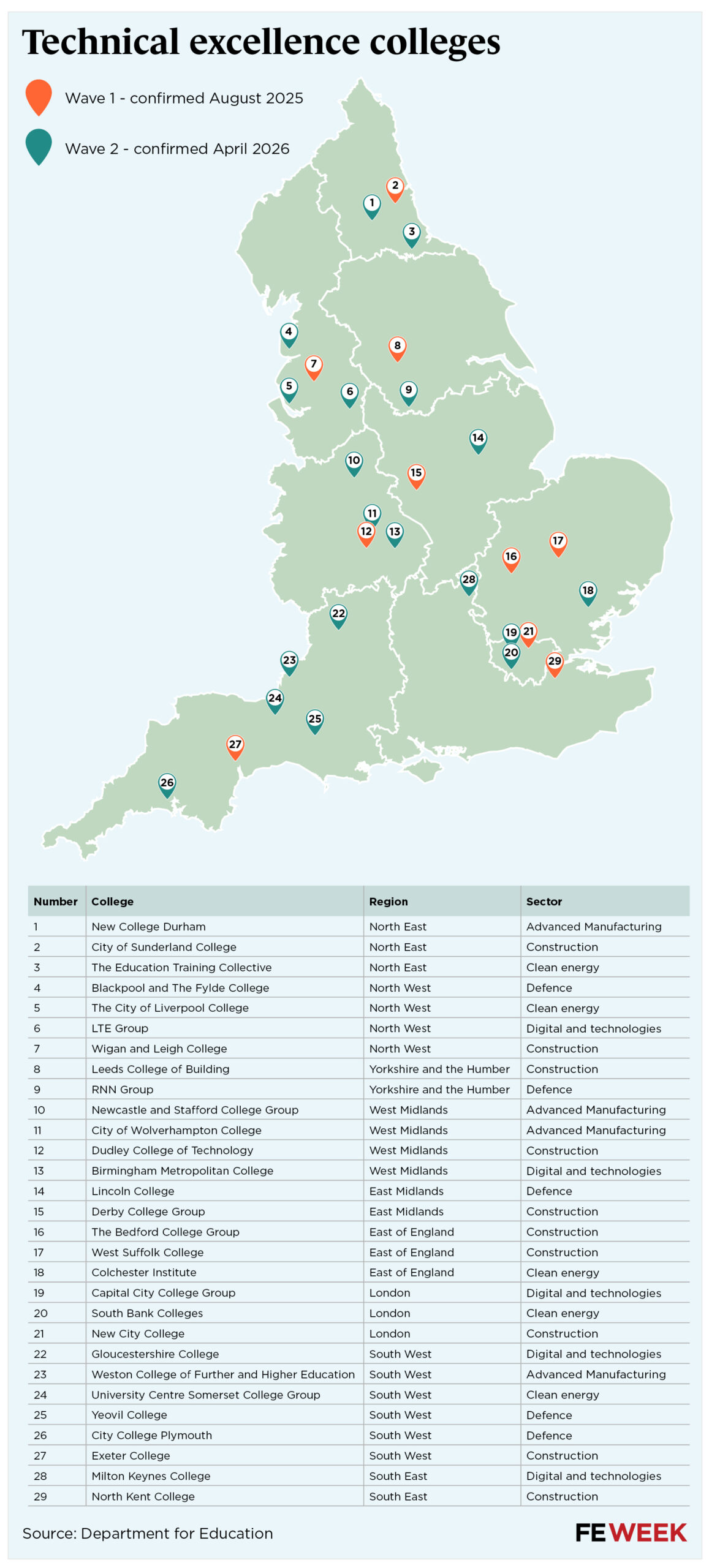
The government has confirmed the locations of 19 new ‘technical excellence colleges’ as part of a £175 million skills investment in training for priority industries.
The second wave of technical excellence colleges (TECs), which will begin delivery from this month, are spread across England and will focus on four sectors: defence, clean energy, digital and technologies, and advanced manufacturing.
Ten TECs had already been announced in August 2025 under an earlier £100 million phase of the programme which specialised in construction.
Ministers said the new TECs will support around 65,000 learners to access training for “high-demand jobs” in key growth sectors, where estimates suggest nearly 600,000 additional workers will be needed by 2030.
TECs will act as “hubs of excellence” with funding for selected colleges going towards facilities, teaching and employer partnerships.
As hubs, TECs are also expected to share their expertise with other providers across the country including other FE colleges, independent training providers and university technical colleges.
The sector specialisms are spread across English regions and “strategically located” to align with local industrial demand, the government said.
This includes a defence focus for Blackpool and the Fylde College and City College Plymouth, while Birmingham Metropolitan College and Capital City College will specialise in digital and technologies.
Every region has at least two TECs, while no colleges have more than one specialism.
Prime minister Keir Starmer said: “I want every young person to know there is a clear route into well‑paid work, whatever their background.
“These colleges put technical skills front and centre, opening up high‑quality jobs in the industries driving Britain’s future.
“We are backing talent across the country, strengthening our workforce and making sure opportunity is built into the system – not left to chance.”
Six TECs are also lead partners in the DfE’s Institute of Technology (IoT) network, launched by the Conservative government with £300 million in capital funding seven years ago.
Last year, FE Week revealed that some colleges have ditched the IoT brand in the face of waning ministerial enthusiasm.
The 19 new TECs will receive £175 million in funding for high-quality teaching, better courses and “state-of-the-art specialist equipment”.
For this wave, the funding is divided into £137 million in capital and £38 million in revenue.
The funding package includes £97 million from the Department for Education, £50 million from the Ministry of Defence and £28 million from the Department for Business and Trade.
‘Hubs of excellence’
The government has set out five key aims for TECs: boosting skills provision that leads to in-demand and well-paid work, increasing quality, stronger partnerships with employers, collaborative delivery, and promoting “clear pathways” to higher level learning or growth-driving industries.
In guidance issued for wave two bids, the government said TECs will act as a “hub of excellence” in their sector, sharing their innovative teaching and curricula excellence.
The DfE also expects them to establish networks with other providers who have similar sector needs, such as the automotive industry for advanced manufacturing.
Bid winners will now be expected to submit “high quality” costed delivery plans this summer, setting out how they will spend about £2 million in revenue funding over three years.
Capital funding will vary depending on the TEC’s activity, geographical spread and concentration of industry being supported.
Chief executive of the Association of Colleges, David Hughes, said: “This investment in 19 colleges will help colleges support even more people into good jobs and encourage employers to take on more apprentices and skilled workers.”