
In the heart of Budapest stands a monument that represents the dangers of the “memory business.” It isn’t the moving “Shoes on the Danube Bank” memorial; it is the disturbing one where a pure Angel Gabriel, representing a blameless Hungarian nation, is attacked by a black Nazi eagle. This statue, installed in 2014, has become a symbol of the Orbán administration’s attempt to absolve Hungary of its responsibility for the Holocaust. One wonders what the new prime minister will choose to do with it now.

Monument to the victims of the German occupation by Péter Párkányi Raab, 14 April 2022, PD/ Creative Commons (Ank Kumar)
Every year on Yom HaShoah, we declare: Zachor. Never forget. But what, exactly, must we not forget? What must we insist on remembering? And this year, amidst ongoing wars, what is vital for us as Jews, as Israelis, to recall in the wake of the Shoah?
Here are four things I believe we must remember and never forget in our conversations with youth this year, and across every generation.
1. Feeling like a “Pawn of History” – and making choices anyway
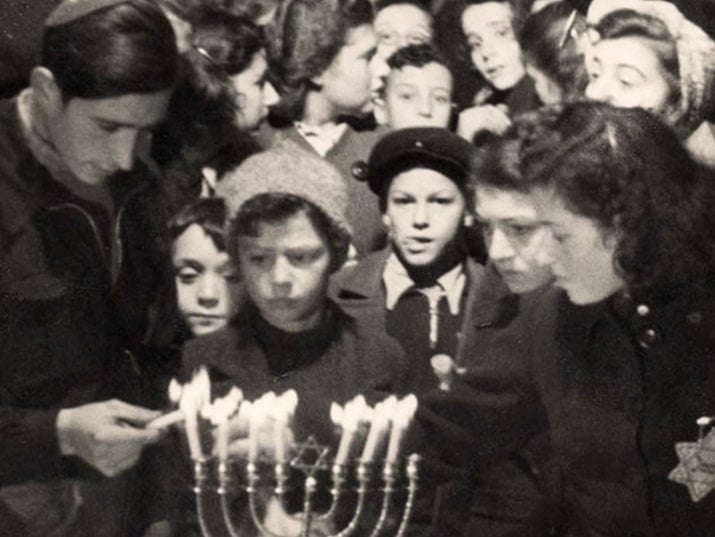
Hanukkah candle lighting ceremony in the Westerbork transit camp, Netherlands, December 1943. (Yad Vashem)
“In the end, departure came without warning,” Etty Hillesum wrote in her final postcard, tossed from a train to Auschwitz. Despite having years to prepare, and despite every page of her diary being filled with the rumblings of war, when it finally arrived, “History” gripped her private life and crushed it. Freedom was stripped away; the surprise was absolute.
Every Jewish story from the 1930s and 40s contains this moment. For years, I struggled to understand it – and suddenly, this year, I identify with it completely. In our own troubles (different as they are), we are tasting the flavor of History as it rattles our windows, tramples our personal lives, and hurls us toward an unknown future.
“I’ve never felt like such a pawn of history,” a friend told me this week. Now, we feel it. This is the entry point for speaking with young people about the Holocaust this year: the memory of that surprise when History knocks on the door and tramples the wings of personal liberty. In such a moment, it is easy to drop all sense of agency and become cynical. Yet Etty Hillesum says, “We left the camp singing.” Those who choose to continue choosing – as Hillesum, Viktor Frankl, and others taught us – remain free. To remain human even in extreme situations, to believe our choices still have weight: that is the ultimate act of freedom.
2. An Israeli jet over Poland, and Iran, changes the story
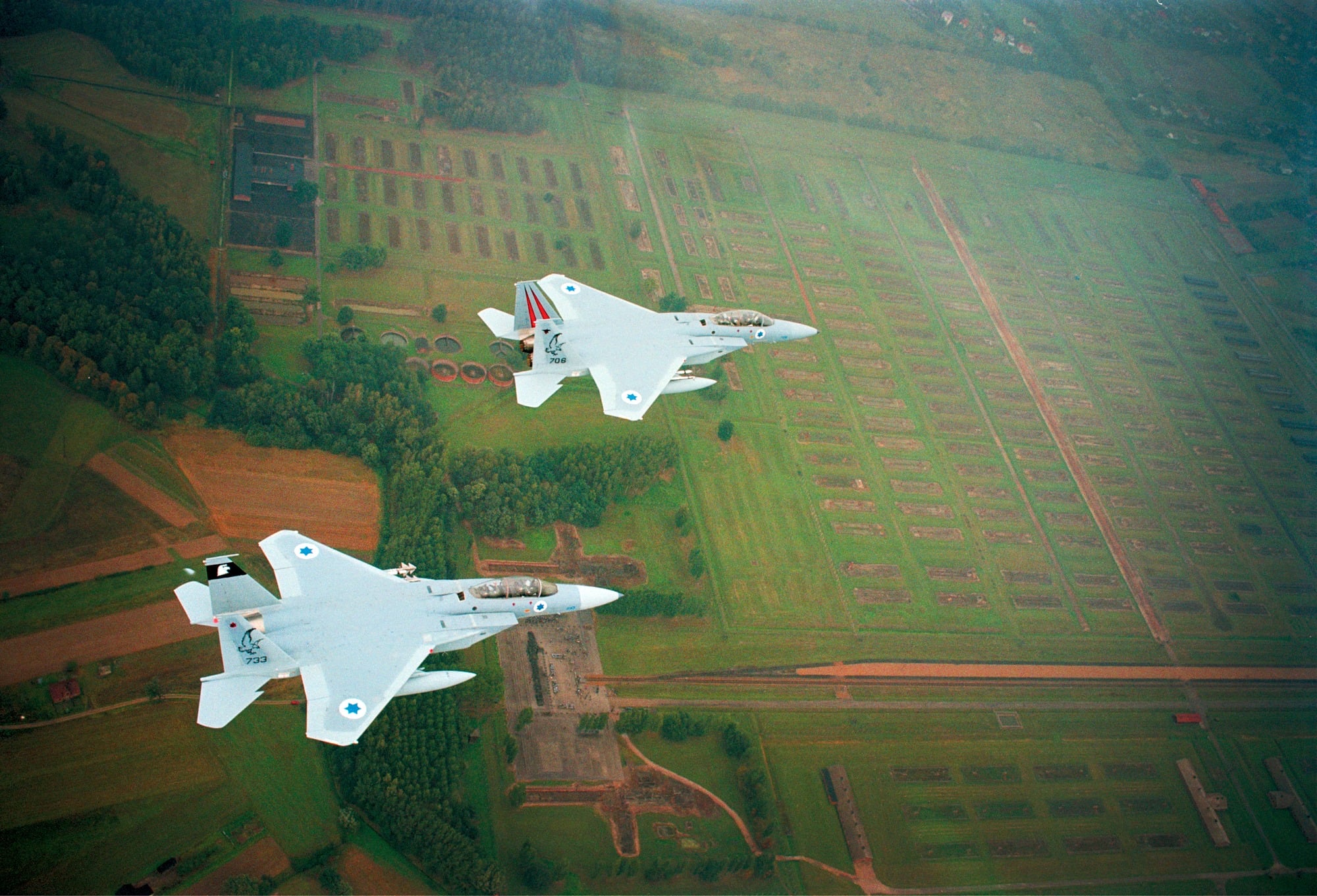
Israeli Air Force jets fly over Auschwitz concentration camp, Sept. 4, 2003 (IDF Spokesperson’s Office)
Major General Ido Nehoshtan once told me that the most significant day of his life was leading the IAF flyover above Auschwitz. This was the same camp where Ido’s father’s Hungarian family went up in smoke. There, too, it happened quickly – and no Allied plane was willing to bomb the tracks.
We swore “Never Again,” promising that the State of Israel would have the wings to protect Jews from future plans of annihilation. When those Israeli jets crossed the skies of Auschwitz in 2003, Nehoshtan (later Commander of the IAF) said we fulfilled that promise. I thought of him recently when I saw the Blue Star of David on the wings of bombers over the skies of Tehran.
Yom HaShoah is the day Jews bring Jewish vulnerability – historical, tragic, and unique – back into focus. To our horror, today that vulnerability, which peaked eighty years ago, is returning. We are seeing levels of antisemitism, from both the Right and the Left, that we haven’t witnessed in decades. The wave is only gaining momentum.
But this cannot be our only focus. We are at a peak of vulnerability, yes, but we are also at a peak of power.
Twice this year, Israeli planes dominated the skies of an enemy plotting our destruction, something unimaginable in the skies of 1940s Poland. With great power comes immense responsibility. In the unidimensional discourse of binary positions, the vulnerable is always the blameless victim, and the powerful is always the guilty aggressor. A century ago, we were only a story of vulnerability; we were the ultimate victims. Yet to speak that way today is to tell a distorted story. Conversely, some see Jews and Israelis only as powerful, holding us responsible for the hatred directed at us. That, too, is a distortion.
Yom Hashoah 2026 arrives at the height of both our power and our vulnerability. We are not the Angel Gabriel, but we are certainly not the black Nazi eagle. We must tell a multi-focal story that accounts for both our power and our vulnerability. This is the truly Zionist act: Taking Jewish responsibility for our own fate, with all that it implies.
3. Remember the Brownshirts
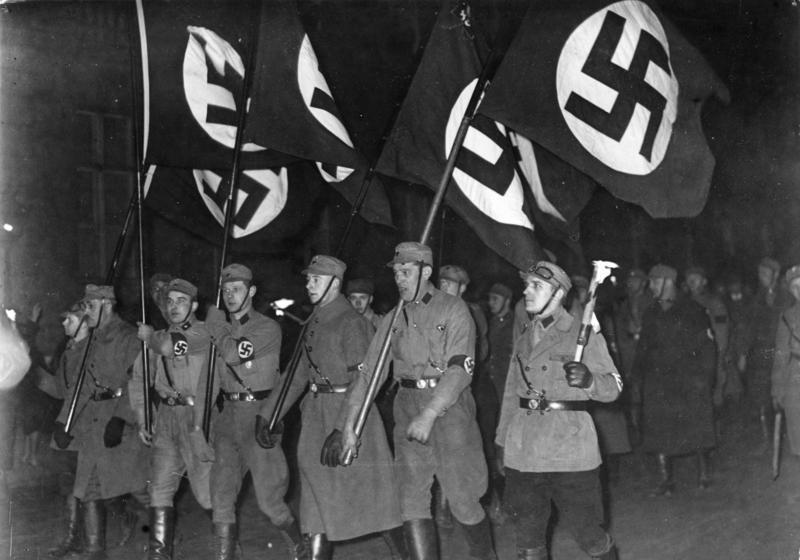
Members of the Nazi Party’s Sturmabteilung (SA), the paramilitary ‘Brownshirts’ parade past the Reich Chancellery on Wilhelmstrasse, January 30, 1933 (German Federal Archives, via Wikimedia Commons)
Students of Jewish history know that the most dangerous violence towards Jews often didn’t emanate from the regime itself. There were always fringe groups who volunteered to be violent on the regime’s behalf, allowing the state to encourage attacks with one hand while denying responsibility with the other. This is what Pharaoh did in Egypt. He didn’t send the army at first; he sent the neighbors to take the babies. This is what happened in the Russian pogroms. This is what prepared the ground for the Holocaust.
Sometimes they were called “Youth” (Jugende), sometimes they were called “Brownshirts.” Their parents were model citizens. Many of the boys were “good kids.” One even eventually became the Pope. They didn’t always use direct violence; usually, they simply imposed a climate of fear and terror, dressed in the brown khaki shirts of local “defense” units. Ask the few Holocaust survivors who remain – the shouts of those youths still echo in their ears. First comes the intimidation, then Kristallnacht, then the ghettos, then the camps – unless they are stopped in time.
This is a story we Israelis must tell our youth this year, noting the similarities and the differences. We must strengthen those who raise their voices against extremist “youth” in Israel today – and the way regimes exploit them. If the Bible teaches us anything, it is that Jews are also capable of behaving like our worst enemies – and if we aren’t careful, we might do it in the name of the Torah itself. We were not chosen because we are the most moral people; we were chosen to uphold a standard that no other nation would take upon itself. If we fail to stand against the extremists among us and those who enable them, we will find ourselves, once again, on the losing side of history.
4. The chilling touch of belonging
Arnold Schoenberg was a “shocking” musician. His music was designed to shatter the symphonic norms of his time and redefine music itself. He saw himself as a German, a European composer who liberated notes from “tonal belonging.” But we know the end of that story, how the Germans saw him only as a Jewish composer, and how he was forced to flee the only national home he knew. The incredible decade of Weimar (“You can be whoever you want to be”) turned into the chilling decade of Wannsee (“You will forever be the people you were born into”).
In 1933, Schoenberg wrote: “Throughout my long life, I have sought to serve German art with all my might. According to my conviction, art has nothing to do with politics or ancestry… I have awakened from the dream I have dreamed all my long life.”

Indie singer Noga Erez performs at Coachella music festival on April 11, 2026 (Screenshot)
Today, Israeli artists around the world are feeling that same chill. No matter where they go or what their politics are, the world labels them as Israelis, as Jews. There is no distancing oneself from it. Noga Erez, the first Israeli artist to perform at Coachella after a year where organizers allowed anti-Israel (read: antisemitic) rhetoric to reach the central stage, gave the music world a masterclass this week. She stood on that stage and off it, telling a complex Israeli story. She belongs to the world of music, and she belongs to Israel.
Like many artists, Israelis and Jews worldwide are feeling the chilling touch of belonging: if I am destined to be a Jew and an Israeli in the eyes of the world, then I must fill that inheritance with meaning. Not the content others project onto me, but the content I seek for myself. In doing so, I reclaim the freedom that my enemies seek to take from me.
* * *
From Hillesum’s letter to Nehostan plane, from the warning of rogue Youth to the chilling touch of Schoenberg’s belonging, the stories we tell on this Yom Hashoah will urge us: Zachor, Never Forget. I look directly at history, and I remember – not just that which is comfortable, but a full, complex picture. I remember, and I do not forget. I remember, and I am responsible. I remember, and I belong. I remember, and I am free.