
The International Monetary Fund on Tuesday lowered its outlook for global economic growth this year and warned that the global economy could risk slipping into a recession if the oil shock from the Iran war is severe.
“Once again, the global economy is threatened with being thrown off course — this time by the outbreak of war in the Middle East,” the IMF’s World Economic Outlook report stated.
The IMF laid out three scenarios for global growth given the uncertainty of the conflict. If the war is short-lived and damage to oil facilities is limited, global growth is projected to rise 3.1% this year, slower than the 3.4% pace of the past two years.
Absent the war, global growth would have been revised upward by 0.1%.
The IMF also raised its inflation forecast for the year. Global inflation, which had been projected to drop, is now expected to head higher by 0.7% to 4.4% this year due to the global energy shock. That would be up from 4.1% last year.
Read more: How to protect your money as Mideast turmoil fuels market volatility
The IMF warned that the global economy could teeter on the verge of recession if energy infrastructure in the Middle East were further damaged, forcing oil prices to $110 per barrel starting in the second quarter. Under that scenario, the international body says, growth would plunge to around 2% this year, calling it “a close call for a global recession.” By the IMF’s definition, a global recession is characterized by a growth rate below 2%, which has happened only four times since 1980, the most recent two corresponding to the global financial crisis and the COVID-19 pandemic. Under this scenario, inflation would spike over 6% by next year.
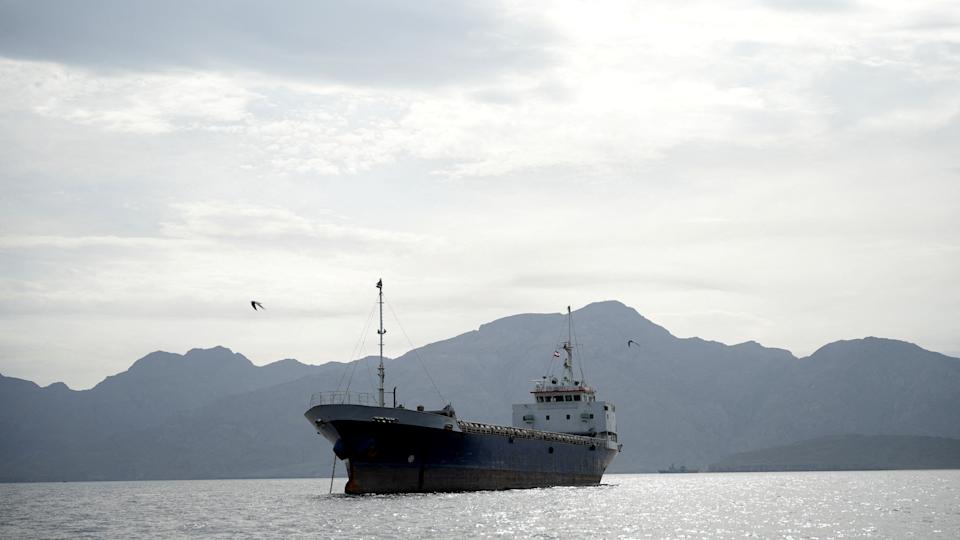 A vessel in the Strait of Hormuz, off the coast of Oman’s Musandam province, on April 12, 2026. (Reuters/File Photo) · REUTERS / REUTERS
The IMF warned that domestic political strains could erupt and geopolitical tensions could worsen even further, turning the situation into the largest energy crisis in modern times.
Peace talks between the US and Iran failed over the weekend, prolonging uncertainty over whether the fragile ceasefire will continue as the US started a naval blockade of the Strait of Hormuz. President Trump said he remains open to a diplomatic solution, even as he threatened again to target Iran’s infrastructure.
Read more: March CPI breakdown: Iran war sends gas prices skyrocketing, airfare climbing
The impact of the Iran war isn’t uniform across the globe. The conflict is forecast to hit the US economy less hard than the rest of the world. The IMF projects US economic growth will now be 0.1% lower than previously forecast, settling at 2.3% this year. That buoyancy is thanks to the country’s status as a net energy exporter, as well as fiscal policy tailwinds, high productivity growth, and the continued ripples from three Federal Reserve interest rate cuts last fall.
The IMF does not expect US inflation on a “core” basis to return to the Federal Reserve’s 2% target until next year due to a gradual pass-through of tariffs and limited pass-through of increased energy costs. The IMF noted that evidence indicates that the direct burden of tariffs has largely fallen on US importers and consumers.
Read more: How oil price shocks ripple through your wallet, from gas to groceries
The UK economy is expected to take a hit from the Iran war to the tune of 0.5% this year, resulting in growth of 0.8%. Saudi Arabia is forecast to see growth drop 1.4% to 3.1%, while the Mideast region is expected to see 2% lower growth. Europe will see growth shaved off by 0.2% to 1.1%.
The impact on emerging markets would be almost twice that of advanced economies.
 Gas prices are displayed at a gasoline station on April 7, 2026, in Los Angeles. (AP Photo/Damian Dovarganes, File) · ASSOCIATED PRESS
The IMF stressed that risks are firmly to the downside, noting that the conflict in the Middle East could take the wind out of AI-driven productivity, and that high stock prices and lower bond yields, which have meant lower borrowing costs for consumers, could reverse.
However, the IMF added the caveat that continued fiscal policy could offer support lasting long enough to carry the global economy through disruptions from the war to a higher-growth path paved by productivity gains from AI.
“The recent surge in AI-related investment and acceleration in the adoption of AI could substantially increase productivity and boost medium-term growth sooner rather than later,” the report said.
When it comes to central bank policies, the IMF advised that policymakers can look through the surge in inflation so long as inflation expectations don’t increase and interest rates are at an appropriate level for that economy.
Jennifer Schonberger is a veteran financial journalist covering markets, the economy, and investing. At Yahoo Finance she covers the Federal Reserve, Congress, the White House, the Treasury, the SEC, the economy, cryptocurrencies, and the intersection of Washington policy with finance. Follow her on X @Jenniferisms and on Instagram.
Click here for the latest economic news and indicators to help inform your investing decisions
Read the latest financial and business news from Yahoo Finance