
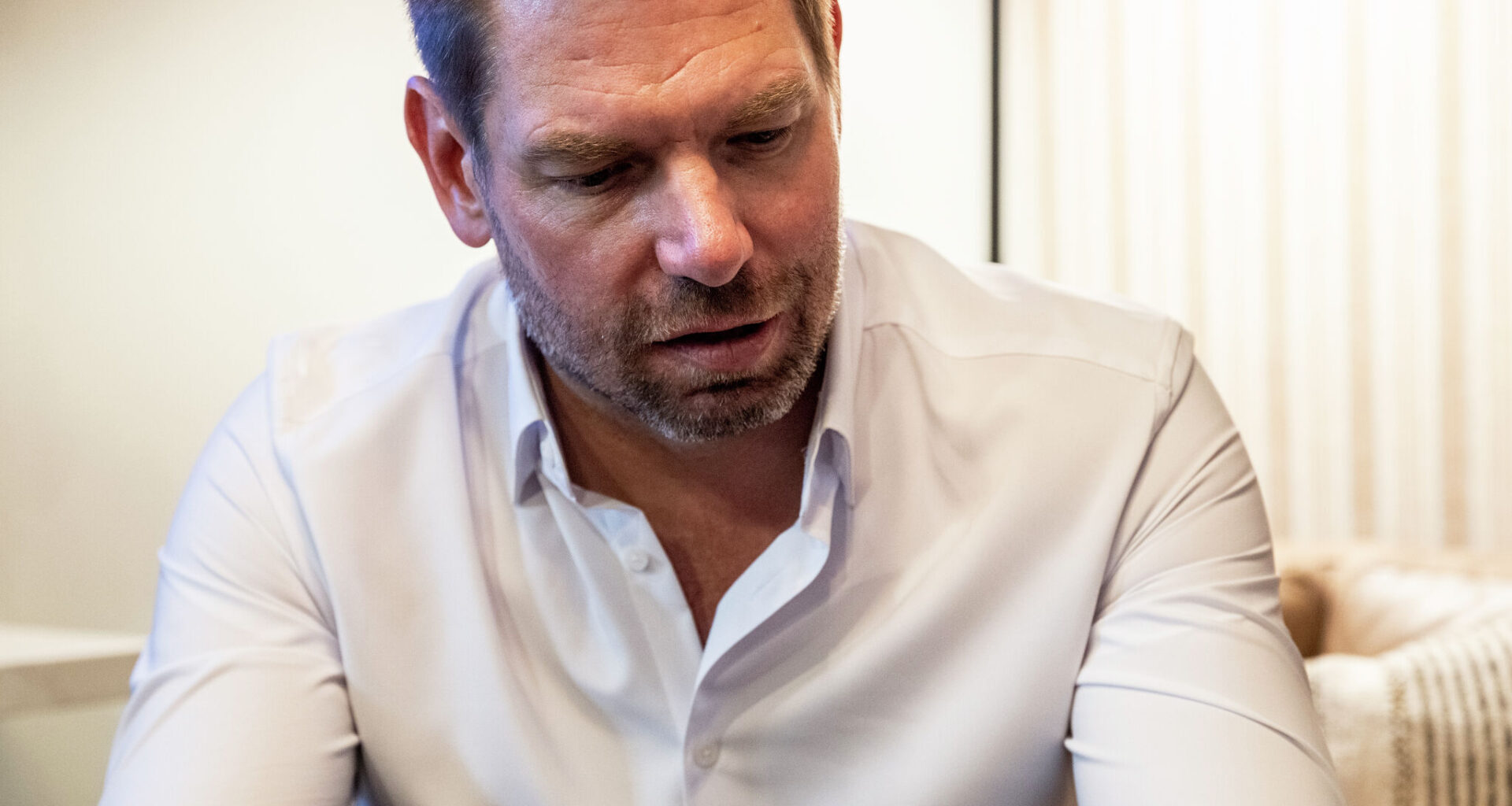
Former Rep. Eric Swalwell sits backstage before his appearance to on “Jimmy Kimmel Live” show in Los Angeles on Nov. 20, 2025, where he announced his run for governor.
Stephen Lam/S.F. Chronicle
The event that set in motion Eric Swalwell’s swift downfall, from congressman running for governor to political outcast accused of sexual assault, was the most routine act in journalism: a cold call.
The caller was the Chronicle’s D.C. correspondent, Alexei Koseff. The woman who answered on the morning of March 25 was cagey, at first. She withheld the painful account she would later reveal. But she urged, “Keep digging.”
Article continues below this ad
Koseff and Sophia Bollag, our Sacramento reporter, had decided to contact people who had worked for Swalwell in his suburban East Bay district over the years, particularly female staffers. They wanted to know if anyone could speak to rumors they were hearing, and which were spreading virally online, that the Democrat had a history of sexual impropriety.
Such reporting excursions are time-consuming and often turn up little. But at a time when newspapers are shrinking for a host of reasons, they are a testament to the vital role of journalists, who spend years building skill as well as relationships on their beats.
San Francisco Chronicle Logo
Make us a Preferred Source to get more of our news when you search.
Add Preferred Source
As Koseff used the website LegiStorm to obtain contact information for current and former political staffers, he noticed the name of a woman he’d met earlier in his career. She doesn’t want to be identified by name — which we allow under our written standards for alleged sexual assault victims — so in this story I’ll call her “Jane Doe.”
The Chronicle’s work had actually begun in early March. Bollag had heard from women outside the hothouse of the California gubernatorial campaign that Swalwell carried an “open secret.” But her initial interviews unearthed only rumors and second-hand accounts of the kind we don’t print.
Article continues below this ad
Then Arielle Fodor, a popular online content creator known as Mrs. Frazzled, began publicizing allegations against Swalwell. Fodor had in December posted a positive message about Swalwell, only to receive replies warning of his behavior. One alleged he’d slept with an intern.
Unverified claims of this kind against a public figure are challenging. They may be true, but we don’t publish them until we corroborate the details. We not only seek firsthand accounts from victims, but ask them about contemporaneous conversations they had and messages they sent that were consistent with their stories. We gather public records: police reports, 911 calls, lawsuits. We look for witnesses. We also look for facts that might counter or disprove an accusation.
The influencers’ posts lent urgency to our efforts. Which brings us to the cold calls. When Koseff rang Jane Doe, he hoped to gut-check whether the rumors were legitimate. She responded that she had firsthand knowledge they were, but didn’t feel comfortable elaborating.
She had her own question: Had someone leaked information about her to the Chronicle — perhaps a rival in the governor’s race? Koseff, who assured her there was no such leak, left that first call with the sense something had happened to her. The next morning, she asked to keep talking.
Former Rep. Eric Swalwell speaks at a town hall meeting in Sacramento on April 7, 2026.
Rich Pedroncelli/AP
Journalists with a gift for developing sources manage the feat in different ways. The best ones, like Koseff and Bollag, deliver a straightforward message: I’ll be honest, meticulous and fair.
Article continues below this ad
The woman told Koseff that she’d been contacted days earlier by a CNN reporter. Though she had chosen not to speak to the network, the call prompted her to get in touch with Swalwell’s campaign to see what was going on — to find out whether her name had surfaced among rumored victims.
She said a staffer asked her whether Swalwell had ever been inappropriate with her, and then, when she hesitated to answer, said, “Actually, I don’t want to know.” When this person told her that Swalwell was not afraid of the rumors because he’d done nothing wrong, the woman said something broke in her. She wasn’t quite ready to share her experience, she said, but wanted the truth to come out.
On March 31, another online influencer, Cheyenne Hunt, posted a video airing more allegations against Swalwell. Koseff called Hunt, still trying to get in contact with potential victims of the congressman.
As he spoke to other sources and learned of Swalwell’s alleged pattern of reaching out to young women on the disappearing messages app Snapchat, he shared that information with Jane Doe. She was struck by the parallel to her experience. But she also worried that coverage of these allegations would not reflect the severity of what happened to her.
Jane Doe agreed to meet Koseff in person April 3, nine days after the cold call. That morning, she canceled, saying she had another obligation, but promised to reschedule.
Article continues below this ad
Even as she continued to speak with the Chronicle, she learned that CNN, our competitor, was working on a story that would include multiple women. She contacted CNN and decided to speak with the network as well in solidarity with these women. Ultimately, she recorded an on-camera interview in which only her silhouette was visible.
Jane Doe also agreed to sit down with Koseff. She did so on April 8, the day after Swalwell, at a town hall in Sacramento, denied abusing or sleeping with female staffers during his seven terms in Congress.
The entrance to the office of former Rep. Eric Swalwell is seen on Capitol Hill in Washington on April 14, 2026, the day Swalwell’s resignation was made official.
Jose Luis Magana/AP
She walked him through her experience with Swalwell for two hours, saying he had begun pursuing her within weeks after hiring her at age 21 to work in his district office in Castro Valley. He was 17 years older. She said he sexually assaulted her twice — in 2019 after a dinner in the Bay Area and in 2024 following a gala in New York City — when she was too intoxicated to consent.
These were serious accusations, and Koseff and Bollag had more painstaking work to do. They confirmed through social media posts, videos, photos and documents that Jane Doe had been with Swalwell on the days in question. They reviewed texts she sent to a friend three days after the New York incident, stating she had been “sexually assaulted” by Swalwell. She wrote she had “blacked out” but “woke up once during it and even told him to stop at one point.”
Article continues below this ad
Koseff spoke with the friend and the woman’s then-boyfriend, whom she told about the alleged 2024 assault when she got home the next day. Both described her as still disoriented that morning. She said she did not file a police report, but agreed to allow us to review medical records showing she obtained pregnancy and STD tests a week after the incident.
“You are a survivor, always so proud and admire your strength. Shine on!” the provider wrote in her treatment plan.
Bollag also spoke to a witness provided by the Swalwell campaign, a friend of the congressman who was with him for the event in New York. But he had gone back to his hotel before Swalwell had, according to Jane Doe, invited her to meet up with him.
Jane Doe initially thought CNN’s reporting would publish before the Chronicle’s, which made her more comfortable because the network had located additional accusers and she preferred not to step out alone. The Chronicle agreed to hold off on publishing until multiple women came forward, either to us or through CNN.
Koseff and Bollag worked quickly to prepare a story that would be ready to go as soon as Jane Doe was comfortable. Bollag contacted Swalwell and his representatives Thursday afternoon, laying out our reporting.
About 7:30 that evening, a brief response arrived: “These anonymous election eve claims are categorically false, and Rep. Swalwell plans to fight them.”
Swalwell’s team got busy. During the night, an attorney representing him sent Jane Doe a cease-and-desist letter, ordering her to retract her accusations. Her former boss was not only calling her a liar but saying she had a perverse motive: to wound his candidacy.
Koseff spoke to her Friday morning. Absorbing the fevered online chatter and the congressman’s threats, she feared Swalwell’s alleged misconduct would become “tabloid fodder” and that she might lose the ability to tell her own story. She told the Chronicle she was ready to move forward, even though hers would be the only accusation.
Rep. Eric Swalwell leaves “Jimmy Kimmel Live” after announcing his campaign for governor on Nov. 20, 2025.
Stephen Lam/S.F. Chronicle
Political editor Sara Libby published our story just before 1:15 p.m. Friday. A couple of hours later, CNN published its story, which included three additional accusers. The articles complemented and strengthened each other precisely because we had worked in competition, not collaboration — another foundational argument for why strong journalistic institutions benefit readers.
As of this writing, Swalwell has denied assaulting anyone, while vaguely acknowledging “mistakes.” But he has abandoned the governor’s race and has resigned from Congress. Manhattan prosecutors are investigating the alleged sexual assault in 2024. Another woman has gone public, saying he drugged and raped her.
And those who worked most closely with Swalwell say they plan to stand not with him, but Jane Doe.