
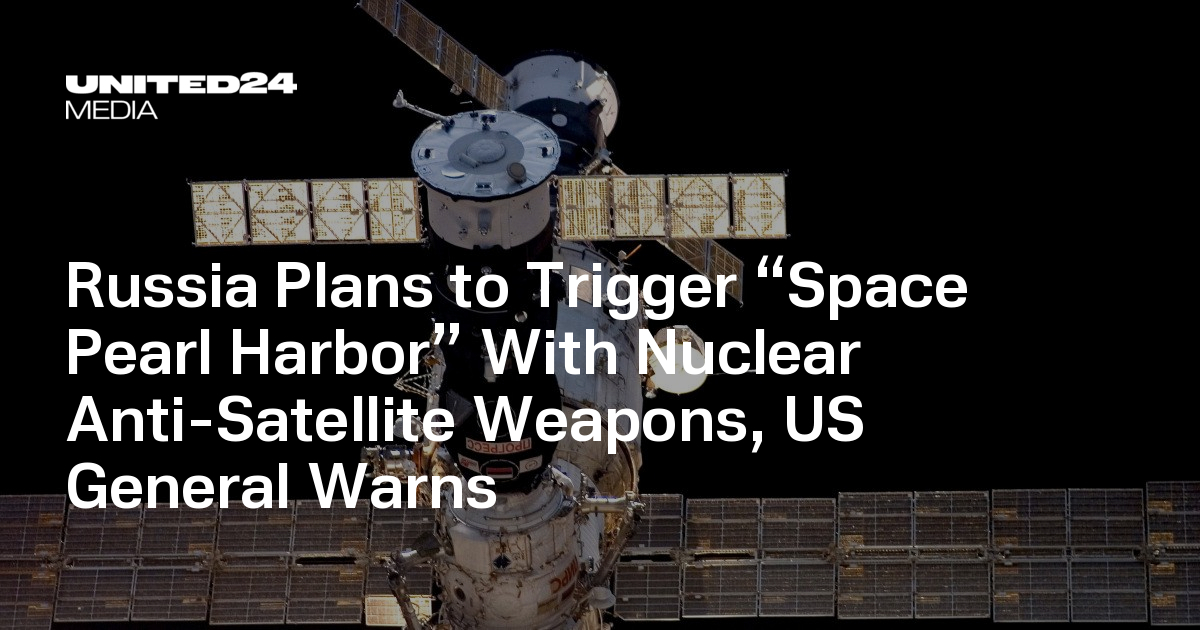
Russia is reportedly planning to deploy nuclear anti-satellite weapons capable of triggering a “space Pearl Harbor,” a development that poses a threat not only to NATO’s military advantage but to the entire global digital infrastructure.
This information was shared by General Steven Whiting, Commander of the US Space Forces, in an interview with The Times, on April 15.
We bring you stories from the ground. Your support keeps our team in the field.
According to General Whiting, Russia intends to place a nuclear warhead into low Earth orbit, between 300 to 1,200 miles above Earth. The move is aimed at neutralizing Western technological superiority by “leveling the battlefield,” he stated.
The consequences of such a deployment could be catastrophic. A single nuclear explosion in space could potentially destroy or disable up to 10,000 satellites, approximately 80% of the global satellite network. This would result in immediate disruptions to GPS, satellite internet, mobile communication services, and military reconnaissance and targeting systems, paralyzing NATO’s operational capabilities.
“I won’t speak about our intelligence sources and methods, but obviously it’s a report that we’re very concerned about,” the general added.
Read more
CategoryWar in UkraineLasers, Rogue Satellites, And Brain Drain. Inside Russia’s Space Warfare
Apr 15, 2024 12:39
According to Whiting, the United States plans to double its investments in space defense to $71 billion annually US allies should also increase their spending in this area if they want to avoid facing a “space Pearl Harbor.”
“The space domain has fundamentally transformed over the last decade because [of] the threats we now see in space where China and Russia build a suite of operational space weapons,” he stated.
The general believes that the next big war will “likely be a war that starts in space.”
Read more
CategoryLatest newsRussia’s Space Launches Fall to Historic Low, Matching Early 1960s Gagarin-Era Levels
Jan 12, 2026 23:34
In June 2025, the Russian satellite Kosmos-2558, which has been shadowing the US USA 326 reconnaissance satellite for nearly two years, deployed a new subsatellite, sparking significant alarm. According to Dr. Marco Langbroek, a Dutch space tracking expert, this new object—dubbed Object C (2025-089C / NORAD 64627)—could potentially be part of a weapons-testing platform, possibly equipped with anti-satellite (ASAT) capabilities.
US officials and independent analysts have raised concerns about the close proximity of Kosmos-2558 to USA 326 during the deployment, fearing the satellite’s military intentions. Langbroek, who has previously highlighted the risks of such operations, expressed ongoing concerns that Russia’s space missions, officially classified as “inspection operations,” might actually be camouflaging the development of dormant anti-satellite systems.

Read more
CategoryLatest newsUS Shares Top-Secret Orbital Warfare Intelligence With UK to Counter China and Russia Threat
May 02, 2025 16:59
Nevertheless, Russia has seen a significant decline in its space capabilities, with its launch rates hitting an all-time low, the lowest since the early days of human space exploration.
During the Russian Space Forum, Lev Zeleny, the scientific director of the Space Research Institute of the Russian Academy of Sciences, acknowledged that Russia has no plans to pursue manned deep space or lunar missions over the next decade. Instead, the focus is now on the development of a new Russian Orbital Station.
“Of course, there should be Russian manned lunar cosmonautics, but we must find some difficult, non-standard solutions to go from lagging behind to overtaking,” Zeleny emphasized.
-9a7b3a98ed5c506e0b77a6663f5727c5.png)
