
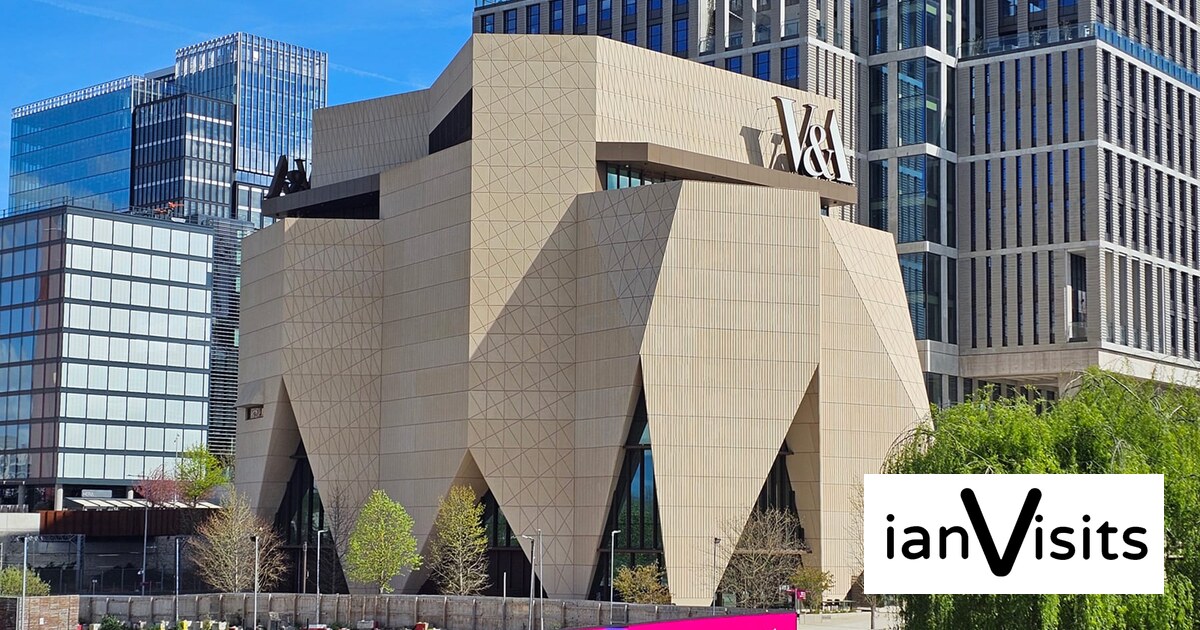
A giant stone armour-clad hermit crab of a building has arrived in East London, as the latest expansion for the V&A’s growing empire of outposts.
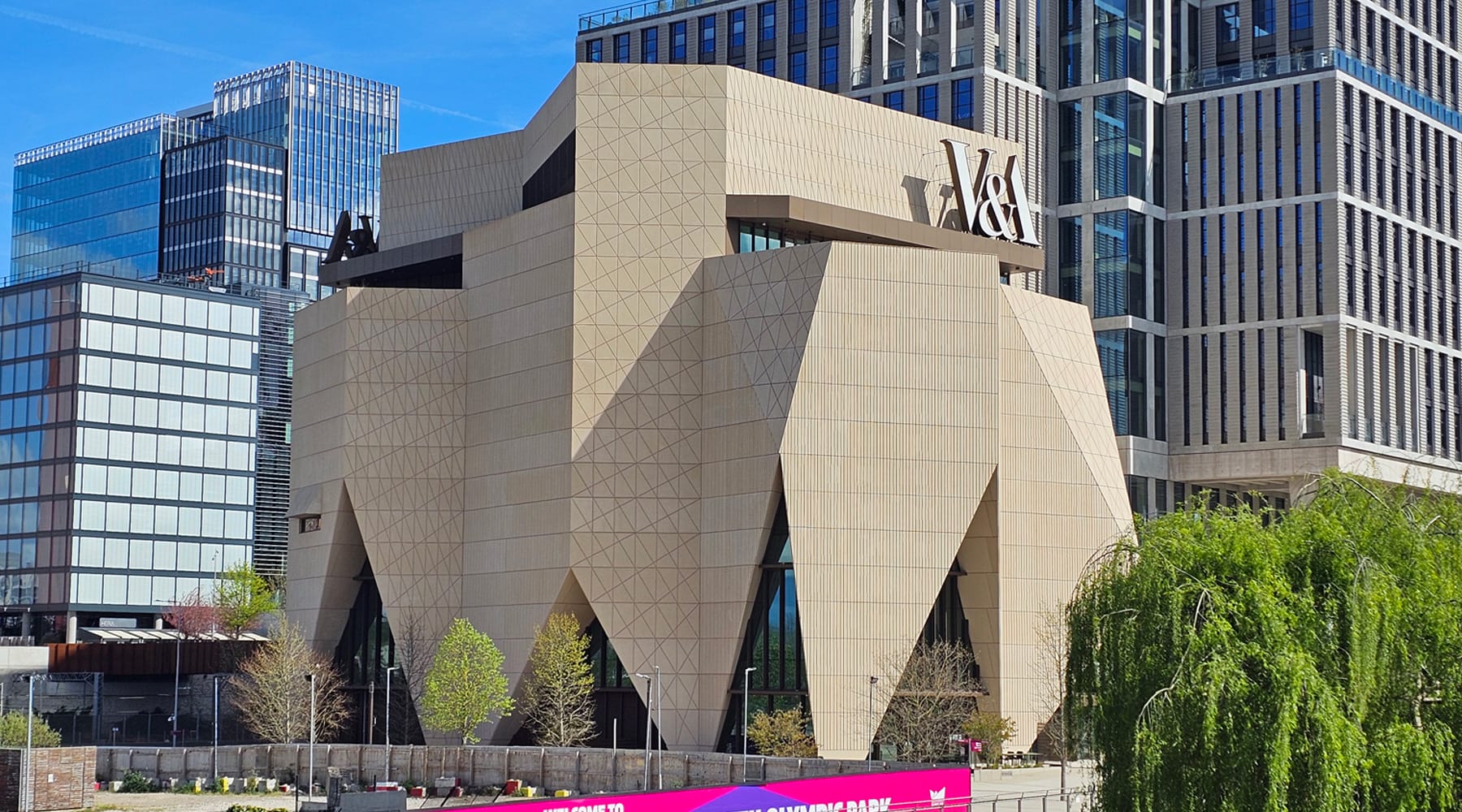
The crab sits in the QEII Olympic Park’s recently rebranded East Bank, which has already seen the BBC, London College of Fashion and Sadler’s Wells open outlets, and while those are fairly boxy buildings, the V&A is very different indeed. That’s a deliberate decision by the wider masterplan, which called for one of the new buildings to be architecturally distinctive to create a local landmark, and also separate the row of cultural buildings from the row of residential buildings about to go up on the other side.
And although the O’Donnell + Tuomey designed building looks like a crab ready to scuttle away, they say it’s inspired by a “lady’s dress and the space between garment and body, as well as the Japanese concept of Ma, or the space in between”. Which you might need to squint a bit to understand, as, candidly, it’s a fairly standard structure with a concrete core, several floor plates, and a sculptural external skin.
Fortunately, there’s a lot of sculptural design in that skin, and playfulness in the staircase within. Indeed, I’d almost call it a museum of staircases, as they are clever and quite inviting to explore.

Unlike the gallery spaces, which are large double-height boxy spaces off to one side of the building, and that’s about it.

The temporary gallery space sits near the top – not because they want you to have to go through the whole museum to get to it (although that probably appeals), as the original plan was to put it on the ground floor. However, it had to be the largest space in the building, which meant it had to be structurally raised a few floors, where the building widens out a bit and avoids the necessary ground floor entrance clutter.
There are two shops, because of course there are, and a cafe, because you can’t be a museum without one these days. But for many visitors, the rooftop terrace will be more appealing, where you can push against some very heavy doors and step outside for a view across the Olympic Park.

There’s also a smaller, more intimate space a couple of floors down.

Structurally, the building is packed with angles, which offer very appealing views and contrasts, and will be full of people seeking dramatic views. I wouldn’t be too surprised if they have to borrow an idea from the Tate Modern and put up signs telling people not to have photoshoots on the stairs.
Where the museum is a bit weak is the two long-term gallery spaces. We’re told that the V&A interviewed some 30,000 young people living in the area to get their views about what the museum should display.
But it doesn’t really show.

There’s interesting “stuff” on display, all worth looking at, but I came away with a bit of a shrug about why it was here and what it was all trying to say. It reminded me more of small local museums where they’ve inherited loads of random objects and put everything on display – here, on a grander scale, but with the same sense of randomness pervading.

The building is interesting, the staircases are rather fun, and the rooftop terrace will be a big draw for visitors. But apart from the paid exhibition space and the roof terrace, it’s hard to see what would bring people to the two long-term galleries, or what would make them want to visit repeatedly.
Back in the 1980s, the V&A teasingly described itself in an advertising campaign as “An ace caff, with quite a nice museum attached”, and here at V&A East, I feel we have an ace building with quite a small museum inside.
The V&A East Museum opens on Saturday 18th April and will be open daily from 10am to 6pm, and late to 10pm on Thursday and Saturday.
More details are here.


 Yes, there are lifts – obviously.