

Listen to this article
Estimated 3 minutes
The audio version of this article is generated by AI-based technology. Mispronunciations can occur. We are working with our partners to continually review and improve the results.
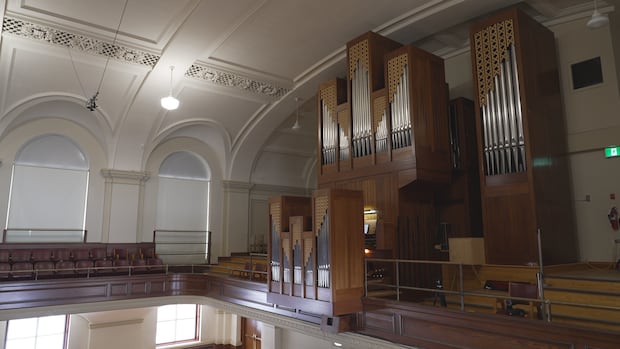
Some faculty members at the University of Alberta want the institution to reconsider a plan to remove the nearly 50-year old Casavant organ from Convocation Hall.
The U of A said it is proceeding with a much-needed renewal of the performance space, which opened in 1915, to enhance accessibility, increase capacity and improve the experience for performers and audiences.
“As part of this important renovation, the university has made the difficult decision to remove the Casavant organ, which presents a barrier to accessibility for individuals with physical disabilities and mobility needs,” a spokesperson said in a statement to Radio-Canada.
The original organ was first installed in 1927. It was rebuilt and rededicated in 1947 as a tribute to the staff and students who died during the First World War, according to the U of A website.
That instrument was replaced in 1978 with the current organ, which is attached to the north wall of the balcony.
Laurier Fagnan, a professor in the U of A’s music department, said the organ has a very special place in the hearts of those who have used or listened to it.
“It has important historical and ethical significance as well,” said Fagnan in an interview with CBC News, as he reminisced about the numerous recitals with the organ that he was involved with.
“But for me, the music is what brought this organ to life and what brought our experience as students to life.”
Casavant Frères is a respected builder of pipe organs, founded in 1879 in Saint-Hyacinthe, Que. In 1930, the founders were awarded the Grand Prix at an international exhibition in Antwerp, Belgium, and its organs can be found around the world.
‘Next chapter for the instrument’
The university said it is approaching the future of the Casavant organ with “the highest level of respect” and “committed to treating its transition with the technical care and dignity it deserves.”
That will include identifying options to safely relocate the organ to create “a meaningful next chapter for the instrument.”
It added: “We acknowledge that this is upsetting to some members of our community, and we value the guidance of those with long-standing connections to the instrument.”
Marnie Giesbrecht, professor emerita and former organist at the U of A, said this isn’t the first time the organ’s future has come into question.
Giesbrecht told CBC News that she and another colleague collected 20,000 signatures in 2019 on a petition to preserve the organ.
“What shocks me is the lack of consultation and the surprise effect of the secrecy of it,” she said about the current decision.
The U of A told CBC News its “project team is consulting directly with the organ community and technical experts to identify a path forward that honours the instrument’s calibre and history.”
As part of the renewal, the university said it is exploring potentially installing a commemorative display that honours the organ and pays tribute to veterans, ensuring their service remains a visible, central part of the hall’s future.