
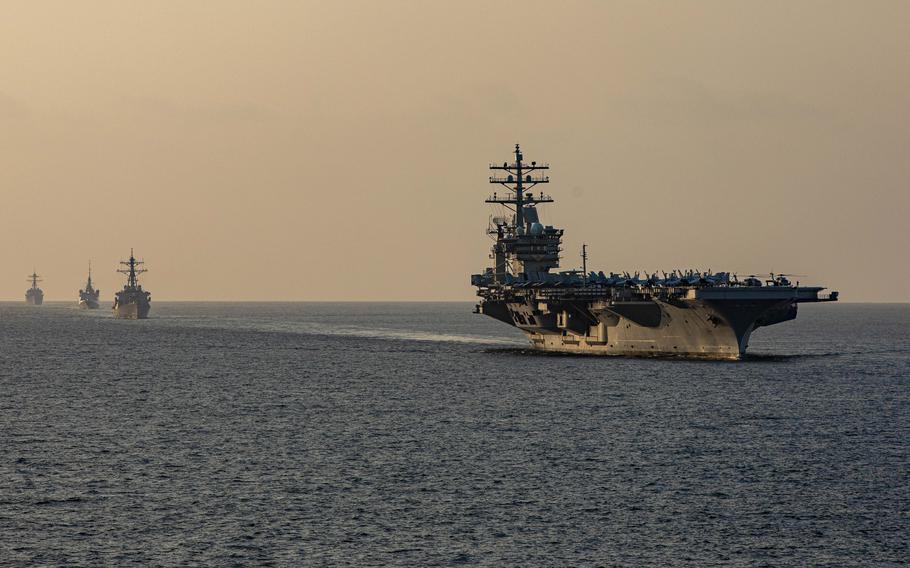
American and French naval vessels transit the Strait of Hormuz in this undated photo. (Keith Nowak/U.S. Navy)
Iran on Friday announced that all commercial shipping traffic can pass through the Strait of Hormuz for the duration of the ceasefire between Israel and Lebanon, even as President Donald Trump said the U.S. naval blockade against Tehran will continue.
“In line with the ceasefire in Lebanon, the passage for all commercial vessels through Strait of Hormuz is declared completely open for the remaining period of ceasefire,” Foreign Minister Seyed Abbas Araghchi said in a statement on X.
Ships must travel through a “coordinated route” announced by Iran’s maritime authorities, Araghchi said.
Crude oil prices plunged by 10% immediately after Iran’s declaration.
In a post on Truth Social, Trump thanked Iran for opening the Strait of Hormuz but said the naval blockade against Iran “WILL REMAIN IN FULL FORCE AND EFFECT.”
The development follows Thursday’s announcement of a 10-day ceasefire between Israel and Lebanon after weeks of cross-border fighting between Israeli forces and Iran-backed Hezbollah militants. As of midday Friday, the ceasefire appeared to be holding.
In a later post, Trump said Israel “will not be bombing Lebanon any longer,” noting that it is “PROHIBITED from doing so by the U.S.A.”
Trump also said, without elaborating, that Iran “has removed, or is removing, all sea mines,” presumably from the Strait of Hormuz, with the assistance of the United States.
The strait has been effectively shut down since the launch of the joint U.S.-Israel military operation against Iran nearly two months ago. The U.S. Navy blockade aims to wrest control from Iran, whose retaliatory measures have reduced maritime traffic there to a trickle.
The United States and Iran are reportedly negotiating a plan to end the conflict. According to Axios, one proposal under discussion would trade roughly $20 billion in frozen Iranian funds for Tehran giving up its stockpile of enriched uranium, the report said.
The developments come as leaders in Europe also plan for a future mission in the area, as rising costs stemming from the U.S.-Iran impasse threaten to ripple through the global economy.
France and the U.K. on Friday chaired a meeting of some 40 nations to discuss how to ensure the safe passage of shipping through the strategic sea lane, through which 20% of the world’s oil usually flows.
The disruption has raised the stakes for Europe, which relies heavily on oil and gas transiting in and out of the Persian Gulf.
While gas prices have already soared, airline industry leaders this week also warned of a jet fuel shortage that could force flights to be curtailed within weeks.
At a press conference Friday, British Prime Minister Keir Starmer praised the news that Iran is opening the strait but stressed the need for a long-lasting and workable solution.
Starmer and French President Emmanuel Macron are trying to establish a multinational initiative to protect freedom of navigation through the strait. The aim is to deploy a combined military effort “as soon as conditions allow,” according to Starmer.
Allies in Europe have come under heavy pressure from U.S. President Donald Trump to help clear the waterway.
However, the current plans, which are focused on assisting once security conditions allow, have been characterized by the Trump administration as too little, too late.
In a post Friday, Trump said he told NATO leaders during a phone call that they should “STAY AWAY, UNLESS THEY JUST WANT TO LOAD UP THEIR SHIPS WITH OIL.”
“They were useless when needed, a Paper Tiger!” Trump added.
Meanwhile, the U.S. is rushing minesweepers to the Persian Gulf as it continues to enforce its blockade, which includes the Gulf of Oman and encompasses the entirety of the Iranian coast.
So far, 19 ships have complied with the U.S. forces’ demands to turn around and return to Iran, U.S. Central Command said Friday. Zero vessels have evaded U.S. forces, it added.
A mix of roughly 20 tankers, cargo ships and other vessels managed to transit the strait during the first 24 hours of the mission, The New York Times reported Wednesday, citing an unidentified U.S. official.