
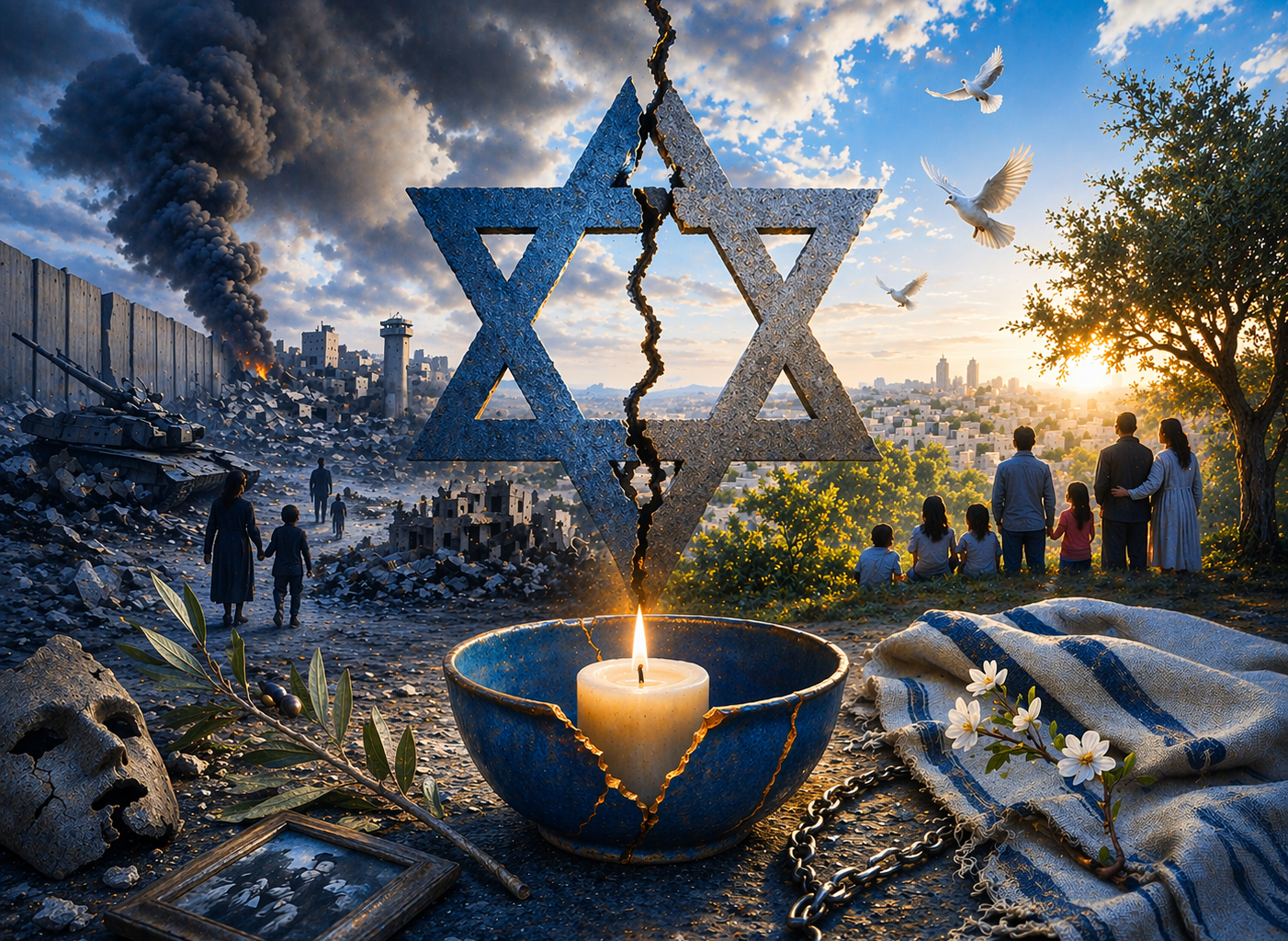
Israel emerged from the disruptive shocks of modernity: mass politics, the modern state system, the world economy, social upheaval, empire, war, and prejudice. As a result, it came to occupy a central place in the way many Jews imagined collective continuity across the lines of state, ethnicity, and culture. For that reason, mourning on Yom Ha’atzmaut over the direction Israel has taken presupposes that Israel is not only a state, but a space of collective attachment, identification, and hope. When the state becomes bound up with domination, destruction, or moral failure, the injury is experienced as a historical, cultural, and collective loss, touching the very terms through which continuity, belonging, and self-understanding have been imagined.
There is, then, much to mourn on Yom Ha’atzmaut: first of all, the dead, the wounded, the displaced, the bereaved, and all those whose lives have been shattered by war, terror, and violence; but also the pursuit of national recognition through the negation of another people; the failure to imagine national existence on terms other than domination or disappearance; the reduction of a dense, entangled, and heterogeneous history to slogans of nation, religion, and civilizational struggle; and the inequality, devastation, denial, and despair that follow.
These are losses of the ordinary conditions that make a livable world possible, the very losses that helped make Israel thinkable in the first place, and whose recurrence within and through Israel now converts the promise of repair into the experience of renewed injury. What signifies refuge, continuity, and collective restoration also bears the marks of domination, fear, and suffering. These are losses of trust, moral orientation, historical understanding, and political possibility. They show that collective attachments are not abstractions but living social formations, vulnerable to being shaken when the protection of one people comes to depend upon the dispossession and vulnerability of another.
Mourning may be understood as a gradual reckoning with reality, through which one can begin to see what remains: the possibility of more honest meanings, truer images, and better ways of representing the past and the present. As Sigmund Freud suggested in “Mourning and Melancholia,” a text often used to think about the effects of losing “a loved person, or … one’s country, liberty, an ideal, and so on,” mourning involves the painful process of coming to avow that something has been lost or broken. One does not simply cease to be attached; rather, attachment is compelled to reckon with the loss. In melancholia, by contrast, Freud suggests that the loss cannot be fully avowed, either within the self or, by extension, within the shared language of public life. The object may remain bound to the self in such a way that love, injury, rage, and guilt cannot be easily separated; idealization and disillusionment may then emerge as divergent ways of managing the same unavowed loss.1
This matters because political communities are organized not only by laws and institutions, but also by norms of recognition that determine whose suffering counts, whose history becomes legible, whose lives become publicly grievable, and whose losses are denied, minimized, or absorbed into official justification. In contemporary Jewish discourse on Israel, unresolved loss can sometimes be seen taking polarized form. Beneath many of the sharpest reactions lies an injured attachment that has not found a language adequate to itself. Two divergent ideological responses tend to surface. In one, even sober and measured rejection of Israel, whether of its policies, its moral claims, or its political form, is heard as an attack on a still-idealized object. Since the latter is tied to collective self-understanding, such criticism is recast as betrayal, animosity, or antisemitism. In the other, Israel becomes morally intolerable, and so the effort is made to repudiate not only the object altogether, but also the living tissue that binds people to their history, to one another, and to inherited forms of belonging that persist into the present.
Both responses may become forms of disavowal. One refuses to let the violence, dispossession, and unequal grievability bound up with the object disturb its idealization; the other refuses to let the historical vulnerability, contingency, and attachments from which the object emerged disturb its repudiation. In each case, the difficult work of remaining in relation to a broken object gives way to a rigid public performance, where negation stands in for mourning. Disavowal is a knowing and not-knowing at once, a refusal to allow what is already sensed to alter the terms of attachment, and thus a refusal not only of facts, but of the political reorganization those facts would require.
Mourning would require avowing that an object of genuine historical attachment has become bound to death-dealing forms of power, and that this cannot be repaired through denial or disavowal. But neither can it be resolved by imagining that collective attachments can simply be severed from the conditions of their formation. Jews did not enter modernity from nowhere, and they cannot be reduced to bearers of power. Yet historical vulnerability does not exempt anyone from the obligation to confront suffering, nor does fear of future vulnerability justify an unequal distribution of grievability, in which one population’s injuries are memorialized while another’s are explained away, minimized, or rendered invisible.
Mourning, then, asks whether one can remain truthful about violence, dispossession, and inequality without allowing repudiation to become erasure, and whether one can remain attached to a history without becoming captive to its justifications. In this sense, mourning becomes an ethical condition for the public life of a political community. If Yom Ha’atzmaut marks a political beginning, it also marks losses bound up with that beginning, losses still waiting to become speakable in public life.
Perhaps it is not mere happenstance that Yom Ha’atzmaut falls during the period of mourning between Pesach and Shevuot. Old traces of an agrarian anxiety about the ripening of the barley harvest, “for they are days of judgment concerning the grain,” were carried forward by later generations no longer living within the same landed rhythms, through the collective mourning of Rabbi Akiva’s thousands of students, who died in this same period from a plague “because they did not treat one another with respect” and “the world was desolate” until Rabbi Akiva began again with new students.2 In this snapshot of the transition from land to “portable homeland,” these collective memories do not say the same thing, but they disclose a shared anxiety about continuity, about the fragility of the conditions that sustain a world, and about the ways a community’s own bonds can become damaged from within.
To mourn Israel on Yom Ha’atzmaut is to accept that attachments are real, historically formed, and vulnerable to the suffering with which they become entangled. It is the work of facing what has been broken without falsifying the past, without surrendering the bonds that still matter, and without allowing those bonds to become alibis for the domination of those displaced, subordinated, or rendered ungrievable. Let that mourning take form. Set aside fifteen or twenty minutes. Light a candle. Sit quietly, and name, either aloud or in writing, three things Israel has meant for you or for the Jewish people, and then three things you mourn in what it has become or in what has been done in its name.
Endnotes
Sigmund Freud, “Mourning and Melancholia” (1917), in The Standard Edition of the Complete Psychological Works of Sigmund Freud, trans. and ed. James Strachey, vol. 14 (On the History of the Psycho-Analytic Movement, Papers on Metapsychology and Other Works), 237–58 (London: Hogarth Press, 1957); David L. Eng and David Kazanjian, eds., Loss: The Politics of Mourning (Berkeley: University of California Press, 2003); Paul Gilroy, Postcolonial Melancholia (New York: Columbia University Press, 2005).
↩
R. Zvi Hirsch Ganzweig, Ḥoq Ya‘aqov, Oraḥ Ḥayyim 493:1; R. Yechiel Michel Epstein, Arukh HaShulḥan, Oraḥ Ḥayyim 493:1
↩