
Editor’s Note: This story has been updated with additional comments from officials.
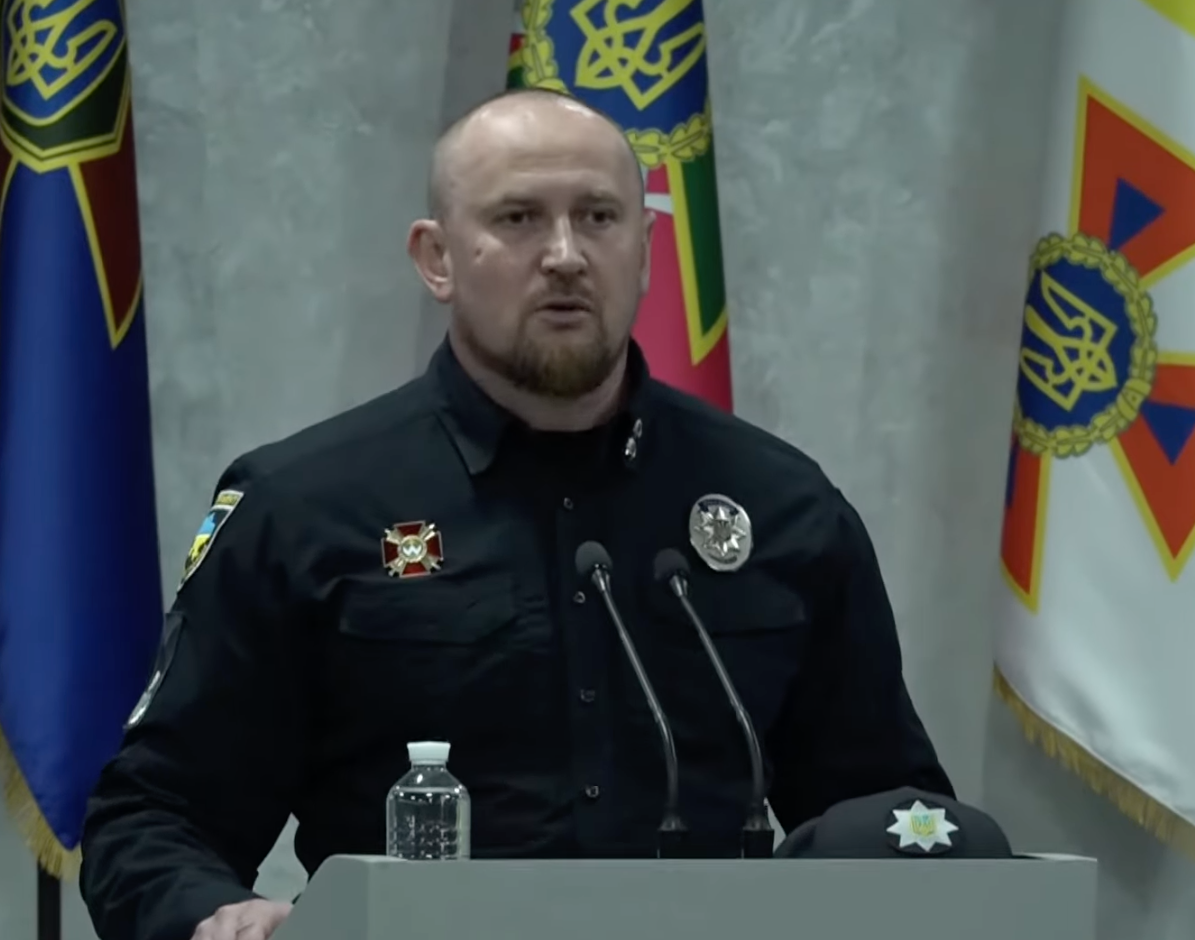
Yevhen Zhukov, head of Ukraine’s patrol police, resigned on April 19 amid controversy over the police response to the deadly mass shooting in Kyiv the previous day.
The resignation comes after a gunman opened fire at a supermarket in Kyiv’s Holosiivskyi district on April 18, leaving at least six people dead and 14 others injured, including a 12-year-old boy. The shooter was killed by police.
The incident sparked an investigation into possible police negligence, after video emerged of two officers running away from the scene after hearing shots fired.
“As a combat officer, I have decided to submit a report for dismissal from the position I hold. I think it will be fair,” Zhukov said at press briefing on April 19.
Zhukov described the actions of his subordinate officers during the shooting as “shameful.” The two officers have been suspended pending an investigation.
“An internal investigation will be conducted and all managers will be held accountable for these actions, all managers who are currently the superiors of these two police officers,” Zhukov said.
Ukraine’s Prosecutor General Ruslan Kravchenko previously announced announced that a criminal case has been opened into the alleged negligence of police officers during the attack in Kyiv. The investigation, led by the State Bureau of Investigation, will assess whether law enforcement failed to act promptly, including possible endangerment of a child and delays in stopping the attacker.
Ivan Vyhivskyi, head of Ukraine’s National Police, said that Zhukov would not be dismissed from law enforcement altogether but would likely be transferred to another position in the Interior Ministry, possibly one involved more directly with the war effort.
Zhukov has headed the Patrol Police Department of the National Police since 2015.
In his evening address on April 19, President Volodymyr Zelensky said the officers who fled the scene “were required to act in those circumstances.” The protocols for responding to such situations will be reviewed, he said, along with the processes for hiring and training officers.
Zelensky also said Interior Minister Ihor Klymenko would be reviewing law enforcement personnel decisions “across the entire chain of command.”
Klymenko called the response of the two officers “a disgrace for the entire system” — though he cautioned against generalizing about the entire police force and praised those involved in the special operation who stormed the supermarket and stopped the gunman.
“‘To serve and protect’ is not just a slogan. It should be backed up by appropriate professional actions. Especially in critical moments, when people’s lives depend on it,” he said.
Klymenko also said there would be no “mass checks on gun owners” in the wake of the shooting, but that the ministry would open up expert discussions to prepare final legislation on civilian gun ownership.
Zelensky said the motives of the the gunman, a 58-year-old native of Moscow who reportedly lived in Donetsk Oblast, are still under investigation.
“The investigation into the attack and the verification of all facts regarding the killer, his condition, and how he obtained the weapon are being conducted jointly by the Security Service of Ukraine and the National Police of Ukraine,” he said.
Vyhivskyi revealed additional details about the shooter during the briefing on April 19.
The gunman served in the Arm Forces of Ukraine from 1992 until his retirement in 2005, Vyhivskyi said. The individual served mainly in the automotive troops in Odesa Oblast. He moved to Russia after retirement, returning to Ukraine in 2017 and residing in Bakhmut.
Investigators found “negative views” expressed on his social media pages and reports of domestic conflicts with neighbors, Vyhivskyi said.
When asked if it was possible the shooter was a Russian agent, Vyhivskyi said the SBU was investigating that possibility.