
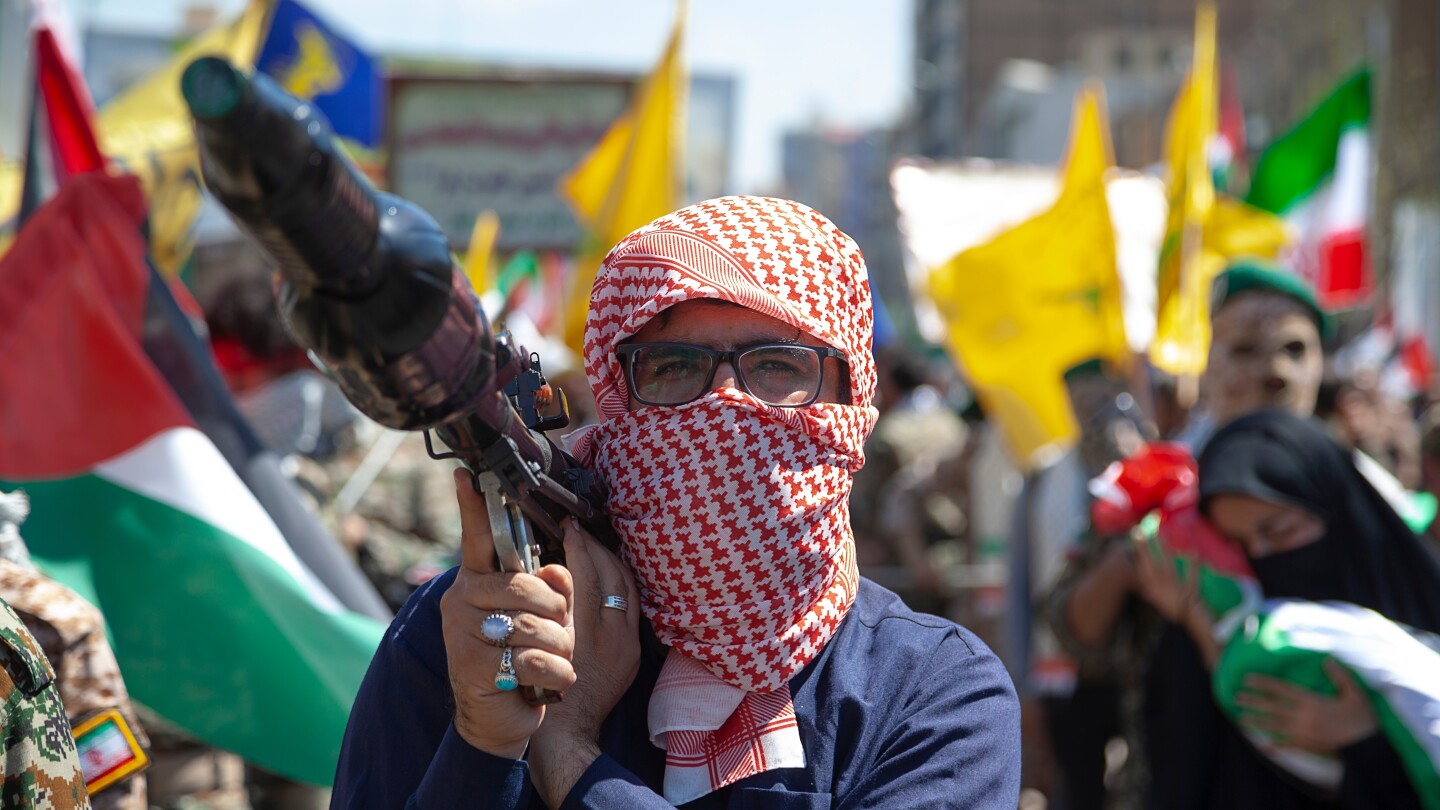
The Palestinian cause has dominated the Arab world’s moral compass for seven decades. It defined friend and foe, organized political life, and gave the word “resistance” its meaning. Tehran understood and exploited this.
Since 1979, Iran has systematically hijacked that cause, repurposing the language of resistance to project power across the Arab world while proxies dismantled the states it claimed to defend from within. The Palestinian cause predates the Islamic Republic by three decades. Iran did not inherit it but seized it and turned it into the cover story for the most sustained assault on Arab sovereignty in modern history.
In Lebanon, Hezbollah built a parallel state that overrides constitutional institutions and rewrites sovereign decisions. For over two years, its parliamentary bloc blocked the election of a president, vetoing any candidate outside its axis. When it faced resistance from within, the response was unambiguous: In May 2008, Hezbollah turned its weapons inward and occupied West Beirut.
Since 1979, Iran has systematically hijacked [the Palestinian] cause, repurposing the language of resistance to project power across the Arab world.
In Iraq, Asa’ib Ahl al-Haq’s Qais al-Khazali, trained by the Islamic Revolutionary Guard Corps, commands one of dozens of Iran-aligned militias embedded in the state. The Badr Organization’s Hadi al-Amiri fought on Iran’s side during the Iran-Iraq War and now leads a parliamentary bloc that shapes government formation. In 2022, Iran’s Coordination Framework engineered the appointment of Prime Minister Muhammad Shia’ al-Sudani, vetoing candidates who might have charted a more independent course.
In Yemen, the April 2022 United Nations-brokered truce, the most promising peace initiative in years, collapsed when the Houthis refused renewal, demanding maximalist concessions aligned with Tehran’s positioning. UN Panel of Experts reports have documented Iranian-origin components in Houthi missiles and drones, including Toophan anti-tank missiles and Sayyad-series systems. Every peace initiative placed before this conflict has been methodically destroyed.
What links these cases, and Syria alongside them, is the deliberate unraveling of the nation-state from within and its reassembly according to transnational loyalties that answer to Tehran. The Arab world has confused two fundamentally different models operating under the same banner: a resistance that seeks to end occupation, and an expansionist project that feeds on state fragility.
Iran does not practice what it preaches. During its war with Iraq in the 1980s, Tehran purchased 2,004 American TOW anti-tank missiles and 240 HAWK surface-to-air missile parts through Israeli intermediaries, in what became the Iran-Contra affair. Iranian arms dealer Manucher Ghorbanifar brokered approximately $30 million in transactions with a regime that publicly called Israel the “Lesser Satan.” Tehran bypassed every slogan the moment the mullahs’ survival required it.
If Tehran operates by the logic of interests when it suits, why should Arabs remain prisoners of an ideological script that Iran itself abandoned at the first test?
A growing segment of the Arab world, particularly in the Persian Gulf, has broken out of the old binary view. These states view Iran as a direct threat to sovereignty without implying endorsement of Israeli policies. The central question has shifted: What project preserves the Arab state? The answer begins with sovereignty as the cornerstone of any regional order, extends to realistic partnerships grounded in shared interests, and requires a political horizon for Palestinians that prevents their cause from perpetual instrumentalization.
If Tehran operates by the logic of interests when it suits, why should Arabs remain prisoners of an ideological script that Iran itself abandoned at the first test?
Gulf Arab states that joined the Abraham Accords did not surrender their voice on Palestinian statehood. Bahrain recalled its ambassador from Israel in late 2023, a form of leverage that exists only because normalization created something to withdraw. The United Arab Emirates used its diplomatic channels to coordinate humanitarian aid into Gaza. Morocco backed Palestinian statehood at the United Nations. Normalization gave these states new tools of influence. They used them. Rhetorical enmity from the sidelines has liberated no land and protected no state.
How many Arab states has Israel dismantled from within? And how many has Iranian influence dismantled? Lebanon, Iraq, Yemen, Syria. The answer requires no ideological interpretation.
The fundamental struggle in the Middle East today is between the nation-state and the transnational network, between governments that govern according to the will of their citizens and armed movements that manufacture instability and answer to Tehran.
The regime that built this architecture of destruction now fights for its own survival. Its economy is under siege. Its navy is at the bottom of the sea. Its proxies are isolated: Lebanon diplomatically, the Houthis by blockade, and Iraq’s militias by their own government. The “unity of the arenas” that Tehran boasted about is coming apart.
This window will not open again. Each Arab state, on its own sovereign terms, must now chart a course built on its interests rather than inherited slogans. The states that have already begun are the proof that it works. Four Arab states that Iranian proxies parasitized have left millions displaced. They have lost decades of sovereignty to a project dressed in the language of liberation.
The hijacking has gone on long enough. And for the first time in five decades, it actually can be ended.