
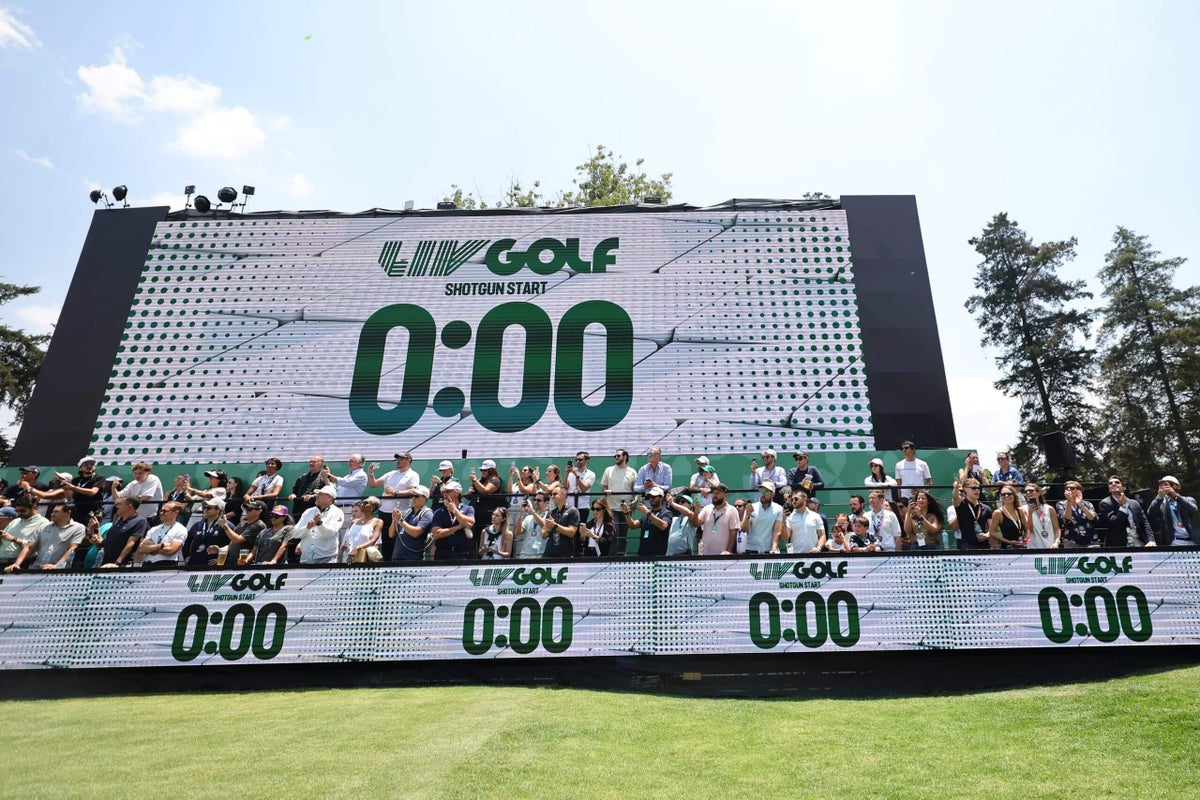
MEXICO CITY — A power outage, they said. Maybe so. But at this moment, I’m looking at a large, black, fire-breathing Día de Muertos-style skull with eyes that change color and a DJ inside its mouth pounding music as he overlooks a small body of water in front of the 18th green.
A hundred yards away, at the first tee, more music is being played from a different speaker system. Bruno Mars and lively salsa music clash and compete — just as the artists intended. The power is indeed on, but the TV feed is off. The hospitality sections are full. The crowds are strong. But while the entire sporting world was trying to figure out the future of LIV Golf for nearly three hours Thursday, the only way to know was to be on the ground here in Mexico City.
So yes, the show goes on here at LIV. Just nobody knows for sure what’s happening.
On Wednesday, The Athletic, along with others, reported that the Public Investment Fund of Saudi Arabia is preparing to pull its funding for the 4-year-old league. The Athletic sent me here to learn more and understand the scene at LIV’s sixth event of the season amid radio silence from both LIV and PIF. Because of that — LIV Golf’s communications staff did not return multiple messages from Tuesday evening on, and because it was too late to apply online — I was without a media credential. So I bought a ticket and watched the first day as a spectator. As LIV staffers began to return calls, they learned I was in Mexico City and provided me with a credential for Friday and Saturday.
But as I walked the property Friday, I was stopped by a LIV security worker. He pulled out his phone and showed me a company chat with a large photo of my The Athletic headshot and said I needed to come with him. I asked if there was some sort of security alert sent out on me, and he said yes, there was on Thursday. I don’t know how they even knew I was on the property Thursday, but I certainly wasn’t sneaking, as my goal was primarily to run into a LIV official and talk. I explained I was just given a credential that morning, which greatly surprised him. He made two calls to ask, and I overheard him say, “Oh, he’s OK now?” before he let me go.
When I asked multiple LIV executives about this, they adamantly denied knowing anything about it or even knowing I was in Mexico City on Thursday.
Over the next two days, in conversations with LIV sources briefed on events, employees unsure of their future, and various sources throughout the golf industry, a picture formed of a company indeed blindsided by PIF’s change in strategy but projecting extreme confidence in a business plan that can succeed without PIF’s billions, even as the outside world remains skeptical.
As recently as 10 days ago at the Masters, CEO Scott O’Neil stood under the famous big oak tree at Augusta National Golf Club, smiling as he gladhanded with power brokers and sponsors. He requested time with PGA Tour CEO Brian Rolapp, and the two had a meet-and-greet. ANGC Chairman Fred Ridley finally laid out for O’Neil and LIV the red carpet provided to the sport’s top leaders. And feedback from O’Neil’s Saudi benefactors remained of an investment strategy measured “in decades.”
But by that Sunday afternoon, the situation changed, in part due to the U.S. war with Iran. Leadership team members were told their positions were at risk. During a mad dash of meetings in New York City and Mexico City, O’Neil and his leadership team attempted to ensure PIF would at least fund the league through the remainder of the 2026 season. Sources, speaking to The Athletic on the condition of anonymity because they were not authorized to speak publicly, said that funding came down to the wire. “The life of a startup movement is often defined by these moments of pressure,” O’Neil wrote in an email to LIV staff on Wednesday evening, promising the season’s sixth tournament and eight remaining would go on as scheduled.
While O’Neil and LIV’s broadcasters, Arlo White and David Feherty, have taken the strategy of criticizing last week’s reporting, O’Neil did admit to White on LIV’s broadcast Thursday (once it went back live) that changes are coming. He also conceded: “Do you have to raise money? Probably. This is business.”
And while O’Neil publicly complained about the lack of names attached to reporting on LIV’s financial situation, not one LIV official was willing to go on the record to The Athletic.
O’Neil did submit to one interview with UK rightsholder TNT Sports, saying, “The reality is you’re funded through the season, and then you work like crazy as a business to create a business and a business plan to keep us going.” TNT initially published the full interview on its social media feed, then scrubbed it and, hours later, posted a sanitized version missing that quote. As much as LIV maintains that it is just normal life in private equity, this is a stark contrast from years of publicly boasting massive financial support from a near-trillion-dollar sovereign wealth fund.
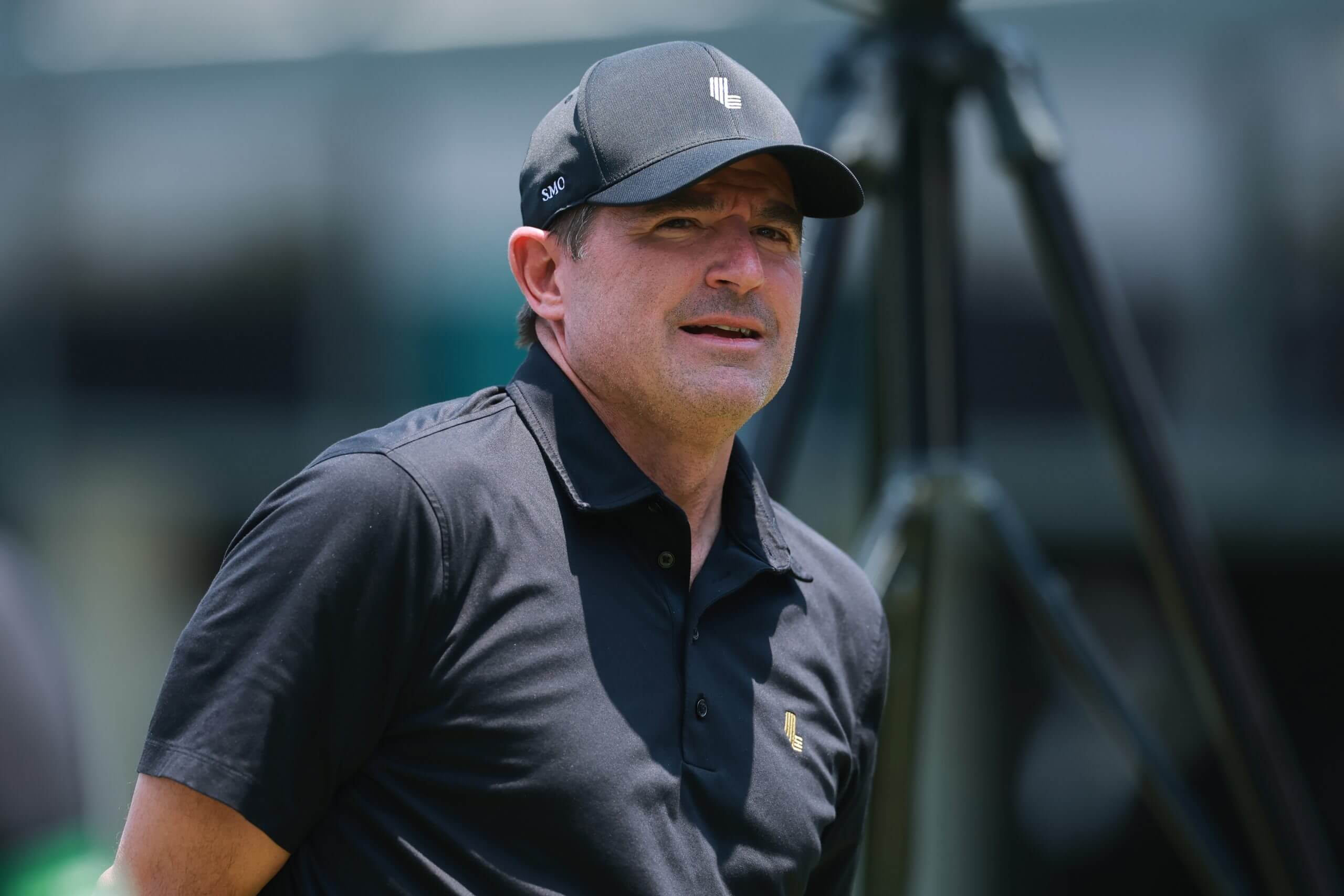
LIV Golf CEO Scott O’Neil has admitted the league will need more funding. (Hector Vivas / Getty Images)
It must not be forgotten that LIV is not a traditional pro sports league, with a collection of team owners that compete individually but cooperate organizationally. It operates and behaves much more like a start-up.
To that end, it’s helpful to think of the 57-man roster and the 13 teams as assets that took hundreds of millions to acquire and retain, and each of its 14 tournaments as a product.
In its current situation, LIV is forced to shift from a company operating with open-ended support and little expectation of short-term profit to one needing to provide a tangible business plan to investors. Their returns will no longer be measured in decades but in quarters.
Rather than close up shop or embrace a Plan B, LIV seems determined to accelerate through the bend. That means selling equity stakes in its 13 teams, increasing sponsorship revenue and continuing to put on a worldwide golf schedule.
So let’s start with what works.
Aside from the Thursday power outage at the offsite TV compound — and, according to a source, the replacement generator also blew a fuse — LIV Mexico City went on as scheduled. Players still riled up crowds and went through lengthy, focused practice routines like athletes competing for a $20 million purse. Jon Rahm and Sergio Garcia spoke of the reports as “rumors” to the assembled media, which was made up entirely of in-house media and Mexican news outlets.
In the simplest terms, people looked happy. And the fans came, tapping into one core tenet of LIV Golf that nobody has argued — bringing golf to untapped markets around the world highlights an opening in the game’s landscape. The league’s biggest successes have been in Australia and South Africa, with record-breaking, 100,000-plus crowds.
But it would be willfully naive to ignore an aura of mystery at Club de Golf Chapultepec.
In the center of the putting green before the first round, the league’s two largest stars by a wide margin, Bryson DeChambeau and Rahm, were seen having a lengthy private chat.
The ever-demonstrative DeChambeau energetically spoke with his hands as Rahm listened and seemed to ask questions. This multi-faceted symbol of the league’s strength and vulnerability couldn’t be ignored; at least a dozen other golfers were so distracted by what was taking place that it took LIV officials multiple pleas to get everyone into golf carts and into position for the shotgun start.
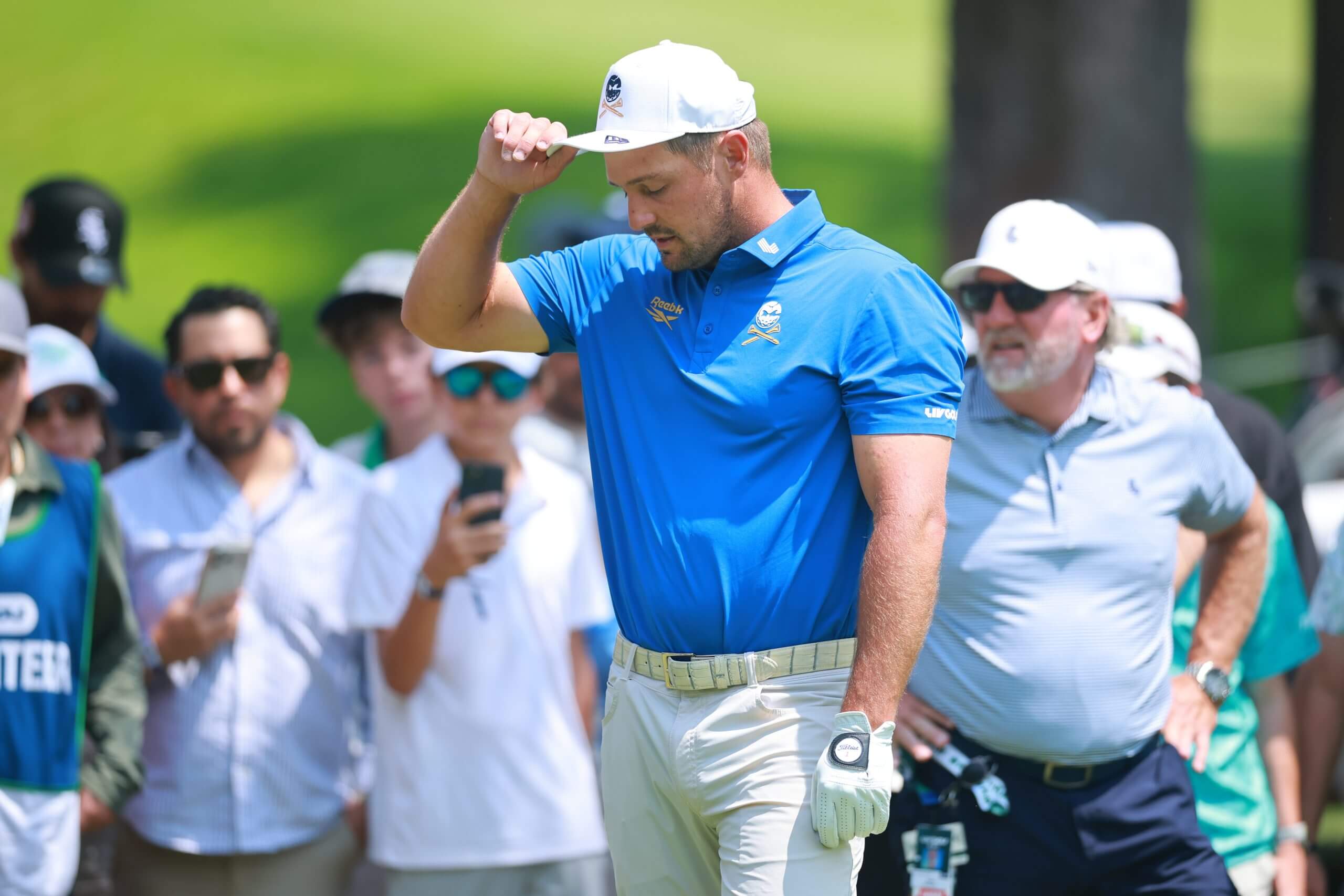
Bryson DeChambeau ultimately left LIV Mexico City early, citing a wrist injury. (Hector Vivas / Getty Images)
LIV attempted to provide DeChambeau to The Athletic Saturday, but DeChambeau seemed frustrated after his 2-over round and declined to speak, even uncharacteristically walking past autograph-seeking kids. He then withdrew from LIV Mexico City on Sunday morning, citing a wrist injury, but said he’ll return for LIV Virginia in two weeks. Rahm declined to speak further about LIV, referring The Athletic to his Thursday press conference comments.
DeChambeau’s place in this cannot be overstated. One of the most popular athletes in sports — thanks in part to his gargantuan YouTube channel that brings anywhere from 2 to 17 million viewers to a given video — is in the last year of his current contract.
According to golf industry sources, DeChambeau and his team spent a part of Masters week meeting with organizations to discuss possible options if he chose to leave LIV. Speculation persists that, in the wake of others leaving LIV for the PGA Tour earlier this year, his ask to resign is up to $500 million. DeChambeau has even used his YouTube success as a leverage play with all potential suitors, indicating he’s open to only filming content and playing the four major championships.
He is essential to LIV, and DeChambeau and O’Neil were seen joking around with each other in the first fairway on Thursday. There’s optimism within LIV that he’s not going anywhere, while also a clear concession that they cannot ever go back to the world of contracts worth hundreds of millions in guaranteed dollars.
He is their greatest asset, and also may be too rich to resign at his market value.
And while O’Neil has taken immense pride in shifting focus from former CEO Greg Norman’s passion for aging veterans to exciting young prospects like Tom McKibbin, Josele Ballester and David Puig, there remains concern that much of the sponsor interest comes from those established stars. What happens to that interest if any stars decide to leave amid uncertainty? What does this chaotic week of scrutiny and speculation that the league might fold do to those negotiations?
Reports surfaced of quarterly player salary payments not arriving as scheduled on Tuesday, and Sports Business Journal reported the payments ultimately processed Thursday afternoon. LIV sources deny ever being in breach of contract but maintain that these volatile stresses are the normal life of working with private equity, with one source briefed on the situation saying negotiations on funds have often gone down to the wire.
The league reportedly spends $100 million a month. Between team and individual purses, LIV pays north of $30 million per tournament before you even get to the cost of fireworks, DJs and multiple concerts. O’Neil told the Financial Times in February that the league was 5-10 years from turning a profit. LIV lost $590.1 million in its United Kingdom-based entity alone in 2024, which doesn’t include its U.S. operations.
Structural changes are also coming. O’Neil alluded in one of his pre-recorded TV spots that LIV is looking into partnering with national opens around the world, but it’s unclear what that would entail, as most national opens are operated by the DP World Tour. While O’Neil and Rolapp met in Augusta and claim a good relationship, it’s also unclear if LIV could attempt to return to the table with the PGA Tour, or if the latter even has any interest.
The heart of most professional sports businesses is the TV deal, with teams sharing revenue from billion-dollar deals like the NFL’s $110 billion and the PGA Tour’s $6 billion deals. But LIV sources reject this “American-centric” notion of TV deals being the only business, which is part of what makes pinning down LIV’s business so difficult. Its greatest successes have come as an events business, which in turn helps attract sponsors, but is that all enough to carry the company?
The belief that this is still a product worth saving is fueling O’Neil and his subordinates, and even before the last week, had them pushing for revenue beyond the PIF.
LIV claims a 100 percent increase in revenue from 2024 to 2025, with the 2026 season another $100 million ahead of the five-event pace from 2025. Sponsorships with partners like Rolex, HSBC, Salesforce, Qualcomm, Under Armour and Celsius are up 40 percent year over year and surpassing $500 million, according to LIV. Ticket sales are up 129 percent, and hospitality sales are expected to sell out through 2026.
LIV also claims four events will be profitable in 2026, and 10 of 13 teams are expected to be in the black.
Those teams are the largest area of optimism for O’Neil and company.
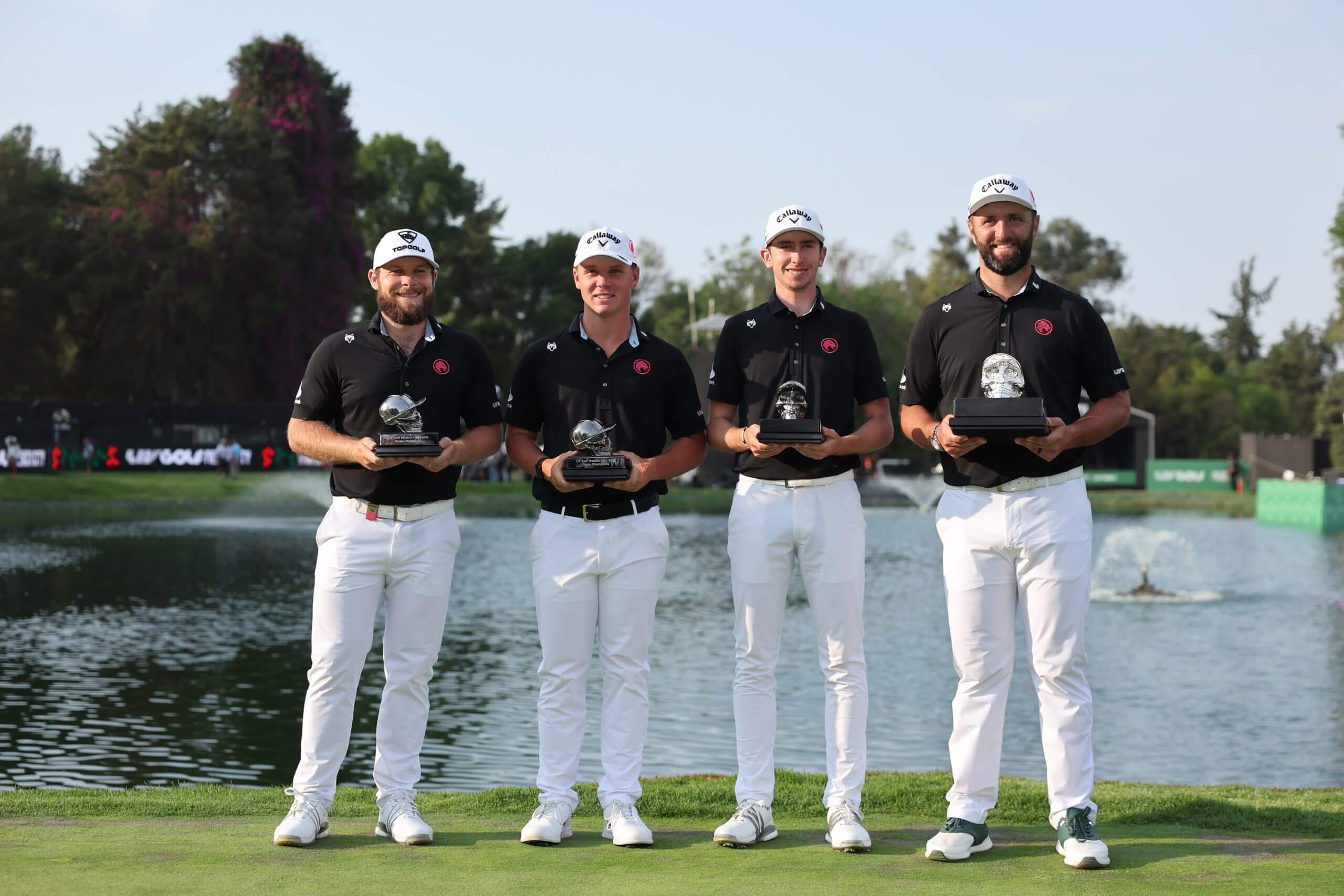
LIV believes that the value in Legion XIII and the other 12 teams is part of its future. (Hector Vivas / Getty Images)
Bloomberg reported in January that LIV was looking to sell minority stakes in its teams with the help of Citigroup, targeting evaluations as high as $300 million. Both LIV executive and team sources confirm that the number is the expectation.
Multiple LIV general managers and O’Neil met with sponsors throughout the week in Mexico City and set up new meetings for potential partners, with one team confirming on background a new sponsorship will be announced on Monday.
Two different teams also said they have meetings this week with investors trying to buy stakes in their respective teams. One said he has two suitors, one he reached out to and another who reached out to him. The way the team deals work currently is that team captains own 25 percent of their respective teams, while the league owns the other 75 percent.
After that, LIV will likely need to pursue other private equity suitors, but until O’Neil’s supposed plans for structural changes become public, it’s difficult to know where LIV may look. Or how available that money is at an uncertain time globally.
No matter the confidence, LIV finds itself in a troubling situation. The history of Silicon Valley is littered with failed startups and others that pivoted to previously unforeseen plans — you might have heard Allbirds no longer sells shoes but instead artificial intelligence infrastructure.
But one thing I noticed across the past two weeks, from LIV talks in Augusta, to New York meetings, all the way to Mexico City, is a shift from day to day. Monday to Wednesday were frantic. Thursday and Friday were filled with emotional resolve. But by Sunday, the league’s tone turned to apparent belief.
What is reality and what is projection for investors is impossible to know. For now, the music keeps playing.
The Athletic‘s Brendan Quinn and Gabby Herzig contributed reporting to this story.