
Authorities have warned residents of northeastern Japan to prepare for an even larger earthquake after a magnitude 7.7 quake struck off the coast of Iwate on Monday, triggering tsunami across a broad swath of the area.
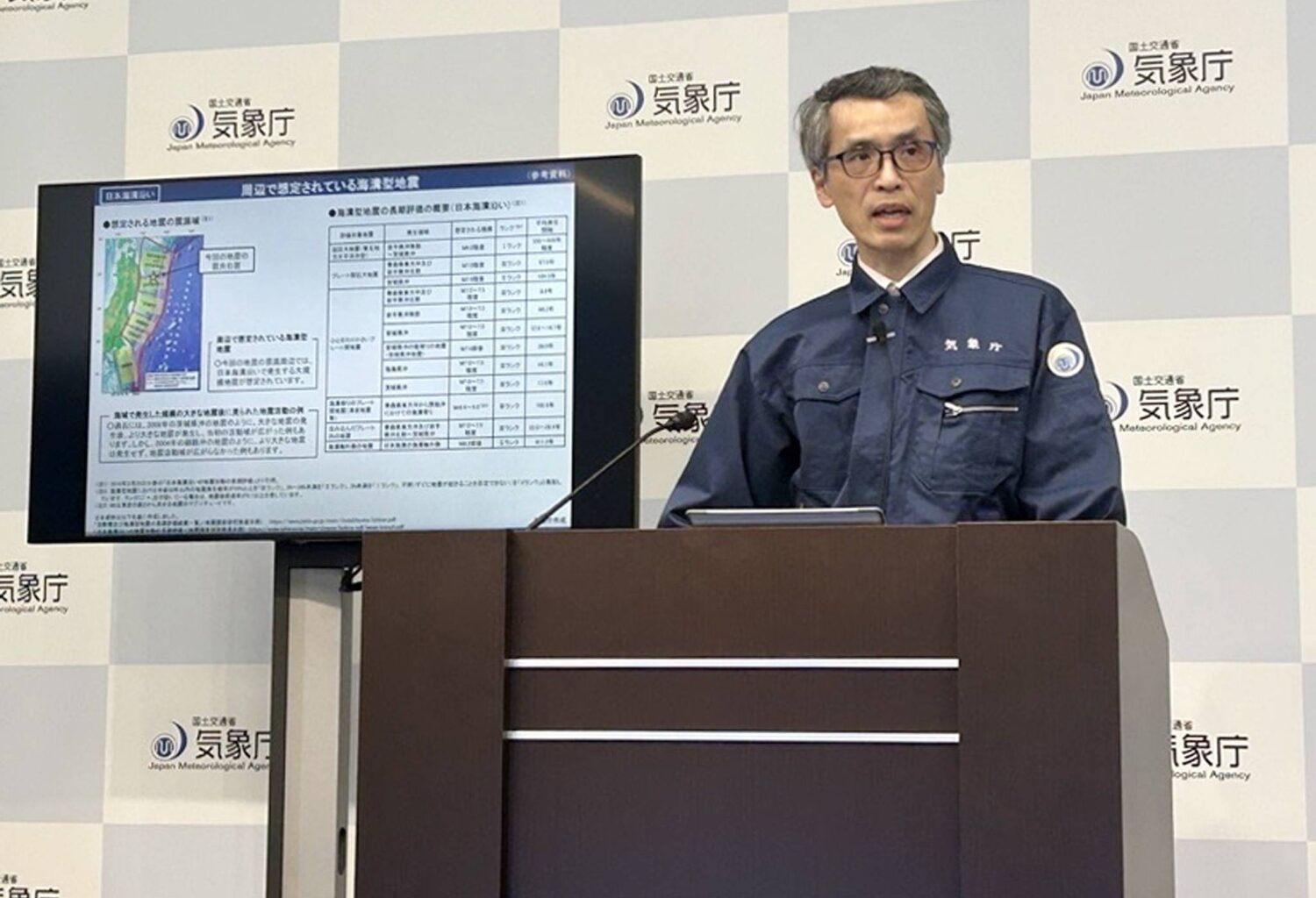
Residents in areas where a special advisory has been issued — for 182 municipalities from Hokkaido to Chiba Prefecture — should be on alert and ready to evacuate at any moment, officials from the Japan Meteorological Agency (JMA) and Cabinet Office told a joint news conference Monday evening.
Residents have been urged to reconfirm their evacuation plans, including escape routes and ways of communicating with family.
The JMA has had a system in place since 2022 where, if a magnitude 7-level earthquake strikes off the coast of Iwate and Hokkaido, it will consider issuing an alert for a potentially stronger quake — called a “subsequent quake advisory” — given similar instances in the past.
Although the possibility of massive earthquakes of magnitude 8 or stronger striking is higher than usual, the odds are still around 1%, compared with 0.1% in regular times, the JMA said.
If a major quake was to occur, a subsequent tsunami would be expected as well. Smaller quakes hitting the region are also possible.
A special advisory was last announced in December, following a magnitude 7.5 earthquake off Aomori Prefecture’s eastern coast. The current advisory will remain in place until Apr. 27 at 5 p.m.
Monday’s quake, which struck at a depth of 20 kilometers about 100 km off the coast of Iwate Prefecture at 4:53 p.m., registered a lower 5 on the Japanese seismic scale to 7 in some parts of Aomori, Iwate and Miyagi prefectures, according to the JMA.
Tokyo and its vicinity — where buildings swayed for several minutes — registered a 3 on the Japanese scale.
A man in his 60s in the city of Hachinohe, Aomori Prefecture, was injured after falling down a staircase, according to NHK. No other injuries had been reported as of 9 p.m.

A television screen shows a news report about the Japan Meteorological Agency’s tsunami warning for a swath of northern Japan’s coast, after a powerful earthquake struck off the northeastern coast Monday. The warning was later downgraded to an advisory.
| REUTERS
The quake triggered an 80-centimeter tsunami at Kuji Port in Iwate Prefecture, while Miyako Port, also in Iwate, saw a 40-cm tsunami. Waves were also forecast to arrive at other locations across a wide swath of the prefecture’s coast.
In Hokkaido, the town of Urakawa observed 40-cm tsunami. At Aomori’s Hachinohe Port, a 30-cm tsunami was recorded, while the towns of Erimo and Ayukawa Port in Miyagi Prefecture saw 20-cm tsunami.
Some JR Hokkaido trains in the affected areas were canceled, but trains were running normally in the Sapporo area, including between Sapporo and New Chitose Airport.
Across Hokkaido and Iwate, Aomori, Miyagi and Fukushima prefectures, evacuation orders were issued to nearly 172,000 people, NHK reported, citing the internal affairs ministry.
The quake initially triggered a tsunami warning, under which waves are forecast to reach up to 3 meters. The alert was downgraded to an advisory later in the evening, with the maximum forecast wave heights lowered to 1 meter.
The quake and ensuing tsunami alert prompted anchors on TV news programs to urge residents to move to higher ground, away from rivers and coastlines, calling on people to “remember the 3/11 disaster.”
“Tsunami! Evacuate!” flashed on NHK in English. “Don’t turn back.”
The alerts and warnings were a stark reminder of the March 11, 2011, Great East Japan Earthquake and tsunami that struck the area, leaving nearly 20,000 people dead and forcing some 125,000 people to evacuate.
Earlier, JMA officials emphasized at a news conference that the region — which has experienced repeated earthquakes over short periods in the past — should be on alert for more strong quakes over the next week, especially the next two to three days.
Following a 6.9 magnitude earthquake that also occurred off the Sanriku coast in 2015, a 6.5 magnitude quake struck three days later and another 6.4 magnitude quake hit after five days.
Secondary impacts, such as landslides, were also a concern for the coming days, with rain forecast for Tuesday in Hokkaido and Aomori.
Monday’s quake came after a large temblor hit the Sanriku coast last November. However, since the epicenter of the most recent earthquake was further to the north, it is not believed to have been directly influenced by it, JMA officials said.
Chief Cabinet Secretary Minoru Kihara, the government’s top spokesman, told a news conference Monday evening that the government had set up a crisis management center..
“We are making every effort to assess the situation and carry out emergency disaster response measures, including search-and-rescue operations,” he said, adding that power outages were reported at around 100 households in Aomori Prefecture so far.
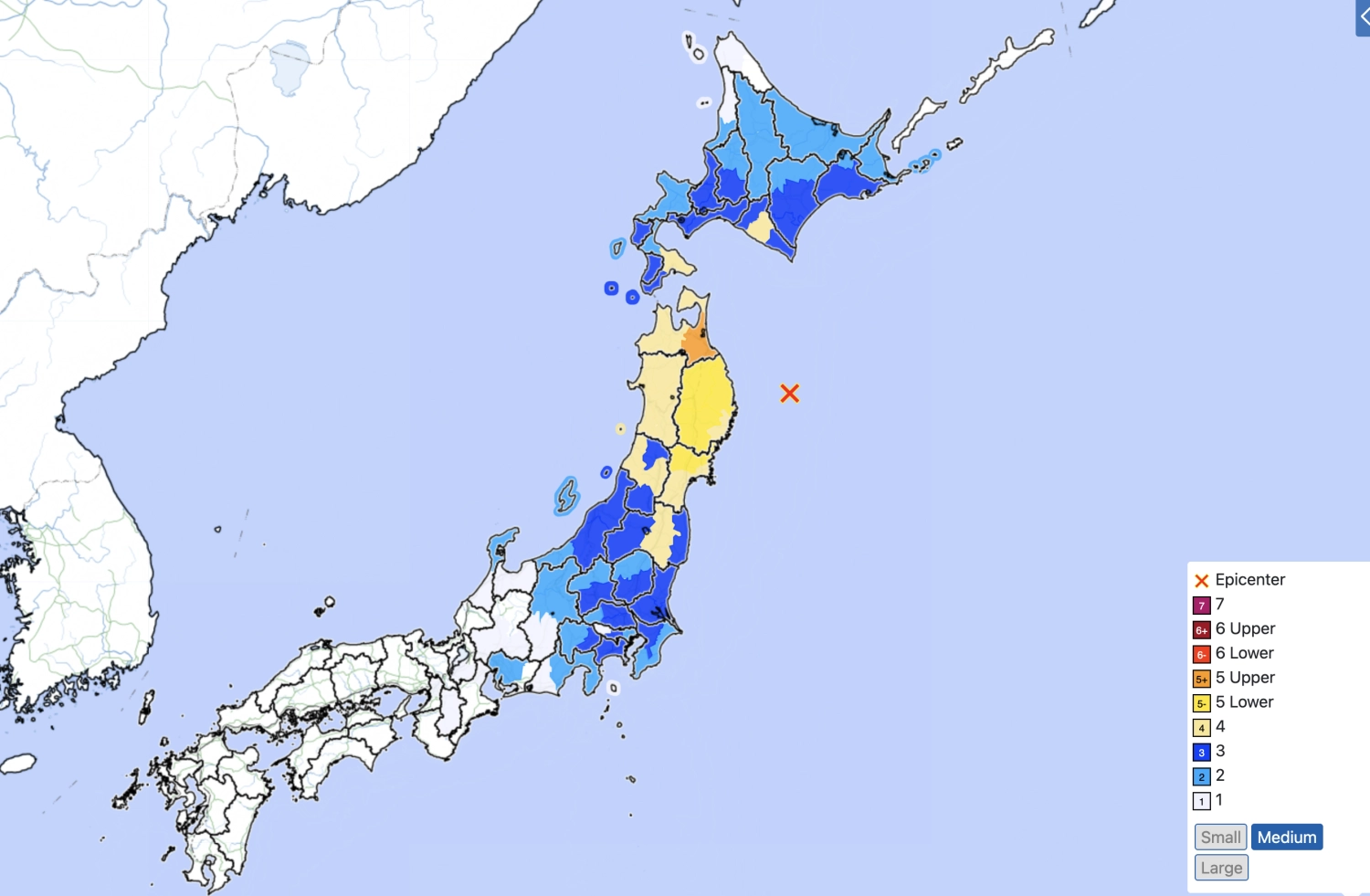
The seismic intensity and epicenter of Monday’s earthquake are shown on a weather agency map.
| Japan Meteorological Agency
Speaking to reporters in Tokyo, Prime Minister Sanae Takaichi urged residents to continue their everyday activities, but maintain a readiness to evacuate at a moment’s notice.
“It is particularly important in coastal areas to evacuate immediately if you feel tremors or if a tsunami warning is issued,” she said.
A Maritime Self-Defense Force SH-60K helicopter was flying over the Sanriku coast of the Tohoku region to gather information and conduct a damage assessment, the MSDF said.
The Tohoku Shinkansen line resumed operation between Tokyo and Hachinohe stations after operations were suspended between Tokyo and Shin-Aomori stations. Operations were still suspended between Hachinohe and Shin-Aomori stations in Aomori. The Akita Shinkansen line also resumed operations after initial suspensions, according to the operator.
No abnormalities were reported at the crippled Fukushima No. 1 and No. 2 nuclear power plants in Fukushima Prefecture or the Onagawa nuclear power plant in Miyagi Prefecture, operator Tokyo Electric Power Company Holdings said.
The JMA also said it observed a level 3 of what’s called long-period ground motion — or seismic waves of different durations that last for a long time — in Akita Prefecture.
Level 3 is defined as shaking that makes it hard for people to remain standing, and one that makes rolling furniture move uncontrollably, while furniture that is unsecured may topple over.