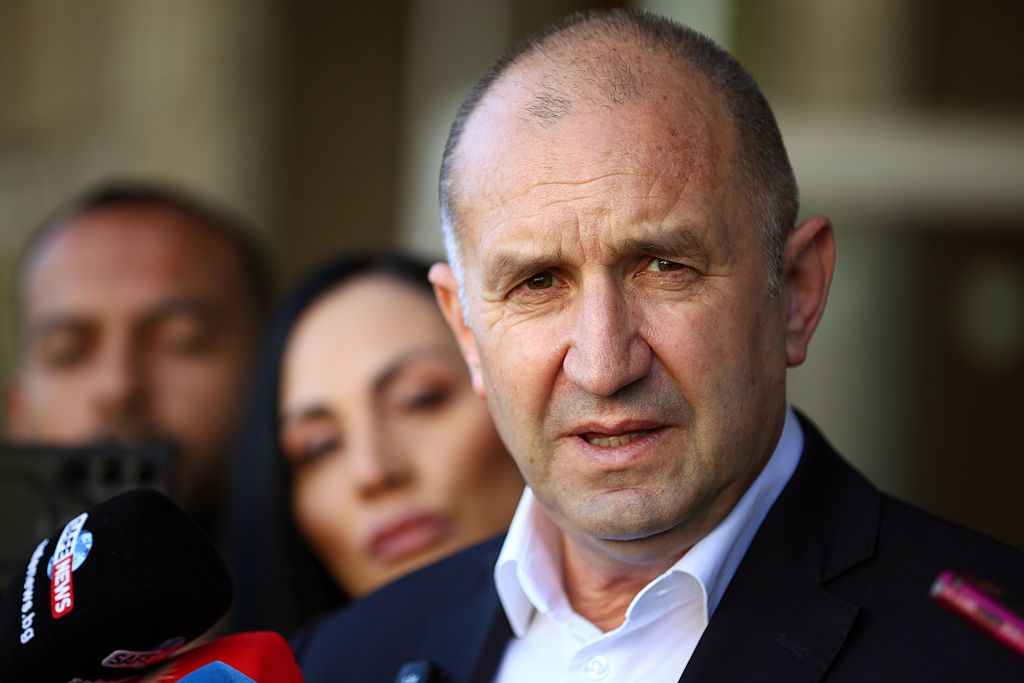
Progressive Bulgaria, the coalition led by Bulgaria’s Kremlin-friendly ex-President Rumen Radev, won the country’s snap parliamentary elections on April 19 with 44.6% of the vote.
The result puts the party in a position to potentially govern on its own, without the need to form a coalition with pro-European or smaller parties.
The politician has frequently criticized aid to Ukraine and Western sanctions against Russia while also opposing Ukraine’s ascension to NATO and the European Union.
His electoral win marks a victory for pro-Russian representation in the EU, a week after Hungarian Prime Minister Viktor Orban lost his country’s parliamentary vote in a resounding defeat.
“What Europe needs right now is critical thinking, pragmatic actions, and good results, especially to build a new security architecture,” Radev said in his victory speech. “That will be the main contribution of Bulgaria to its European mission.”
Dmitry Peskov, the Kremlin’s spokesperson, praised the politician’s rhetoric on April 20, saying Moscow was encouraged by calls for “dialogue.”
“We are, of course, impressed by the statements made by Radev, who won the election, and by some other European politicians regarding their willingness to resolve issues through pragmatic dialogue with the Russian Federation,” he said.
European Commission President Ursula von der Leyen congratulated Radev on his election victory, saying Bulgaria “is a proud member of the European family and plays an important role in tackling our common challenges.”
“I look forward to working together, for the prosperity and security of Bulgaria and Europe,” she said.
Radev resigned from the presidency in January to lead his Progressive Bulgaria coalition in a bid for parliament, promising to crack down on corruption. His center-left coalition is made up of former socialist politicians and Radev loyalists.
Progressive Bulgaria took a commanding lead in pre-election polls, showing a 10% lead over the GERB-Union of Democratic Forces (SDS) coalition, a center-right populist alliance led by former Prime Minister Boyko Borisov.
The snap elections come amid longstanding political turmoil in Bulgaria, which has held several elections in the last four years and has been swept by anti-corruption protests.
During his nine-year tenure as president, Radev had to appoint seven caretaker governments due to political deadlock and parties’ inability to form stable majorities.
Bulgaria joined the EU in 2007 and adopted the euro on Jan. 1, 2026 — a decision Radev questioned. Radev has also criticized EU support for Ukraine, calling the war against Russia a “doomed cause” and urging Brussels to stop “pouring weapons” into Kyiv.
Radev’s positions led to a heated exchange with President Volodymyr Zelensky in Sofia in 2023. More recently, Radev denounced Bulgaria’s 10-year security deal with Kyiv, signed by caretaker Prime Minister Andrey Gyurov.
While some experts hesitate to label Radev as overtly “pro-Russian,” his Euroscepticism and lack of support for Kyiv are seen as political openings for the Kremlin.
Compared to some of their EU counterparts, Bulgarians — a predominantly Orthodox, Slavic-speaking nation — have held relatively more positive attitudes toward Russia.
While Sofia has supplied Kyiv with Soviet-era arms since 2022, the support has been kept secret for a time due to fears of political fallout.