
This transcript was created using speech recognition software. While it has been reviewed by human transcribers, it may contain errors. Please review the episode audio before quoting from this transcript and email transcripts@nytimes.com with any questions.
tracy mumford
From The New York Times, it’s “The Headlines.” I’m Tracy Mumford. Today’s Monday, April 20. Here’s what we’re covering.
speaker 1
Motor vessel Touska, motor vessel Touska, vacate your engine room.
tracy mumford
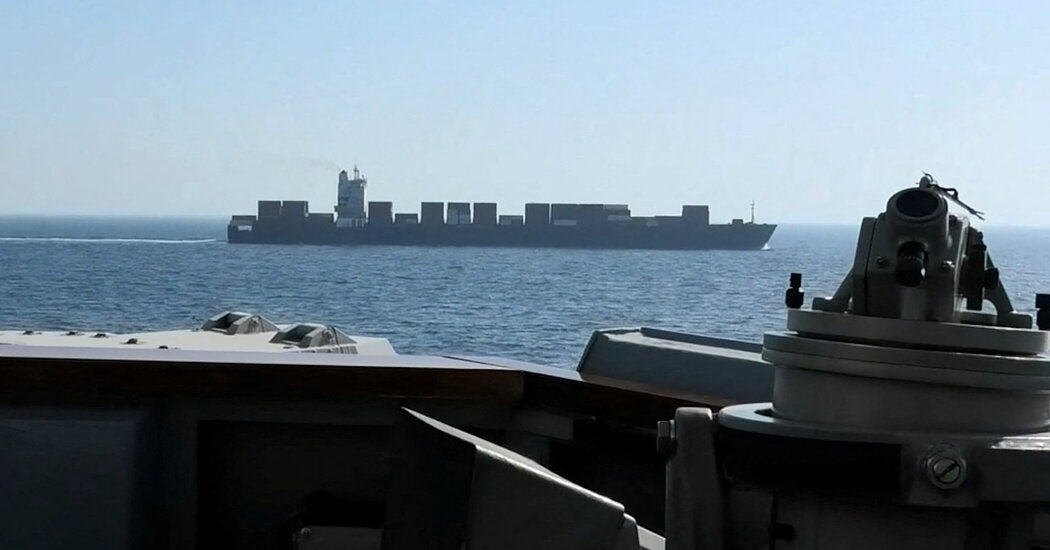
Off the coast of Iran yesterday, the US Navy carried out what appeared to be its first attack on a ship trying to get around the American blockade, striking and seizing an Iranian cargo vessel. The Pentagon posted a video of the incident along with a statement saying an American destroyer opened fire on the cargo ship’s engine room, disabling the vessel, after it ignored demands to stop sailing toward an Iranian port. Marines then dropped in from a helicopter to seize it.
Early this morning, Iran’s military warned it would retaliate for the attack, which it called armed piracy, according to an Iranian media report. The strike capped off what had already been a chaotic weekend in the critical waterways around Iran. President Trump and Iran had both said that the Strait of Hormuz was open Friday. But Saturday, Iran’s foreign minister said his country was taking, quote, “strict control” over the strait again. And Iran then opened fire on two ships that tried to get through.
Both the US and Iran have now accused the other of violating the fragile two-week ceasefire, which is set to expire on Tuesday. With the clock ticking down, Trump said American negotiators are headed to Pakistan for a new round of negotiations. But Iran said today it has no plans to participate, accusing the US of not being serious about pursuing diplomacy.
jake tapper
When do you think it’s realistic for Americans to expect that gas will go back to under $3 a gallon?
us energy secretary chris wright
I don’t know. That could happen later this year. That might not happen until next year. But prices have likely peaked, and they’ll start going down. Certainly, with a resolution of this conflict, you’ll see prices go down.
tracy mumford
Amid the diplomatic uncertainty and the attacks on ships, the price of oil has climbed again. And on CNN yesterday, US Energy Secretary Chris Wright said that fuel costs for consumers could stay high.
Today, the Trump administration is taking its first steps toward returning more than $160 billion it collected in tariffs. President Trump put the duties in place last year, claiming they were necessary to boost American manufacturing and even out global trade imbalances. But the Supreme Court later struck some of the tariffs down. Now the administration is debuting a system for businesses to submit refund requests, but only the entities that officially paid the tariffs will be able to recover money. Think FedEx or Costco. That means the broader group of people affected by the tariffs, including millions of Americans who paid higher prices for products, are not able to apply for direct relief.
And even as the refund filing system gets up and running, there’s still plenty of uncertainty around it, given how many companies could file, how many billions need to be processed, and the fact that the Trump administration hasn’t said whether or not it will try to go back to court to fight giving refunds at all. “The Times” talked with the founder of a women’s outdoor clothing company, who said she was hoping to get back around $250,000 in refunds from the federal government. But she added, quote, “I wouldn’t say I’m at all optimistic that they are going to come in a timely manner.”
[CONTEMPLATIVE MUSIC]
And one last update on the Trump administration — over the past year and a half, the US has drastically upended its relationship with Europe. And “The Times” has been looking at how one State Department employee, just five years out of college, has been at the center of that, in particular, driving President Trump’s culture war in those countries.
michael shear
Sam Samson is not at all your typical high-level federal employee. He’s 27 years old, was a conservative activist, and in just a very short time, has now risen to become a very important senior advisor at the State Department and really a messenger for President Trump across Europe.
tracy mumford
“Times” correspondent Michael Shear is part of a team who talked to more than two dozen American and European diplomats, lawmakers, and former officials to trace Samson’s efforts. Samson had a secret meeting with Nigel Farage in Britain last March to discuss abortion and censorship. He was in France in May trying to argue that Marine Le Pen, a far-right leader convicted of embezzlement, had been unjustly persecuted. And he met with members of Germany’s rightwing AFD party, which German intelligence has designated as a suspected extremist organization.
michael shear
Part of Samson’s travels have been meeting with far-right groups in each of these countries to essentially say, what can we do to help you affect policies like free speech, migration, anti-woke, anti-diversity policies that these far-right groups have been pursuing for years? But now, essentially, Samson is the one traveling around Europe saying the United States government wants to help you with that.
The European governments have reacted with alarm, mainly because they have themselves been fighting against some of these far-right parties to tamp down their influence throughout their countries. And so to have a senior US official traveling around the country pledging his support, but more importantly, pledging the support of the United States to these groups, has really been something that strikes fear into the hearts of many of the politicians that are in office right now across Europe.
tracy mumford
In response to questions from “The Times,” Sam Samson declined to be interviewed. In a statement, a State Department spokesman said that the administration is having what it called hard conversations with Europe and that the transatlantic relationship will be, quote, “stronger because of it.” For the full profile of Samson and the State Department’s wider efforts in Europe, go to “The Times” app or nytimes.com.
Across the US, it’s the time of year when students are deciding whether they want to say yes to grad school acceptance offers and whether or not they can afford to go. And for the first time in two decades, they won’t be able to automatically cover the full price tag with federal student loans. Starting this year, the government has capped those loans for most graduate programs at just over $20,000 a year. And that’s far less than what many of the programs actually cost.
For example, top programs for students wanting to become physician’s assistants or nurse anesthetists charge about $45,000 a year, meaning that students who can’t pay out of pocket will have to sign up for tens of thousands in private loans. That’s raised concerns among some Democratic lawmakers, who have flagged that there’s persistently been predatory behavior in the private student loan market.
And student loan experts say getting a private loan at all could be impossible for some students since it often requires having a cosigner. One analyst at an advocacy group for student borrowers told “The Times,” quote, “The end effect is to essentially make it so that graduate school is only accessible to students from the wealthiest families.”
And finally, it’s been a banner week for creative crimes that turned out to be not quite crafty enough. In the “really?” moment number one, three people in California were sentenced for staging fake bear attacks on luxury cars for insurance payouts. They had someone dress up in a bear suit, climb into the cars, and use kitchen utensils that looked like claws to rip up the interior, according to the California Department of insurance.
They even submitted video footage for the claims, showing a, quote unquote, “bear” rolling around in the backseat of a Rolls-Royce. There’s also footage of a “bear” opening the door of a Mercedes and rummaging around. A biologist was called up to examine the videos and determined that it was, quote, “clearly a human in a bear suit.”
And the second “Wait, you tried what?” moment of the week — another man in California was just charged in a LEGO theft scheme. The suspect is accused of buying over $30,000 worth of LEGO kits from Target, then refilling the boxes with uncooked pasta — I assume so that they would sound the same if you shook them — and returning them for a refund. In a post online, the Irvine Police Department really tried the pun-shaming technique, writing that if anyone else tries this kind of switcheroo, they’ll be caught, calling it a “pasta-tively” terrible plan.
Really, though, there have been a surprising number of LEGO thefts recently. Officials say the toys are targeted because they’re small, untraceable, and in high demand. Less than two weeks ago, a group of thieves was caught after driving off in trucks packed with a million dollars’ worth of LEGO sets.
[THEME MUSIC]
Those are “The Headlines.” Today on “The Daily”—
jodi kantor
Through these papers, we can eavesdrop on the justices at the exact moment that they are abandoning time-tested norms of judicial procedure and backing themselves into a new way of doing business.
tracy mumford
— a “Times” investigation into the origins of the Supreme Court’s so-called shadow docket. You can listen to that in the New York Times app or wherever you get your podcasts. I’m Tracy Mumford. We’ll be back tomorrow.
[THEME MUSIC]