
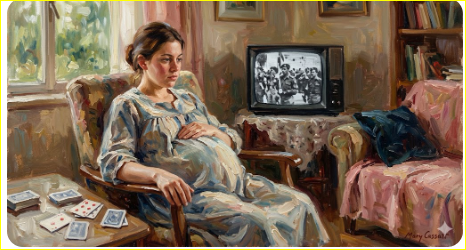
Gemini image for independence day in style of Marie Cassatt
On May 2, 1968, my parents and my husband left me behind in Alonei Yitzchak to attend the IDF parade in Jerusalem for Israel’s 20th Independence Day. I didn’t go with them because I was heavily pregnant, due to give birth at any moment. Ironically, that was exactly why my parents were there—to be with ME. Yet, as tourists, they had seats in the VIP stands, and I was the one left behind. I had no choice, but I resented it.
The military parade in Jerusalem was chosen as the first-ever broadcast of Israeli television. Fortunately, one person in the youth village where we lived owned a television, so I was able to watch it live in black and white, while my parents and husband experienced it in vivid color and in person. It was also the first time I “met” Hayim Yavin, the legendary news broadcaster with his soothing baritone voice. For many years, I fell asleep to his voice, and even today, the news still lulls me to sleep.
More than half a million people lined the streets of what was then newly united Jerusalem, under clear skies, as the parade wound its way through the city. The Air Force put on an impressive display of power and precision. The parade itself was controversial—many questioned whether such a show of military strength was appropriate, arguing that it resembled the displays of dictatorships.
My husband and parents sat in a special section arranged by the AACI on Givat HaMivtar. They were thrilled to see, up close, the President, the Prime Minister, and even Moshe Dayan in uniform. They also saw leaders from Muslim and Christian communities in their religious attire, all standing for “Hatikvah.” They were especially impressed by the Air Force flyovers—jets releasing blue and white smoke to form the number twenty in the sky. My mother was particularly struck by the sight of women soldiers marching with rifles.
There was heavy traffic, but they wisely chose not to complain to me. They stayed overnight in Jerusalem, and I heard all about it when they returned on Friday.
On Saturday night, we went out for pancakes at the then-famous (and only) Pancake House near Hadera. Though I felt occasional twinges, I kept eating and enjoying every bite, joking that if necessary, we were close to the hospital. The next morning, Sunday, May 5, I went into labor and gave birth to my daughter at Hillel Yaffe Hospital in Hadera. For years, my husband liked to joke that the pancakes gave me the strength to go through an entire day without food.
My memories of that time are hazy—except for the feeling of being left out. Giving birth in Israel in those days was a lonely experience. There were no supportive husbands by your side, offering encouragement. Instead, I labored alone in a room with three other pregnant women—strangers to me—passing the time by playing solitaire with a deck of cards. I was admitted at eight in the morning and gave birth at eight in the evening. It was an uncomplicated delivery, and four days later we returned home to Alonei Yitzchak with our newborn daughter.
Later that week, my first cousins—Holocaust survivors living in Dimona, Holon, Nazareth Illit, and Tel Aviv—came to meet their aunt, my mother. The house filled with Hungarian, Hebrew, and English. This time, I didn’t feel left out—I had a baby to care for.
Memories of Early Celebrations
By 1969, we were living in Jerusalem, where I learned that to be truly Israeli on Independence Day, you needed a squeaky plastic hammer to bop people on the head. Our special treat was walking to Café Allenby on King George Street, which usually closed at 10 p.m., to buy glida amerikai—frozen whipped ice cream. This became our tradition for several years (by then, with two children), until we moved to Omer.
In Omer, as a rabbinic couple, we hosted many Independence Day gatherings in our home. They were simple affairs—popcorn, snacks, and singing Israeli songs. Walking with our children to the town center to enjoy free entertainment—usually schoolchildren dancing—and fireworks was always a highlight. When the children were older, they roamed freely, and we never worried about them (at least not until they began to drive).
Our social circle grew, and friends began hosting their own gatherings, which we happily attended. Often, the following day, we would go on nature outings or share picnics and barbecues.
Eight years ago, we celebrated Independence Day at our daughter’s home for her 50th birthday. The entire extended family gathered for a large barbecue.
The past thirteen years, however, have been more poignant. The daughter of one of our closest friends passed away on Rosh Chodesh Iyar, and the shiva fell during this emotionally charged period. We spent every evening at their home—standing for the memorial siren one night, eating falafel together the next. During that same shiva period, my youngest granddaughter was born. She is now thirteen.
The 58th Year
And now we find ourselves 58 years removed from that “innocent” Independence Day.
When we came to Israel after the Six-Day War, we shared in the euphoria of victory. We wanted to be part of this new Israel. We were thrilled to travel freely—something we couldn’t do as students in 1965, when access to the Old City and the West Bank was closed to us. We barely considered what it meant to be conquerors. We believed we were on the right side—there was no nuanced thinking then.
We gave up a comfortable life in the United States—we were on our way to a pulpit in Spokane, Washington—to spend two years in Israel. Those two years became a lifetime.
We also developed a visceral understanding of Yom Hazikaron. My second cousin from Holon suffered from untreated PTSD after serving in the Six-Day War. My first cousin from Dimona lost an eye in the 1948 War. A university colleague was a war widow—her husband had been a pilot. In Jerusalem, I tutored burn victims after the Yom Kippur War. In Omer, we attended the annual memorial at the andarta, knowing personally many families who had lost sons and daughters.
Back then, it would have been unimaginable that the sanctity of Yom Hazikaron could become politicized. Only a few foresaw that victory might lead to prolonged conflict. Even within our own family today, political views span the spectrum—especially among the grandchildren.
Our next-door neighbor’s husband was killed at Suez in 1973. Each year, the family visits his grave in the military cemetery in Beersheba. I know how they would react if a political figure were to turn that sacred space into a platform for speeches.
Today
How will I mark my 58th Yom Hazikaron and Independence Day?
First of all, there is no longer a clear “we.”
In my new home in the Lower Galilee, I have many options—but this year will be subdued. We are all waiting to see whether the ceasefire will hold. There is quiet preparation, even talk of shelters if necessary.
I am not in Omer with dear friends—those who lost a daughter in the Air Force, or those mourning children lost on October 7. Instead of attending the moving tekes ma’avar in the synagogue we founded, marking the transition from mourning to celebration, I will join via Zoom and then watch television, as many Israelis do.
There is a tension in the air—a sense that something may disrupt the ceremonies on Mount Herzl. For safety’s sake, it is being televised. We hope the day will pass without incident.
Later in the evening, perhaps I will drive to my new synagogue and raise a glass—to Israel’s 78th anniversary, and to our 58 years of celebrating Independence in this land.
Atzmaut Sameach!