
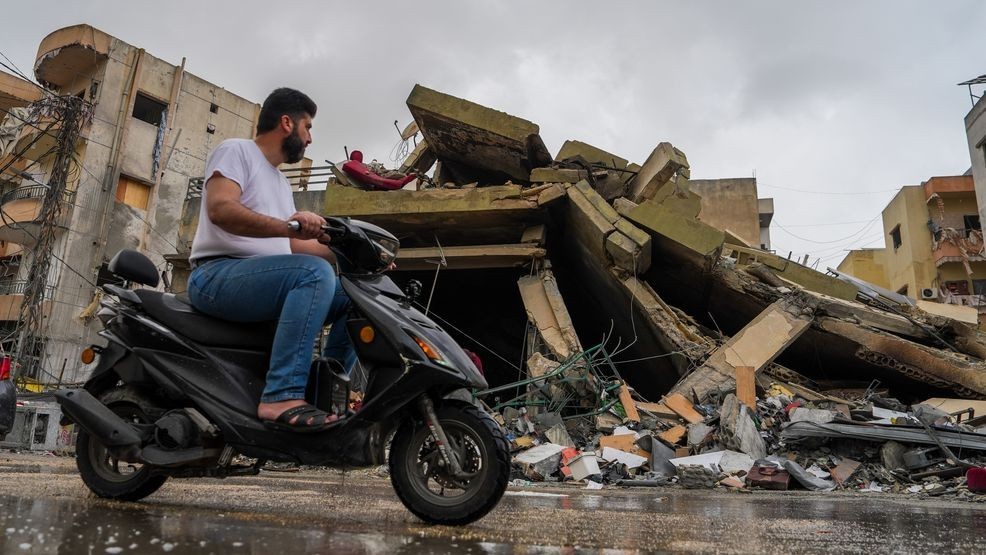
WASHINGTON (TNND) — Fighting between Hezbollah and Israel is continuing despite a temporary ceasefire, with new cross-border attacks raising fresh concerns about the stability of the truce—and the growing human cost of the conflict on the eve of the peace negotiations deadline.
Hezbollah is a Lebanese militia and political organization backed by Iran. The group, whose name translates to “Party of God,” was formed in the 1980s and is made up primarily of Shia Muslims. Over the decades, Hezbollah has evolved into one of the most powerful non-state military forces in the region. It has fought multiple conflicts with Israel and frequently operates as part of Iran’s broader regional strategy, engaging in proxy warfare.
The U.S. State Department designated Hezbollah as a foreign terrorist organization in 1997. Despite that designation, the group also plays a significant role in Lebanon’s political system and provides social services, giving it influence beyond the battlefield.
Civilian deaths rise as ceasefire strains
The human toll from the latest escalation continues to grow. Authorities in Lebanon report that roughly 2,300 people have been killed since fighting intensified, including civilians. On the Israeli side, at least 13 soldiers and two civilians have been killed.
A 10-day ceasefire brokered between President Donald Trump and Iran has technically paused full-scale fighting, but it remains under strain with a deadline approaching.
Both Israel and Hezbollah accuse each other of violating the agreement. Recent exchanges in attacks highlight that fragility. Hezbollah has launched drones and rockets toward Israel, while Israeli forces have responded with airstrikes and ground operations in southern Lebanon.
Israeli troops also remain positioned in parts of southern Lebanon in what Prime Minister Benjamin Netanyahu has described as a “Yellow Line,” a roughly six-mile security zone where military operations are continuing—even during the ceasefire.
The ongoing strikes and troop presence have heightened fears that the conflict could quickly escalate back into a broader war.
As fighting persists, Israel is also introducing new military technology it describes as a “game-changer” on the battlefield. According to the Israel Defense Forces, the country has rolled out a new self-propelled artillery system known as the Ro’em howitzer.
Military officials say the system represents a shift toward faster, more precise, and more flexible firepower. The artillery platform has a range of about 40 kilometers (25 miles) and can be operated by a crew of three.
Developed by Elbit Systems, the system is designed to automate key functions—such as selecting, loading, and firing munitions—allowing for a higher rate of fire and quicker response times on the battlefield.
The Israeli military says the Ro’em system has already been deployed operationally during the current conflict.
According to official statements, troops have used the artillery to conduct what they describe as precise strikes targeting Hezbollah anti-tank and missile launch positions. Israeli officials characterize these actions as defensive measures carried out within the bounds of the ceasefire.
Meanwhile, the broader humanitarian impact continues to draw scrutiny. Lebanese officials report that among the more than 2,300 people killed are civilians, including women, children, and medical personnel.
A fragile pause
Despite the ceasefire agreement, the continued exchange of fire and the introduction of new weapons systems highlight how unstable the situation remains.
With both sides maintaining military pressure and accusing each other of violations, the risk of a return to full-scale conflict remains high, leaving civilians on both sides caught in an increasingly volatile standoff.