
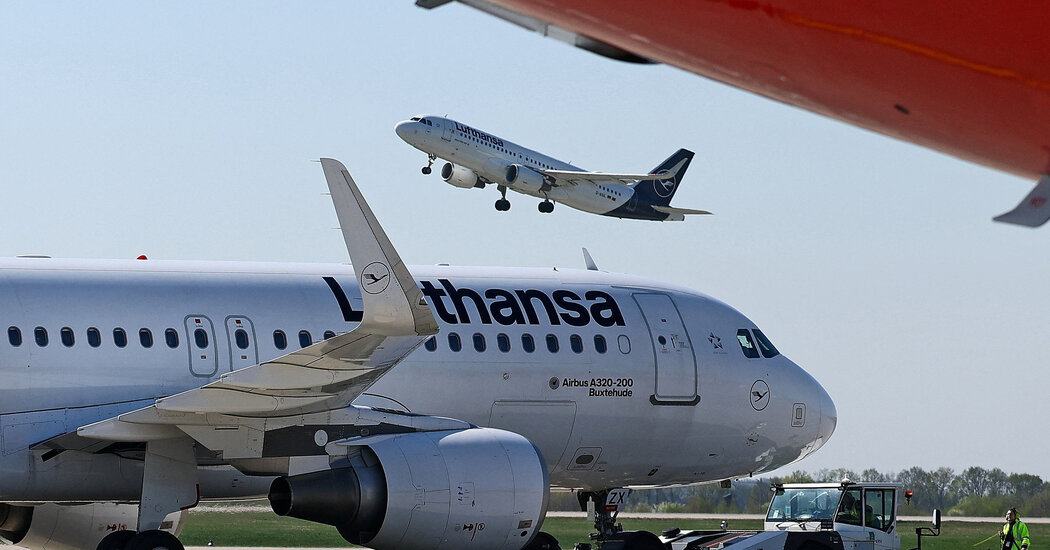
Lufthansa Group, the German airline, said it would cut 20,000 flights over the next six months to save jet fuel as the pressure builds on companies to address surging prices and declining supplies of energy caused by the war in Iran.
The airline said on Tuesday that it had already announced which flights it had trimmed through May. Overall, the cuts would save 40,000 metric tons of jet fuel through the end of October. The company added that it had secured its fuel supply for “the coming weeks.”
Airlines across Europe have warned that the prolonged closure of the Strait of Hormuz, the narrow artery off Iran’s southern coast that is a critical route for energy supplies, would lead to fuel shortages and severe disruptions. Aviation operations in the Middle East and Asia were already affected by the war, leading to flight reductions and fuel surcharges on ticket prices.
Europe is the largest consumer of jet fuel shipped through the strait. Those shipments account for about 41 percent of the region’s jet fuel imports, according to Macquarie Group, a financial services firm. Global prices of jet fuel have risen more than 70 percent since the start the war at the end of February, according to the Platts Jet Fuel Price Index.
Last week, Fatih Birol, the head of the International Energy Agency, said Europe had about six weeks of jet fuel supplies. European transportation ministers met on Tuesday to discuss the energy crisis.
Apostolos Tzitzikostas, the European commissioner for transport, said officials were working to secure alternative fuel supplies, including from the United States.
“And if real supply issues arise, our emergency stocks must be put to the best use,” he added. The European Commission will make jet fuel its first priority as it increases coordination of the distribution of fuel across Europe, he said on Wednesday.
European companies tend to have longer-term contracts for fuels, meaning they were initially protected from surging prices. But as supplies dwindle, prices are expected to jump.
Fuel from the ships that were already at sea before the strait closed has further insulated airlines. “That buffer is now largely exhausted,” analysts at Kpler, an industry data firm, said in a research note.
Lufthansa said it would cancel short-haul flights, focusing on unprofitable routes from Frankfurt and Munich, but would expand routes from its other hubs in Zurich, Vienna and Brussels. Last week, the airline announced measures to save fuel and other costs, permanently grounding 27 older-model planes operating on its Lufthansa CityLine, a regional carrier, and axing some of its long-haul flights at the end of the summer.
Other airlines have warned about the cost of fuel and potential flight disruptions.
Ryanair, a low-cost European airline, said last week that its suppliers could guarantee it enough jet fuel only through most of May. The Dutch airline KLM said that while it was not short of kerosene, it was cutting 80 return flights to and from Amsterdam to save money. This month, TAP, a Portuguese airline, said it would raise ticket prices to mitigate fuel costs, and Norse Atlantic Airways, a Norwegian carrier, canceled its routes to Los Angeles.
The British low-cost airline easyJet said it had spent an extra 25 million pounds (about $34 million) on fuel in March because it needed to purchase some supply at spot prices. The airline had a set price for 70 percent of the jet fuel it expects to use this summer but warned of volatility in prices for the rest of the fuel it needs.
Niraj Chokshi contributed reporting from New York, and Aaron Krolik from Seoul.