
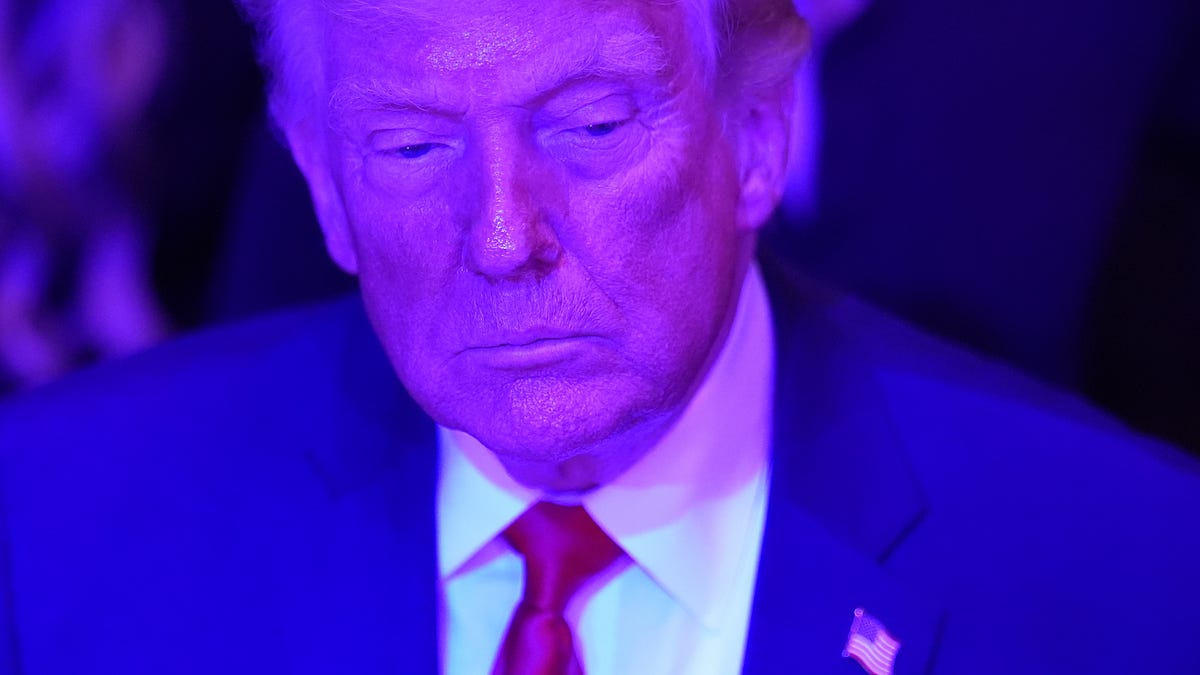
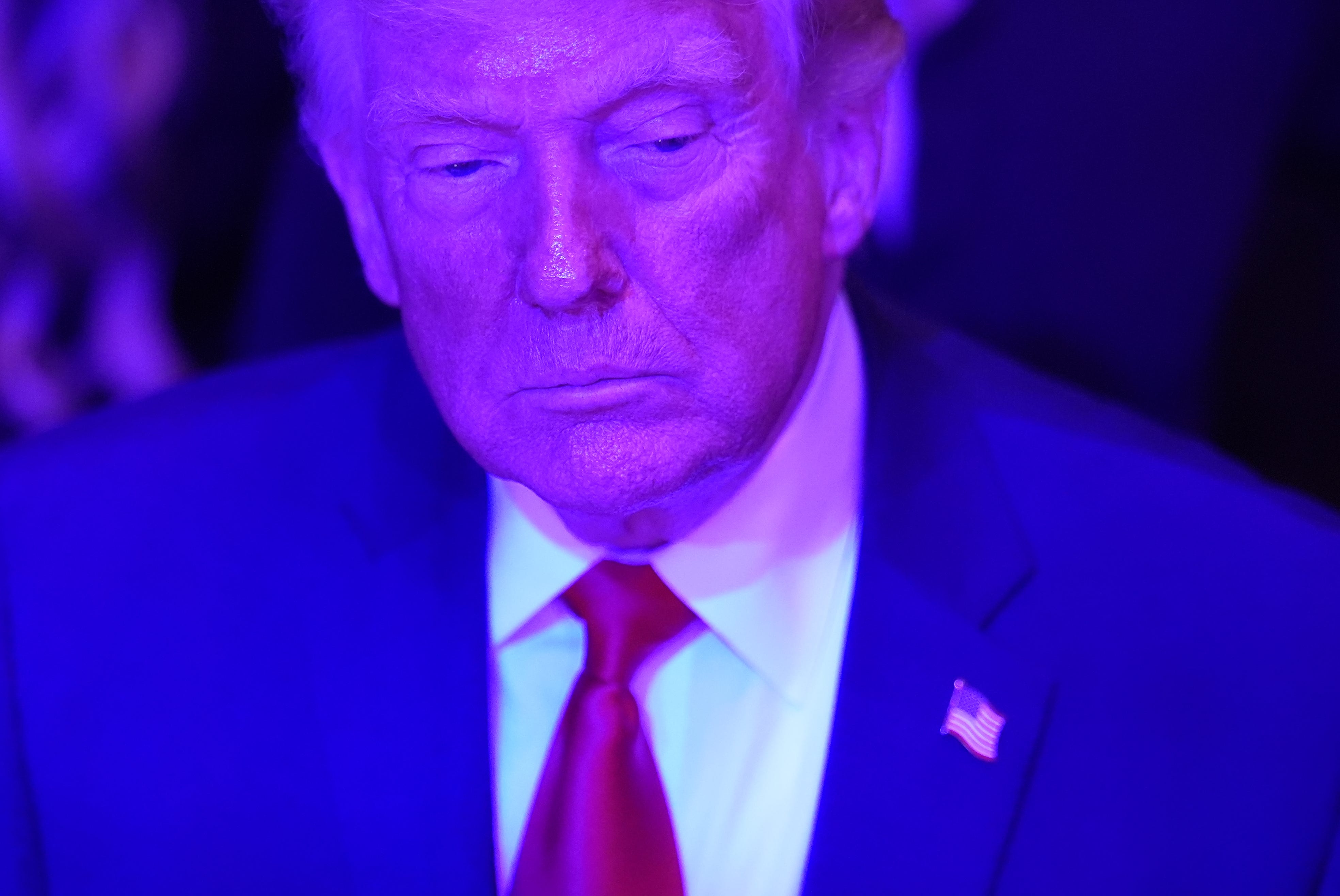
 U.S. President Donald Trump attends UFC 327 at Kaseya Center on April 11, 2026 in Miami, Florida. Photo by Julia Demaree Nikhinson – Pool/Getty Images.
The future of U.S.-Iran negotiations remains in doubt after President Donald Trump and Tehran’s leaders staked out opposing positions on the Strait of Hormuz. “Diplomacy is a tool to secure national interests and security,” said Esmail Baghaei, Iran’s Foreign Ministry spokesman, in a briefing in Tehran on Wednesday. “Whenever we conclude that the necessary and logical grounds for using this tool to realize national interests and consolidate the achievements of the Iranian nation in thwarting the enemies from reaching their evil goals are prepared, we will act.”
On Tuesday night, a senior Iranian official told Drop Site that Iran would move forward with a second round of talks in Islamabad only if Trump extended the ceasefire and ended the U.S. naval blockade. “The Pakistani side indicated that they expect Trump to lift the naval blockade of Iran,” the official said. “If that happens, and the ceasefire is extended, a new round of talks will be held on Thursday.”
Soon after, Trump announced on Truth Social that he was indefinitely extending the ceasefire but added that the blockade will remain in place. “Based on the fact that the Government of Iran is seriously fractured, not unexpectedly so and, upon the request of Field Marshal Asim Munir, and Prime Minister Shehbaz Sharif, of Pakistan, we have been asked to hold our Attack on the Country of Iran until such time as their leaders and representatives can come up with a unified proposal,” Trump wrote. “I have therefore directed our Military to continue the Blockade and, in all other respects, remain ready and able, and will therefore extend the Ceasefire until such time as their proposal is submitted, and discussions are concluded, one way or the other.”
The Iranian official dismissed Trump’s claims that Iran’s leadership was in disarray, characterizing it as a desperate attempt by Trump to save face after his recent false claims, including that Iran had offered him sweeping concessions, and “agreed to everything,” including handing over its enriched uranium and allowing the U.S. military to enter Iran to seize it. “Our people, together with the Iranians, are going to work together to go get it. And then we’ll take it to the United States,” Trump said April 17. Iran swiftly rejected these claims.
Trump also publicly announced on Monday that JD Vance, Special Envoy Steve Witkoff and Jared Kushner, Trump’s son-in-law, were on their way to Islamabad and suggested that a deal was almost finalized. “They’re heading over now. They’ll be there tonight,” he told PBS. He added that he was considering personally attending the talks. When Iran ultimately decided not to send a delegation, Trump scrambled to reconcile his messaging and reverted to threatening to destroy Iran’s civilian infrastructure. On Tuesday morning, he told CNBC he would not extend the ceasefire only to flip flop hours later in the face of Iranian intransigence.
“[Trump] thought we would go into the negotiations under the current conditions. They did everything they could to get our diplomatic delegation sent, and he didn’t expect things to turn out this way,” said the official, who has direct access to Tehran’s internal deliberations. He requested anonymity because he is not authorized to publicly discuss strategy. He added that Tehran’s position remains unchanged: lifting the blockade is a condition for continuing talks.
That position was publicly reiterated by Iran’s ambassador to the United Nations. “The naval blockade initiated by the United States is a violation of the ceasefire,” said Amir-Saeid Iravani in an impromptu press conference in New York Tuesday. “Tehran will not enter into negotiations with the United States until the naval blockade is lifted.”
An adviser to Mohammed Bagher-Ghalibaf, the speaker of Iran’s parliament and Tehran’s lead negotiator in the first round of talks with the U.S. in Islamabad, denounced Trump’s announcement that he was extending the ceasefire, saying it “means nothing.”
“The losing side cannot dictate terms,” said Mahdi Mohammadi, the Ghalibaf adviser, in a post on X. “The continuation of the siege is no different from bombardment and must be met with a military response. Moreover, Trump’s ceasefire extension is certainly a ploy to buy time for a surprise strike. The time for Iran to take the initiative has come.”
The senior Iranian official told Drop Site that Iran continues to prepare for what they see as a likely resumption of U.S.-Israeli attacks on the country and expressed confidence that Iran’s continued control of the Strait of Hormuz and its capacity to conduct strikes in the Persian Gulf and inside Israel would create a crisis for Trump. Iranian officials have said they would not engage in preemptive strikes, but will respond militarily to any attacks.
“In the event of any aggression or action against the Islamic Republic of Iran, [we] will immediately and forcefully strike pre-designated targets,” said Ebrahim Zolfaghari, the spokesperson of Khatam al-Anbiya Central Headquarters, Iran’s conventional joint military command, in a statement on Tuesday night. “Our capable and powerful forces have long been at full readiness, with their fingers on the trigger.”
The situation in the Strait of Hormuz will be at the center of any deal that is reached to continue negotiations. Trump continued to post on social media late into Tuesday night. “Iran is collapsing financially! They want the Strait of Hormuz opened immediately- Starving for cash! Losing 500 Million Dollars a day. Military and Police complaining that they are not getting paid. SOS!!!,” he wrote.
On Wednesday morning, the Islamic Revolutionary Guard Corp announced that its naval forces had seized two vessels—saying that they had “endangered maritime security by operating without the necessary permits and tampering with navigation systems.” Iranian naval forces escorted the ships, one of which is Greek owned, to Iran’s coastal waters, warning, “disrupting order and safety in the Strait of Hormuz is considered a red line for Iran.”
The possibility for a comprehensive deal between Iran and the U.S. any time soon appears low. Both Iran and the U.S. are so far continuing to speak with Pakistani officials and those from other mediating nations. But, even if another round of negotiations does take place, the stated red lines of Iran and the U.S. stand in stark contrast.
Trump has made the transfer of Iran’s highly enriched uranium the centerpiece of his “victory” narrative. Iran has said it will not hand over its stockpile and Baghaei called it “as sacred to us as Iranian soil,” saying it “will not be transferred anywhere under any circumstances.” Iran has indicated it would be open to diluting it for civilian use under the monitoring of the International Atomic Energy Agency.
Iran has also demanded an easing of economic sanctions and the unfreezing of tens of billions of dollars of its assets. Trump has said he will not allow the transfer of funds to Iran and frequently denounces President Barack Obama for the unfreezing of Iranian assets as part of the 2015 Iran nuclear deal, calling it “one of the Worst Deals ever made having to do with the Security of our Country.” In that deal, Iran shipped more than 25,000 pounds—roughly 98 percent of its enriched uranium stockpile—out of the country. Iran is currently estimated to have less than 1,000 pounds of enriched uranium.
Rather than a comprehensive deal, the senior Iranian official told Drop Site he believes a more likely scenario would involve the U.S., through Pakistani mediation, “shaping a de facto end to the war without any formal declaration.” This would leave the major issues unresolved and the possibility for a resumption of war still open.
Perhaps the most vital component for any deal from Iran’s perspective is a non-aggression agreement with the U.S. and crafting terms that would ensure war would not resume if Iran offers concessions as part of a deal. Given Trump’s track record, this would be nearly impossible to guarantee.
“Iranians do not trust the Trump administration at all. But what they’re banking on is the fact that they stood against an aggression and forced [the U.S. and Israel] out of this aggression, short of achieving any of their goals that were stated,” said Iranian analyst Hassan Ahmadian, in an interview with Drop Site. “The Iranians moved past the international community as a protector. The UN Security Council did not stop two wars, illegal wars imposed on the country. And so the Iranians learned it the hard way. It’s about power. If you don’t have power, you will be subject to annihilation,” he added. “The Iranians see that they can balance—asymmetrically—the power of the United States and can push it back. They go for a negotiated settlement, because at the end of the day, you have to stop the aggression.”
But, Ahmadian cautioned, “They don’t trust it.”
On Wednesday, Axios—citing anonymous officials—reported that Trump’s ceasefire extension may only last three to five days. In line with the White House spin about what they claim is chaos within Iran’s ruling elite, a U.S. official told Axios that Trump was offering time “to allow the Iranians to get their shit together.” Trump-aligned media has spent the past 48 hours awash in stories claiming that Ayatollah Mojtaba Khamenei is incapacitated, political leaders have been sidelined, and the IRGC is taking charge of decision-making. The senior Iranian official dismissed these stories as psychological warfare and said Iran continues to run all decisions through its Supreme National Security Council.
Ahmadian said that despite the assassinations of senior leaders and the massive military attacks over the past six weeks, the Iranian government remains a highly structured and organized system of institutions. “Name another system whose top echelon are assassinated and is capable of continuing, and also waging, a retaliatory war effort against two big foes. I don’t see any historical parallel,” he said. “The simplistic view of this institutionalized system is basically wishful thinking.”