
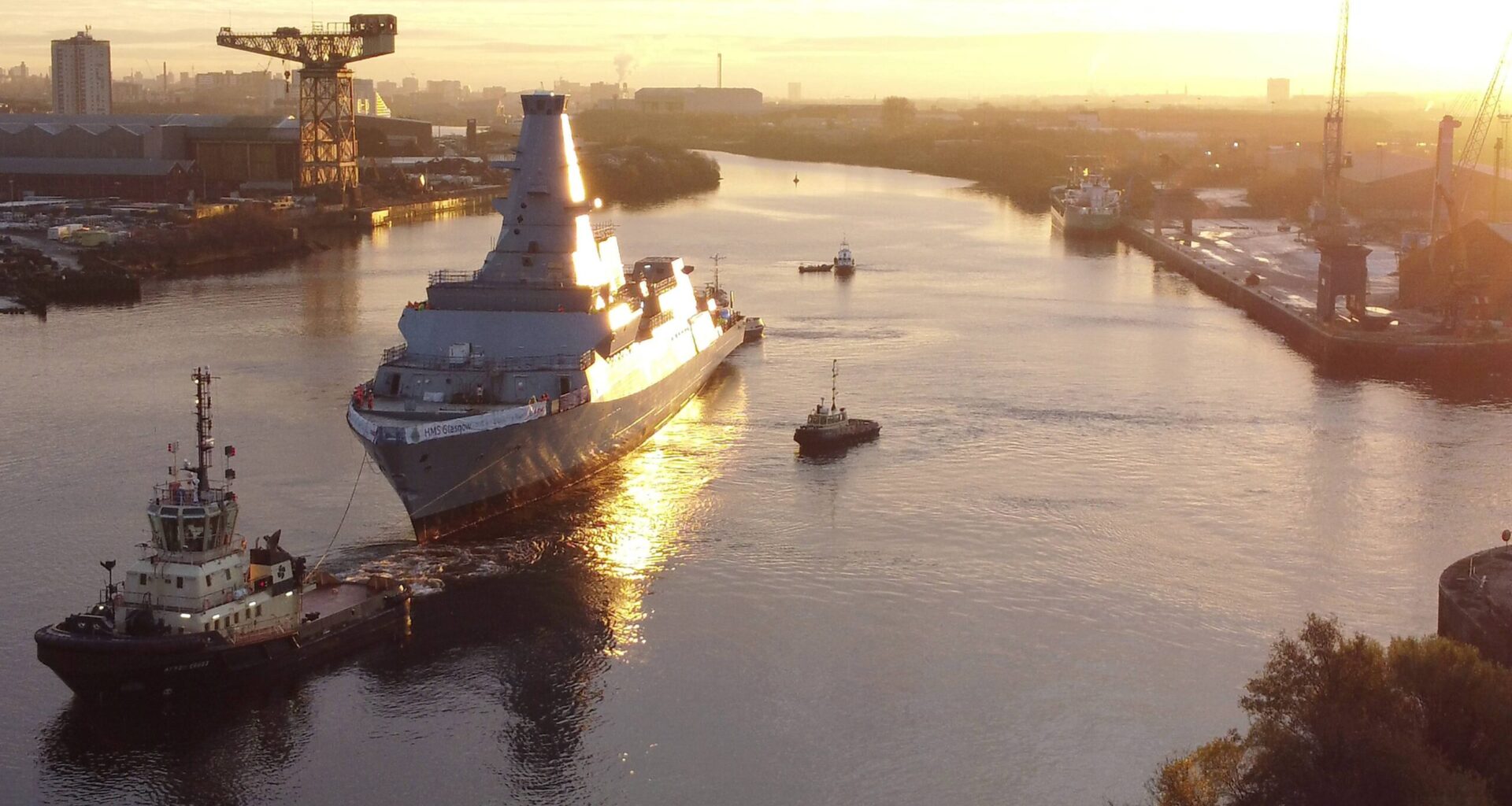
The UK will need to place additional Type 26 frigate orders after the government confirmed that build slots currently allocated to the Royal Navy are being transferred to Norway, leaving a gap that has not yet been addressed and which will be a consideration of the forthcoming Defence Investment Plan.
The detail emerged in a parliamentary answer from Minister for Defence Readiness and Industry Luke Pollard on 22 April, in which he confirmed that 13 frigates were ordered between 2010 and 2024 across the Type 26 and Type 31 programmes, adding that of the Type 26 slots “a number have been ceded as part of the Norwegian deal” and that “the delta is yet to be made up through additional orders, and this will be a consideration of the Defence Investment Plan.”
The transfer was first officially confirmed in February, when Pollard told parliament the UK was “working together with our Norwegian partners” and “assessing options for offering Type 26 build slots currently allocated to the Royal Navy to the Royal Norwegian Navy.” At that point Pollard also confirmed the Royal Navy’s total would not be reduced, stating “the Royal Navy will receive all eight Type 26 ships during the late 2020s and 2030s as planned”, and describing the intended outcome as a combined fleet of “eight British and at least five Norwegian” ships operating jointly in northern Europe where “the only difference between a Royal Navy Type 26 and a Norwegian Type 26 will be the language on the signs.”
The eight-ship commitment has nonetheless come under scrutiny, with Conservative MP Dr Andrew Murrison telling the Commons that “well-placed sources are suggesting that the number of Type 26 hulls on the order book may be reduced or transferred to our Norwegian allies”, and asking Pollard to confirm that the government would “proceed with a minimum of eight Type 26 frigates, particularly given the increase in Russian submarine activity” discussed earlier that week.
Pollard’s response was unequivocal, asked directly whether he could confirm a minimum of eight, he replied “I can indeed“, before going further and describing the Norway arrangement in some detail, saying the deal “sustains Type 26 production on the Clyde for many years to come and involves not only the eight British Royal Navy Type 26s but five Norwegian ones”, adding that “we are currently working with Norway on build slots” and that the result would be “a truly interoperable, interchangeable force” where “the only difference between a Royal Navy Type 26 and a Norwegian Type 26 will be the language on the signs.”
Pollard also said the Norway deal was “part of an agreement about how we can work more closely with our joint expeditionary force allies in northern Europe” and that he hoped it “can be expanded to other nations as we look to sell the Type 31 frigates to more of our partners.”
The commitment was also given previously in a written answer from Al Carns MP in March 2026, who confirmed that “the Type 26 programme will deliver eight anti-submarine warfare frigates for the Royal Navy, which are designed primarily for operations in the North Atlantic and will form a core component of the Atlantic Bastion concept”.
It is worth noting that because Norway is paying for the slots it receives, no money already committed to the Type 26 programme is necessarily lost, and the additional orders needed to get the Royal Navy back to eight ships are expected to be handled through the Defence Investment Plan as spending plans are recalculated, though the practical consequence either way is that the Royal Navy’s later Type 26s are likely to arrive later than originally planned, putting additional pressure on the retirement schedule of the Type 23 frigates they are intended to replace.
There is a broader argument that the flag on individual hulls matters less in the North Atlantic than the total number of capable anti-submarine warfare frigates operating together in that theatre, and the Lunna House Agreement signed in December 2025 is explicitly built around that logic, committing the Royal Navy and Royal Norwegian Navy to operate as a single interchangeable fleet where crews train together, share maintenance and operate virtually identical ships.
From a NATO perspective, a combined force of 13 identical frigates working as one coherent anti-submarine warfare capability across the GIUK gap and Norwegian Sea may represent a more meaningful contribution than eight purely national hulls operating alongside Norwegian ships of a different type, and the agreement has been welcomed by many in defence precisely because it moves beyond the kind of paper interoperability that characterises much of NATO’s surface fleet toward something closer to genuine integration.
The position as it stands is therefore that the Royal Navy’s eight-ship requirement is confirmed and has been stated repeatedly at ministerial level, that at least one hull already in build is expected to be reallocated to Norway to meet the Norwegian requirement for early delivery, and that the additional orders needed to replace those slots and get the UK back to eight have not yet been placed, with the Defence Investment Plan the stated vehicle for resolving that, a document that was originally expected last autumn and for which no publication date has yet been announced.