
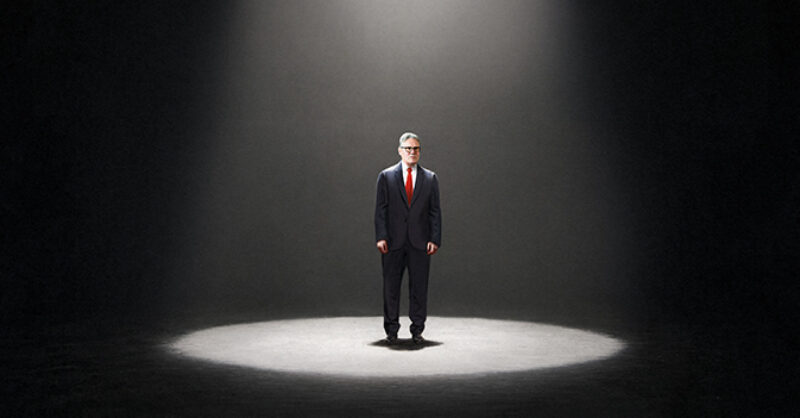

Illustration by Mona Eing and Michael Meissner
“When the herd moves it moves,” Boris Johnson declared with laconic self-justification as he left Downing Street in 2022, having finally, finally, accepted his fate. More often than not, though, it does not move at all, but stays still, docile and dumb, or simply frozen by collective indecision. Watching on from the House of Commons press gallery during those long, painful days of withdrawal from the European Union, I remember being struck by the thought that our politics had entered a state of shock. The authority of government and No 10 had been shattered and British politics had entered a quagmire from which I’m not convinced it has yet managed to pull itself clear.
For much of the past year, UK politics has been stuck in a similar state of fatal passivity. One of the privileges – if that is the right word – of my job is to speak with MPs, cabinet ministers, government officials and political advisers on a regular basis, usually in private, over lunch or dinner or a glass of wine. And when I do so, the same story has been repeated again and again. The Prime Minister is failing. He is not doing the job. He cannot do the job. The country can see this too. And yet, for months, nothing changed, the party as dumb and docile and fatalistic as before. MPs declare the status quo cannot continue, but the herd does not move, and is unsure what to do – how, when or why.
The events of the past fortnight have cast this collective failure in a spotlight so glaring it is impossible to unsee the ugliness that has been revealed. In one sense, nothing new has been exposed. We have long known that the Prime Minister made a poor political judgement in appointing Peter Mandelson as ambassador to the US, a decision for which he has paid a painful political price and repeatedly apologised. But that fateful decision is not the reason his premiership is failing – no more than Johnson’s premiership failed because he decided to defend Christopher Pincher from sexual assault allegations. The reason Starmer’s premiership is failing has been exposed in the very way he has chosen to fight for his survival, revealing a far deeper breakdown in leadership than one lapse of judgement. What we have seen this month is a demonstration of how the Prime Minister practises politics, how he wields power, and how he holds everyone else to account but himself – a form of leadership not particular to one decision, but to one man.
Let us go back to the start of Starmer’s time in office, because that is where this crisis begins. He arrived in No 10 without a plan. That much is clear. On a fundamental level, of course, Starmer did not believe he needed one – not an ideological one, at any rate. Starmer had concluded that the previous 14 years of Conservative rule had failed not because of some ideological failure on behalf of David Cameron or Boris Johnson, but because those who had governed during this period had spent too much time playing selfish political games. The Tories’ failure, in Starmer’s view, was a moral one as much as anything. His government would be different because it was more serious and professional. The partisanship would be taken out of decision-making and, step by step, the country would heal. Yet it is the very lack of politics – the inability to build and manage coalitions in pursuit of some deeper purpose or vision – that has destroyed his premiership, allowing it to rot from the inside.

Subscribe to the New Statesman today and save 75%
What Starmer wanted was a changing of the guard – a return to “grown-up” government. He tasked a grown-up with preparing for government: Sue Gray. Gray did what she was asked: she became chief of staff and started trying to grip the government machine. But to do what? There was no plan, no ideological mission, no politics. Without direction, No 10 descended into factionalism. Morgan McSweeney, sidelined from the power structure imposed by Gray, sought to reimpose political control. Mandelson, operating in the shadows, helped him, while cabinet ministers complained bitterly about their boss and No 10 officials bickered and leaked. In despair, Starmer sought to protect himself and his government by sacking Gray. The pattern was set.
McSweeney was empowered, but – again – to do what? Yes, he had an agenda, a vision for the country, but Starmer was only ever a lukewarm believer. The Prime Minister’s friends were appalled by McSweeneyism and wanted their Keir back. The Labour Party didn’t believe in it, either. McSweeney, isolated in No 10, needed allies. Tony Blair was tapped for inspiration, though he thought Starmer useless, and Mandelson was formally brought back into the fold. The PM, utterly dependent on McSweeney for political direction, and panicked by the prospect of Donald Trump in the White House, listened to his adviser and made Mandelson ambassador.
What is so striking about this choice is the contempt that Mandelson had for Starmer. Starmer was not risking his reputation for some great political ally, as if he was Margaret Thatcher defending Alan Walters at the last. Starmer was taking a political risk for someone he never really knew or particularly liked. He appointed Mandelson ambassador only because McSweeney told him it was worth the risk to send a Machiavel to Washington to charm Emperor Trump.
Now we get to the nub of this crisis. Starmer made this precipitous decision in late 2024. The outgoing cabinet secretary, Simon Case, warned the Prime Minister that if he wanted to make a political appointment of this sort, he should let the civil service know so they could “develop a plan for them to acquire the necessary security clearances… before confirming your choice”. Before. Starmer ignored this advice. Although the Cabinet Office did carry out a due diligence report – uncovering all the evidence Starmer needed to change course – the Prime Minister wanted his man and announced his appointment “without caveats”, as the Foreign Office’s chief civil servant, Olly Robbins, put it to Foreign Affairs Committee MPs with dry calculation on 21 April. Starmer wanted Mandelson in place for Trump’s opening weeks in power. Mandelson was given access to the Foreign Office building and to classified briefings. Robbins told MPs he had to battle No 10 just to run the formal vetting process at all.
When the vetting report was concluded – at speed – Robbins claims he was briefed that it was “borderline” whether Mandelson should be given clearance. The vetters were leaning towards rejecting him, Robbins told MPs, but he was then told by his own departmental officials that the risks identified in the report could be managed. Weighing everything up, including the national interest of having the Prime Minister’s chosen candidate in place for the Trump administration’s first few weeks, Robbins granted the security clearance. “The department rigorously followed the process,” Robbins said, “and we did so, frankly, as I understand it, despite some in government believing it was not a process we ever needed to follow.”
And yet, when it was claimed on 16 April that Mandelson had initially “failed” the vetting process – a characterisation Robbins contested – Starmer said the revelation was inexcusable and sacked him on the spot. There was something of the Geoffrey Howe about Robbins’s cold, contained revenge before the committee.
In summary, the Prime Minister got rid of Robbins for not blocking the appointment of the man he had already announced as ambassador, the man he had blessed by the King and whose appointment had been agreed by the US. And all because Robbins had agreed with the advice of his officials who said the security risks raised about Mandelson in the vetting process were manageable. It is hard to think of a more pathetic series of events.
What are we being asked to believe here? As one official who once worked closely with Starmer put it to me, “We are being asked to believe that, after being told a series of inconvenient truths about Mandelson and waving them away, [Starmer] would have acted differently if he had been told the same inconvenient truths a second time.”
But what makes this sorry saga even sorrier is how utterly familiar it now feels. Robbins was appointed by Starmer and sacked by Starmer for doing something Starmer said he wanted but didn’t, and said he did want it only because someone else told him he should. Before Robbins’s sacking, Starmer had removed the Whitehall mandarin he had appointed cabinet secretary on the grounds that he had not been sufficiently radical at overhauling the way Whitehall mandarins operate. In his place, he appointed another Whitehall mandarin, against the advice of a series of other Whitehall mandarins who thought the right process had not been followed. So it goes on, all the way back to Sue Gray, whom he sacked for not telling him what he should be doing as Prime Minister. On top of all this, Robbins claimed that Starmer also tried to have his friend Matthew Doyle made an ambassador before he became a peer. This is the same Matthew Doyle who was disgraced when it emerged he had continued to support a Labour councillor who had been charged with child sex offences.
Earlier this week, I spoke with a former senior government official who had worked under a series of prime ministers, including Boris Johnson and Keir Starmer. He said he was struck by just how quickly Starmer had taken on the traits of the man he loathed. “The behaviour is just so Boris,” he told me, wearily. “The decency is just a facade. Ask Chris. Ask Sue. Ask Morgan. Ask Olly. He will say he takes responsibility, but then he makes everyone else pay.”
And so we come back to the same fundamentals that have held British politics in stasis for much of the past year. The same cabinet ministers who thought Starmer was not up to the job a year ago still think he is not up to it. The same MPs think the same too. And yet they cannot move because they do not know who to replace him with – how, when or why. The right of the Labour Party is scared about Angela Rayner, the left about Wes Streeting. A majority may well exist for Andy Burnham but the Prime Minister blocked his return to parliament. No one else in government has yet shown the bravery to say what they think in public and to challenge for the leadership on the simple grounds that they would be better than him, and have an idea what they would want to do. Ed Miliband thinks this. Shabana Mahmood thinks this. Streeting thinks this. Burnham thinks this. Yet, by not making a move, by their own logic, they condemn the country to three more years of ineffective government.
But just as Starmer has fallen into the trap of blaming everyone around him for his own mistakes, the Labour Party cannot carry on blaming Starmer for failures of indecision and direction that it also shares. British politics is too entranced by the idea that knife-wielders do not become crown-wearers. They do. Look at Margaret Thatcher.
It is true that, behind the scenes, the political manoeuvring has restarted after a few months of relative quiet. The Tribune group, which brings together the soft-left mainstream of the Parliamentary Labour Party, has become a locus of opposition to Starmer. Burnham, Rayner and Miliband are now, in a sense, allied competitors, the front-runners to replace Starmer should a contest be triggered before or after the May elections. But there are others who will have felt the cold brush of history on their shoulder this week. Who succeeds – if anyone – will depend on the timing of the crisis to come. Should it come sooner rather than later, Burnham understands he may be stranded and the succession will pass over him. But should another opportunity to return to parliament present itself after May – engineered or not – his leadership intentions will no longer be deniable. When Burnham sought the Labour candidacy for the Gorton and Denton by-election, he declared his intention to support the government and be a team player. Still, had he been allowed to run, the challenge to the Prime Minister may well have begun already. But should Burnham stand again, it will be on the basis of a manifesto for change, accepted or rejected by voters. It will be, in effect, the challenge the PM has been seeking to avoid. For now, though, Burnham is forced to watch and wait, hoping no one steals the initiative as Thatcher did in 1975.
But while there is competition for the crown, “there is coordination too”, as one senior Labour figure put it to me. And perhaps there is also the beginnings of a potential understanding. As one leading figure described it, the moment is approaching when deals are made, much as Tony Blair and Gordon Brown settled the transfer of power in 1994. Yet politics does not move in smooth, planned transitions. It is messy, contingent, subject to fortune, favour and those prepared to provoke the herd. It was prodded into life in 1975. And again in 1990. The stampede that dragged Johnson from power reached fatal velocity only when Rishi Sunak resigned. The herd moves, but not on its own.
[Further reading: What Keir Starmer can’t say]
Content from our partners
This article appears in the 22 Apr 2026 issue of the New Statesman, All alone