
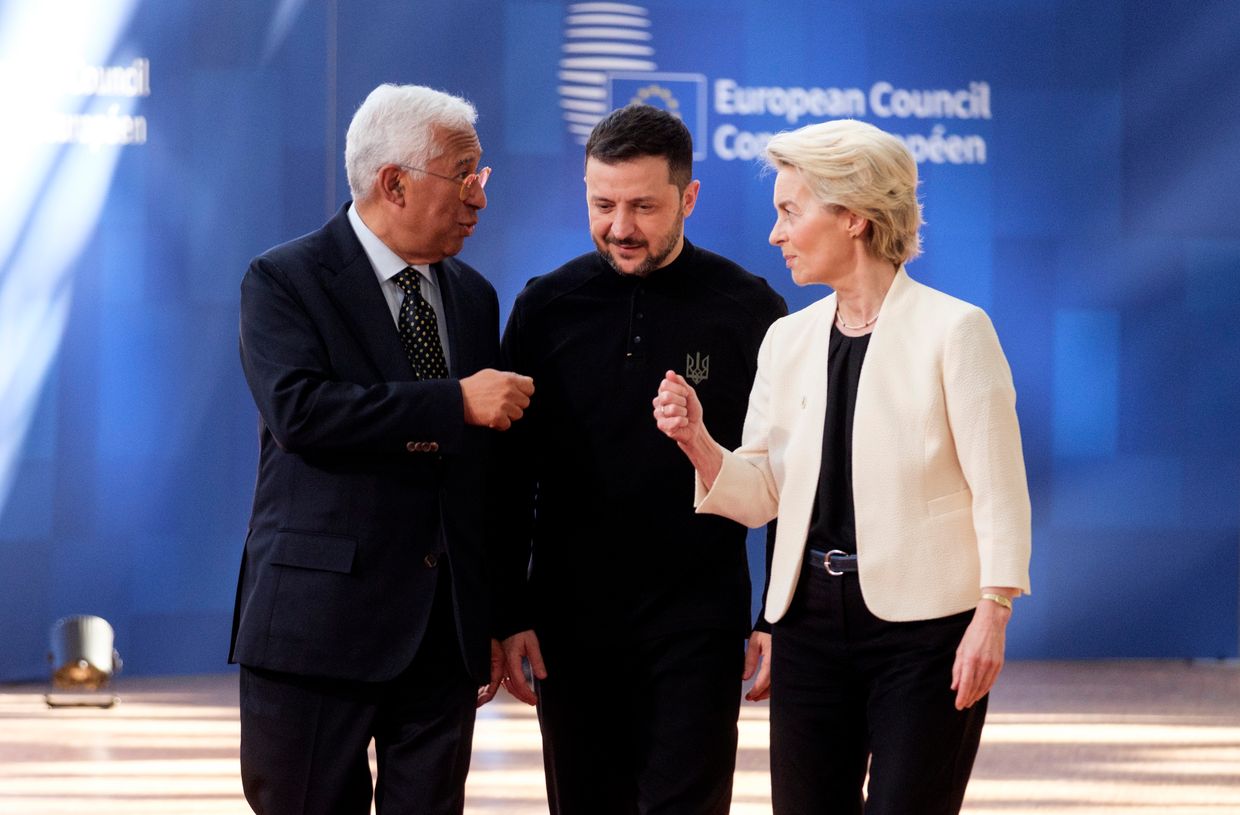
The Council of the EU on April 23 formally adopted the 90-billion-euro ($106-billion) loan for Ukraine and the 20th package of sanctions against Russia, in a major boost for Kyiv.
The EU adopted the final legislation needed for loan disbursement and approved the sanctions package after Hungarian and Slovak envoys dropped their vetoes a day earlier.
The two countries were blocking the sanctions package — with Hungary also maintaining a veto on the loan — over the suspension of oil transit via the Ukrainian section of the Druzhba pipeline.
The pipeline, used to funnel Russian crude to Slovakia and Hungary, went offline in late January after being damaged in a Russian attack. Budapest and Bratislava accused Kyiv of deliberately withholding transit and slow-walking repairs.
Slovakia and Hungary confirmed earlier on April 23 that they had again begun receiving oil via Druzhba, a day after Ukraine reportedly started pumping oil into the pipeline.
The 90-billion-euro loan is a crucial lifeline for cash-strapped Ukraine amid Russia’s invasion, intended to help cover the country’s financial needs in 2026–2027, with two-thirds allocated to defense and the remainder to budgetary support.
“The European support loan for Ukraine has been unblocked — 90 billion euros over two years,” President Volodymyr Zelensky said.
“This package will strengthen our army, make Ukraine more resilient, and enable us to fulfill our social obligations to Ukrainians, as set out in law.”
Ukraine aims to receive the first tranche between May and June, according to Zelensky.
“The funds from the European package will be directed, among other priorities, to arms production, the procurement of necessary weapons from partners that we do not yet produce in Ukraine, and the preparation of our energy sector and critical infrastructure for the next winter.”
Hungary, Slovakia, and Czechia have opted out of contributing to the loan.
The new sanctions package targets Russia’s energy, financial, and trade sectors and includes 120 new listings, the highest number in two years.
The package targets 46 more vessels in Russia’s shadow fleet and mandates due diligence checks for the sale of tankers.
It also bans transactions with the ports of Murmansk and Tuapse, restricts maintenance services for liquefied natural gas (LNG) tankers and icebreakers, and paves the way for a future ban on maritime services for Russian oil.
Further listings target banks and financial institutions involved in sanctions evasion, as well as entities and individuals tied to Russia’s military-industrial complex and the abduction and forced displacement of Ukrainian children.
For the first time, the EU is activating its anti-circumvention tool, banning exports of computer numerical control machines and radios to Kyrgyzstan over re-export risks to Russia.
Other measures include a ban on websites mirroring the content of prohibited media entities or on providing cybersecurity services to Russia.
“Russia’s war economy is under growing strain, while Ukraine is getting a major boost,” said Kaja Kallas, the EU’s chief diplomat.
“We will provide Ukraine what it needs to hold its ground, until (Russian President Vladimir) Putin understands his war leads nowhere.”
Foreign Minister Andrii Sybiha welcomed the decisions, calling them a “significant contribution to strengthening our resilience and the security of Europe as a whole.”
The development marks the end of the months-long standoff between Kyiv, Budapest, and Bratislava over the suspension of Druzhba pipeline transit.
Hungary and Slovakia, regarded as among the most Kremlin-friendly EU members, were the only bloc members still receiving Russian crude via the pipeline’s southern branch before the disruption. The route accounts for roughly 86–92% of Hungary’s oil imports and nearly all of Slovakia’s supply.