
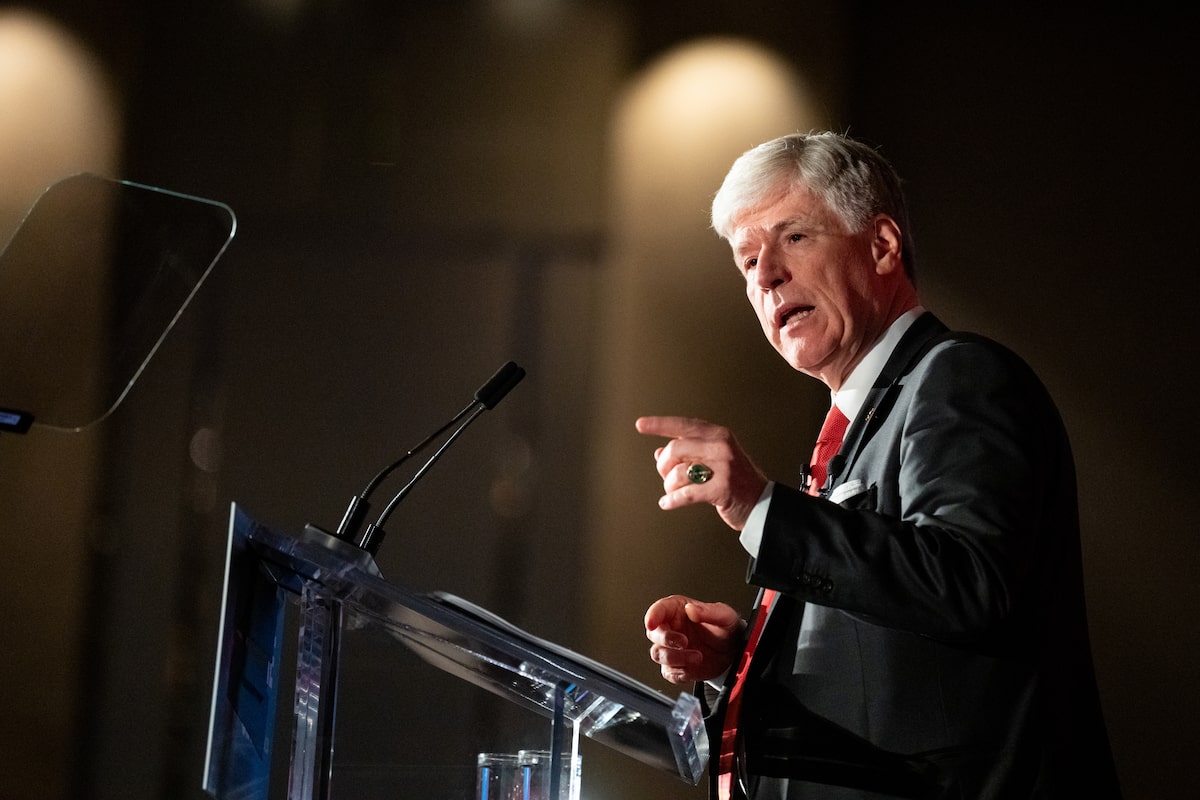
Minister of Energy and Natural Resources Tim Hodgson speaks at the Empire Club of Canada, in Toronto on Friday.Arlyn McAdorey/The Canadian Press
Energy and Natural Resources Minister Tim Hodgson said on Friday that up to 10 new major natural resource projects will be under way by this time next year, as the Liberal government doubles down on its strategy to boost Canada’s economy during the U.S. trade war.
Prime Minister Mark Carney’s Major Projects Office was launched last year with the objective of identifying certain natural resource projects for regulatory fast-tracking, as well as facilitating hundreds of millions of dollars in funding.
So far, 15 projects in mining, electricity, energy and transport have been referred to the office, representing tens of billions of dollars in potential investment.
“We need to keep moving projects from approval to final investment decision (FID), construction, and ultimately, production,” Mr. Hodgson said in a speech in Toronto on Friday at the Empire Club of Canada.
“In spring 2027, you will see projects not just having been added to the Major Projects Office, but at least five to ten new projects having reached FID or broken ground.”
Some of the projects referred to the office, including Canada Nickel Co. Inc.’s Crawford nickel operation in Ontario, and Newmont Corp.’s Red Chris copper mine in B.C., were already far along in the development process.
Final investment decisions in the resource sector are based not only on navigating red tape, but also depend on the economics of the project and nailing down hundreds of millions or even billions of dollars in funding.
The federal government is hoping that moving resource projects along faster will offset some of the pain being generated by U.S. President Donald Trump’s trade war.
Since early last year, Canada’s aluminum, steel, auto and forestry sectors have been dealing with punishing tariffs. The 50-per-cent levy on steel imports into the U.S. has essentially closed off the American market entirely for Canadian manufacturers.
Echoing a well-received speech made by Mr. Carney in Davos, Switzerland, earlier this year, Mr. Hodgson said on Friday that Canada can no longer rely on the U.S. economically, that Canadians can’t be complacent and that self-sufficiency is the way forward.
“For too long, Canadians felt overly secure in the hand we had been dealt: abundant resources, a world order generous to middle powers like Canada, and a social safety net that provided a decent quality of life for most Canadians,” he said.
“It is now clear that the world has changed. Economic integration with our neighbour – once a strength – has been weaponized against us. It is time to stop relying on Neighbourhood Watch, and install our own security systems.”
While there is still work to be done to cut red tape in expediting natural resource projects, Mr. Hodgson said that significant progress had been made. That includes Ottawa working more efficiently with the provinces to streamline environmental assessments. “One Project, One Review” agreements are now in place with many of the provinces, including Alberta, Manitoba, Ontario and New Brunswick.
What are Prime Minister Mark Carney’s four newly announced Northern major projects?
“When I took office, the thought of building big things like we used to again felt nearly impossible. We were mired in slow bureaucracy; duplicative, overcomplicated permitting and regulatory processes; and apathy about the need to build,” Mr. Hodgson said. “We still have a lot to do. But a year into our mandate, it no longer feels impossible.”
As a marker of progress made, Mr. Hodgson in his speech referenced Enbridge Inc.’s decision on Friday to forge ahead with a $4-billion expansion of a natural gas pipeline system in British Columbia.
As the federal government talks up its efforts to turbo-boost the resource industry, Canada faces the spectre of impending negotiations with the U.S. to renew the United States-Mexico-Canada Agreement.
Carney says close ties to U.S. have become ‘weaknesses’ that must be corrected
Mr. Hodgson said key to those negotiations will be leveraging Canada’s strength in energy and natural resources.
“Ultimately, it is about knowing which cards are your best, and playing them effectively. Energy, electricity, forest products, minerals – these are our best cards,” he said.
Mr. Hodgson also called on Friday for a coherent strategy for nuclear energy and electricity, and said that one will be announced and implemented within a year. The current electricity system is disjointed, comprised of 13 “island grids” that better facilitates the trade of electricity between Canada and the U.S., rather than between provinces.
“It is way easier for Ontario to trade electricity with New York or with Michigan than it is to trade with Quebec or Manitoba,” he said in a moderated discussion after his speech. “In the new world that we’re in, that doesn’t make sense.”