
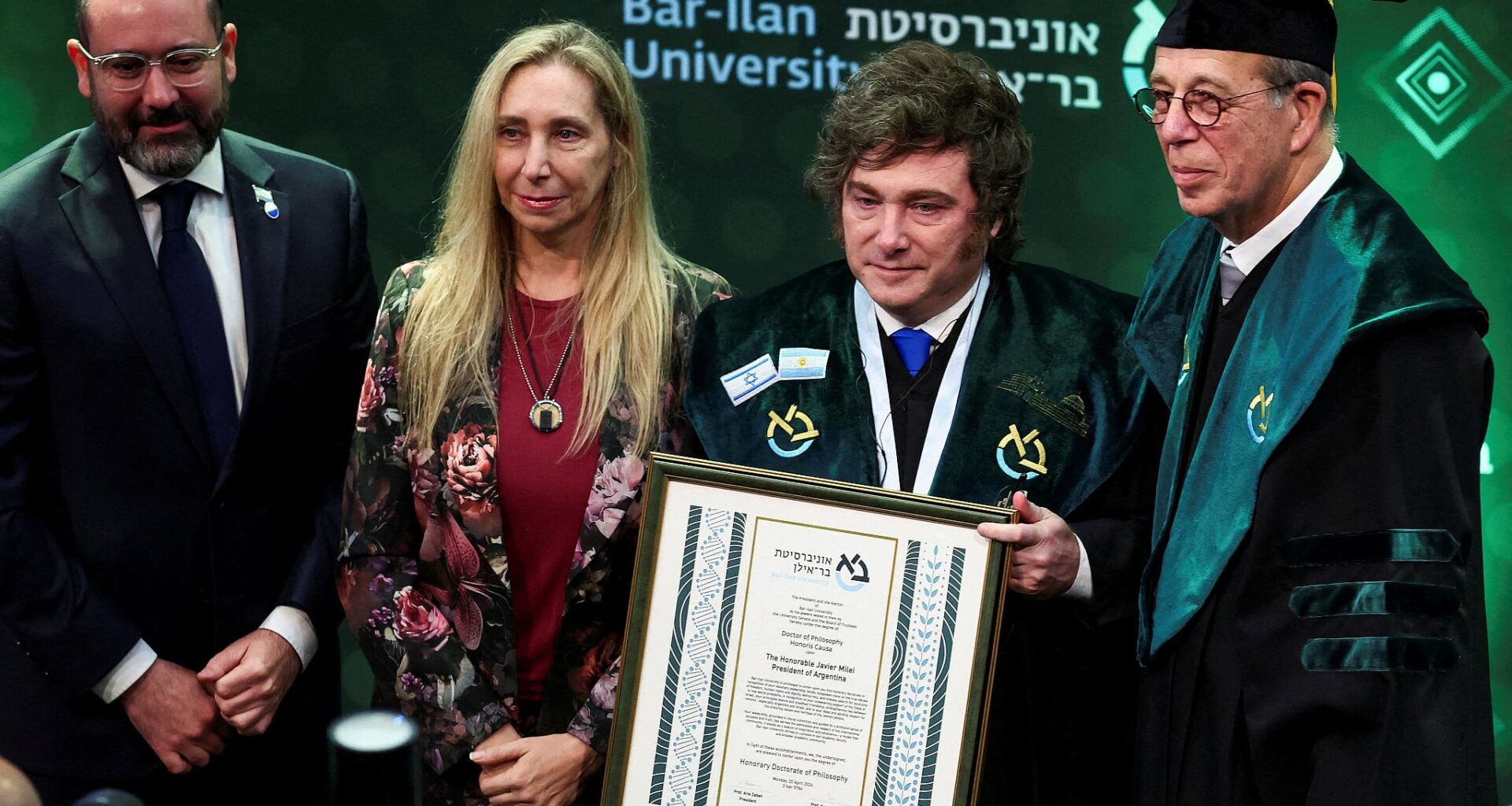
In an era when moral ambiguity too often defines international diplomacy, Argentine President Javier Milei’s recent visit to Israel—and his receipt of both the Presidential Medal of Honor and an honorary doctorate from Bar-Ilan University—stands out as a rare and consequential act of principled leadership. It is not merely a ceremonial milestone. It is a geopolitical signal.
At Bar-Ilan University in Ramat Gan, President Milei was honored for what the institution described as his “longstanding partnership with the State of Israel” and his unwavering stance against antisemitism. Yet the symbolism of the moment extends far beyond academia. In the presence of freed hostages from Argentina’s Jewish community—men and women who endured the horrors of Hamas captivity after October 7, 2023—the ceremony became something deeper: a testament to solidarity rooted in action, not rhetoric.
President Milei’s approach to Israel has been marked by moral clarity. While many global leaders hedge their positions or cloak them in diplomatic ambiguity, Milei has articulated an unambiguous commitment to Israel’s security and sovereignty. His government has actively supported international efforts to secure the release of hostages held in Gaza, elevating their plight on the global stage and refusing to allow their stories to fade into the background of geopolitical maneuvering.
Bar-Ilan University President Prof. Arie Zaban captured the essence of this leadership when he stated that, “in one of the most difficult and painful periods for the Jewish people, President Milei has proven himself a true friend of our country.” These words are not offered lightly. They reflect a recognition that Milei’s policies are grounded in a consistent ethical framework—one that places human dignity, freedom, and historical responsibility at the forefront.
The presence of former hostages and their families at the ceremony underscores the human dimension of Milei’s diplomacy. Names like Iair Horn, David and Sharon Cunio, Luis Har, Clara Marman, and others are not abstractions; they represent lives disrupted and restored. By amplifying their voices and advocating for their freedom, Milei has demonstrated that foreign policy can—and must—be anchored in the defense of human life.
This moment also signals a broader shift in Latin America’s relationship with Israel. Argentina, under Milei, is charting a course that repositions the region within the global conversation on democracy, security, and the fight against terrorism. Historically, Latin America has exhibited a spectrum of positions on Israel, often influenced by domestic politics or external pressures. Milei’s leadership introduces a new paradigm—one defined by alignment with democratic allies and a rejection of antisemitism in all its forms.
The honorary doctorate awarded by Bar-Ilan places Milei among a distinguished group of global leaders, including George H.W. Bush, Shimon Peres, and Margaret Thatcher. Yet the honor is not merely retrospective; it is aspirational. It recognizes not only what Milei has done, but what his leadership represents for the future of international relations.
Critics may argue that such overt alignment carries risks, particularly in a polarized global environment. But history suggests that moments of moral clarity often define the legacy of nations and leaders alike. Milei’s stance is a reminder that neutrality in the face of terror is not neutrality—it is abdication.
Israel, for its part, understands the significance of such alliances. In a world where diplomatic support can be conditional or fleeting, steadfast partners are invaluable. Milei’s visit reinforces the idea that Israel is not isolated; it is supported by leaders who recognize its right to exist, defend itself, and thrive.
Ultimately, Javier Milei’s Israel visit and his recognition by Bar-Ilan University mark more than a diplomatic success. They represent a convergence of values—between a nation that has endured profound tragedy and a leader who refuses to remain silent in its defense. In doing so, Milei has not only strengthened Argentina-Israel relations; he has set a standard for what principled leadership can look like in the 21st century.
In a time of uncertainty, that clarity matters.
The author has written various white papers and articles on the subject of Middle Eastern Studies, and a contributor of geopolitical analysis to several American and European newspapers and journals.