
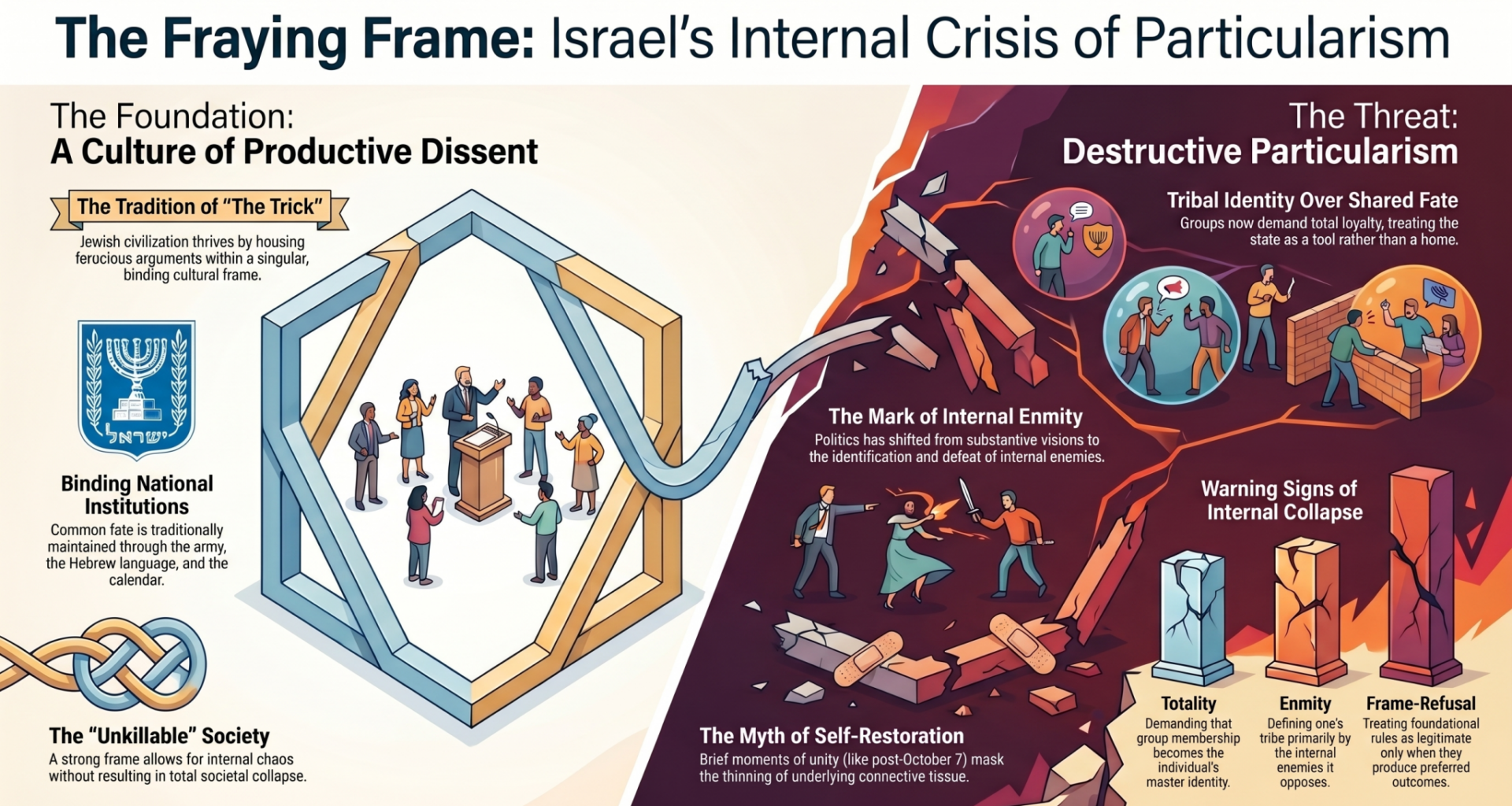
The Frame That Houses Arguments: Israel’s Most Dangerous Enemy May Be Internal
Jewish civilization has a trick, and Israel inherited it. The trick is older than the state, older than Zionism, older than the modern era — old enough to have been refined across the centuries of exile in which a stateless people somehow managed to remain a people while arguing ferociously among themselves about almost everything. The Talmud is the master document of the trick. Hillel and Shammai both survive on the page. The majority rules; the minority is preserved. Elu v’elu divrei Elohim chayim — these and these are the words of the living God. The covenant does not silence dissent; it houses it. A frame strong enough to bind, a dissent culture lively enough to update the frame.
When Zionism built a state, it did so in a largely secular register but on the same architectural pattern. The shared fate of a small embattled country, the binding institutions of army and Hebrew and calendar and existential stakes, formed a frame inside which Israelis could argue with a vehemence that startled outsiders without dissolving the society they were arguing about. This is what made Israel both ungovernable in the conventional sense and unkillable in the deeper sense. The frame held. The arguments raged. The combination produced the most assertive citizenry on earth, the most innovative small economy in modern history, a military whose unit cohesion is the envy of armies many times its size, and a public square so loud that visiting Americans sometimes mistake it for collapse.
It is not collapse. Or it has not been. But something is happening now that should worry everyone who values what the frame has produced, and the warning signs are clear enough that they deserve to be named directly. Israel is showing the symptoms of destructive particularism — the syndrome in which group identity stops being one register among several and becomes a totalizing claim, hostile to the shared frame and corrosive of the very tradition that gave the particularism its substance. The country has resisted this longer than most, for reasons rooted in the genuine unbreakability of its shared fate. But the resistance is weakening, and the trajectory is dangerous, because what destructive particularism takes from a society it does not return.
The Marks of the Syndrome
The mark of totality — the demand that group membership become master identity — is now visible across the Israeli political map. The Haredi tribe, organized around an exemption from the most binding civic institution the country possesses, increasingly defines itself by its separation from the secular and national-religious worlds rather than by the substantive practice of Torah that was once its center. The settler-religious-Zionist tribe, in its more radical wing, has come to demand of its members an alignment that subordinates older religious-Zionist values — service to the state as a whole, respect for democratic institutions, civility toward fellow Jews who disagree — to a particularist project that increasingly speaks of the state as a tool rather than as a shared frame. The secular-liberal tribe, especially in its Tel Aviv elite expressions, increasingly treats traditional and religious Israelis as embarrassments rather than as fellow citizens whose differing convictions are part of the frame’s legitimate diversity. Each tribe has begun to demand that its members order all other loyalties beneath it. The cross-cutting Israeli — religious and liberal, settler and pluralist, Haredi and patriot, Mizrahi traditional and culturally Western — has become a more lonely figure than he was a generation ago.
The mark of enmity as constitutive is even more visible. Watch how recent Israeli electoral coalitions have organized themselves: not around substantive visions for what Israel should be, but around the identification and defeat of internal enemies. The “anyone but Bibi” camp organized for years around a single negation, and Likud’s “anyone but the leftists” mobilized symmetrically, and the smaller parties on each flank fed on the resulting heat. The substantive questions — what kind of economy, what kind of religious-state arrangement, what kind of relationship with the Palestinians, what kind of integration with the diaspora — receded into the background while the question of which tribe of Jews would dominate which other tribe of Jews became the operating content of politics. A particularism that knows itself by its internal enemies has begun to displace particularisms that know themselves by what they are for.
The mark of internal homogenization is the consolidation that has hollowed out previously diverse coalitions. Religious Zionism in its founding form held a remarkable range — from Rav Kook’s universalist mysticism through Bnei Akiva’s labor-pioneer ethos to the moderate Mizrachi tradition of integration with the wider state — and it has been progressively narrowed by its more militant wings to a single dominant register. The Labor movement that built the country, with its kibbutz pluralism and its broad-tent secular Zionism, has shrunk into demographic irrelevance not because its concerns disappeared but because the broader integrative space it once occupied was claimed by no one. Likud under Begin held a coalition that included libertarians, traditionalists, security hawks, and Mizrahi populists in genuine tension; today’s Likud has been narrowed by loyalty tests around its leader. Each consolidation looks, from inside, like clarification or purification. Each is, from outside, the loss of a heterogeneity that used to be the substance of the political life.
The mark of refusing the shared frame is the gravest of the five, and the one that the events of recent years have made impossible to ignore. The judicial-reform crisis of 2023 was not, at root, a debate about courts. It was a contest over whether one tribe could change the foundational rules of the shared frame in ways the other tribes regarded as illegitimate. Both sides drifted toward frame-refusal in their own register. On one side, the willingness to override basic protections of minority and democratic norms in pursuit of a particularist project; on the other, the willingness of elite reservists to threaten — and in some cases enact — refusal of military service, which is the most binding institution the country possesses and the one whose universality is the closest thing Israel has to a sacred frame. Both moves were, in their way, declarations that the frame is legitimate only when it produces the speaker’s preferred outcomes, and the country went into October 6, 2023 in a state of fracture that no enemy could have engineered better than Israelis had engineered it themselves.
October 7 then did what existential crises do in a society whose frame still has any binding power: it briefly restored the frame. The reservists who had threatened refusal showed up. The tribes that had been at each other’s throats found each other in the rubble. The country mobilized as one for a period that surprised everyone, including itself.
But — and this is the warning that needs to be heard — the unity has not held. What has emerged in its place is more dangerous than the pre-October 7 fragmentation, because each tribe has now learned that the frame can be temporarily restored without permanent reckoning, which subtly licenses each tribe to play harder to its own particularism in normal times, trusting that the next crisis will paper over whatever damage has accumulated. This is the wrong lesson, and it is being absorbed in real time. The frame is not self-restoring on demand. Each cycle of fragmentation-and-restoration leaves the underlying connective tissue thinner than before. There is a finite number of restorations available before a crisis arrives that exceeds the frame’s capacity to come back.
The mark of language inversion — destructive particularism speaking in the vocabulary of freedom while delivering its opposite — is visible across the spectrum in Israeli rhetoric. Each tribe presents itself as the defender of “real Israel” or “true democracy” or “authentic Judaism” or “the silent majority,” and each, on inspection, is enforcing a narrower acceptable opinion among its own members than the older, broader Zionist coalitions did. The freedom each side promises against the other is real; the constraint each demands of its own is rarely acknowledged.
What This Costs Israel Specifically
The damages destructive particularism produces are visible across all four dimensions identified by the framework, and Israel is paying in each.
The common life is becoming ungovernable in the conventional sense. Five elections in three years was not a quirk; it was the operational signature of a society whose tribes have stopped being able to share a coalition long enough to govern. The Knesset has spent more energy on the fight over which tribe wins than on the substantive challenges — economic, demographic, security, religious-state — whose neglect compounds with each year of paralysis.
The individual life of Israelis is narrowing in ways that the older heterogeneous public square would have prevented. The thoughtful religious Zionist who is dovish, the secular liberal who attends shul, the Mizrahi traditional who votes left, the settler who speaks fluent Arabic and has Palestinian friends, the Haredi who serves in the army — these figures still exist, but they pay tribal prices that were not extracted a generation ago, and the accumulating cost is producing a citizenry sorted more cleanly into tribes than the older Israel ever was.
The substantive content of the particularisms themselves is being hollowed by their own consolidation. Religious Zionism contained a beautiful integrative vision — Torah u’Madda, the redemption of the people through their full participation in modern life — that the more militant wings have largely abandoned in favor of a politics of land and tribal contest. Labor Zionism contained a substantive ethic of equality and shared sacrifice that its current heirs articulate only feebly. Likud contained Begin’s deep Jewish humanism, his concern for the dignity of the marginalized, his constitutionalist instincts; this content survives in a few elders and is largely absent from the movement’s daily operations. The form of each tribe persists; the substance has been quietly traded for operational alignment.
The possibility of welcome — for olim, for Arab citizens, for diaspora Jews — is fraying in ways that should alarm anyone who cares about the long-term project. Aliyah from the West has slowed in part because the Israel newcomers are being asked to join is no longer the heterogeneous commonwealth that made the older bargain attractive; it is a menu of tribes, each demanding alignment, and the diaspora Jew who arrived expecting full civic membership in a complicated but unified society finds instead that he must choose a side. Israeli Arab citizens, twenty percent of the population, are partially inside the frame and partially excluded from it, and the destructive particularist trajectory makes their position more precarious rather than less. Diaspora-Israel relations are at their lowest point in living memory, in part because the destructive particularisms now ascendant in Israeli public life have made the older bargain — Jewishness as the connective tissue across the great divide — increasingly difficult to sustain.
The Tradition’s Own Cure
What protects Israel — what has protected it longer than equivalent diseases have eaten through other societies — is that the shared fate is genuinely non-negotiable. The rocket does not consult your politics. The army still takes most Jewish Israelis. The language still binds. The calendar still organizes time. These are not voluntary frames in the way American civic institutions were voluntary, and that involuntariness has been the country’s protection against the full destructive particularist trajectory.
But the protection is not infinite, and the trajectory is going the wrong way. Each year that passes, the binding institutions are weakened by exemptions, refusals, and the simple erosion of the disposition that made them work. The Haredi non-service question is not just a fairness issue; it is a frame-integrity issue, and every year it remains unresolved is a year the most binding institution Israel possesses is hollowed by a known asterisk. The reservist refusal threats from the secular elite are the mirror image of the same hollowing. Each side, in its way, is teaching the country that the frame is conditional.
The tradition the country inherits has a precise teaching about this, and it is worth recovering. The Talmudic frame was not built by silencing the disputants; it was built by housing them. The rabbis understood that a covenant which expelled its dissenters would not survive, and a dissent which had no covenant would not survive either, and the trick of the tradition was to build something that could hold both at once. The secular Zionist founders, most of whom had left religious life behind, intuited this and built the state on a structurally similar pattern. The argument is the substance; the frame is the maintenance protocol; neither can do without the other.
The work that Israel needs is not the work of choosing which tribe will dominate. That work is what destructive particularism keeps proposing, and it is the work that, if any tribe were to win it, would destroy what the winners thought they were fighting for. The work Israel needs is the patient cultivation of the frame in normal times — the willingness of each tribe to share institutions with the others, to accept the legitimacy of fellow citizens whose convictions one finds repugnant, to hold argument and membership in the same hand. This is the most Jewish thing a Jewish state can do, and it is the work most clearly resisted by the destructive particularisms now contending for the country.
The frame that houses arguments is the inheritance. Forgetting how to maintain it is the danger. October 7 reminded the country, briefly, that the frame still has binding power. The question now is whether the lesson taken from that reminder will be the cynical one — that crisis will paper over fragmentation indefinitely — or the sober one, which is that no people, however blessed in its tradition and however hardened by its enemies, can take its frame for granted. The frame is built, maintained, and renewed by choice, in every generation, or it is not maintained at all. The civilization that gave the world the model is the civilization most capable of remembering it. Whether Israel will is the open question, and a great deal — for Israelis, for the diaspora, for the longer Jewish project — depends on the answer.