

Fredericton landscape painter Bruce Newman used to be a frequent visitor to the United States. Up to a dozen times a year, he’d travel to the country to vacation with his wife, meet up with fellow artists or capture picturesque landscapes on canvas.
But those visits abruptly ended early last year, when U.S. President Donald Trump started a trade war with Canada and suggested the country should become the 51st state.
Newman says recent events in Minnesota, where U.S. Immigration and Customs Enforcement (ICE) officers clashed with protesters, further reinforced his resolve.
“It’s just a scary place that the U.S. is becoming right now,” he said. “I just don’t agree with any of it. And I don’t want to spend money there to support that type of thing.”
Many Canadians who share Newman’s sentiments are also boycotting U.S. travel. Collectively, they’ve left their mark. Year-over-year return trips by Canadians to the country via air and land dropped by 25 per cent in 2025.
The trend continues
March marked the 14th consecutive month of steep declines, with Canadian return trips to the U.S. plummeting 32 per cent compared to pre-boycott March 2024.
“Clearly, the issue has not waned,” said Amir Eylon, president of travel research consultancy, Longwoods International.
“There are those that may have thought Canadian travellers will ‘Get over it.’ [That] hasn’t happened,” he said.
Much is at stake. The decline in Canadian travellers helped drive a $8.5-billion (4.6 per cent) drop in international tourism spending in the U.S. last year, according to the World Travel and Tourism Council.
WATCH | Is the U.S. starving for Canadian travellers?: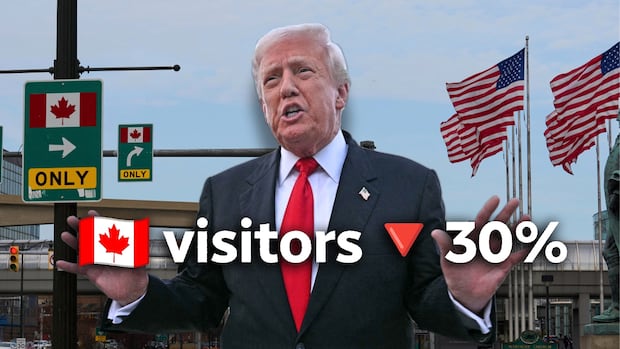
Is the U.S. starving for Canadian travellers? | About That
Canadian travel to the United States has dropped since President Donald Trump retook office earlier this year. Andrew Chang breaks down the numbers to explain the impact on the U.S. economy. Plus, why Trump ‘terminated’ Canada-U.S. trade talks.
A number of Canadians are seeking out new travel destinations. If the boycott drags on, their shifting travel patterns could become permanent.
“Canadians aren’t travelling less overall. We’re seeing more travel to domestic and other international destinations,” said RBC economist Abbey Xu.
“The story here is really a rebalancing” of where Canadians are spending their vacation dollars, she said.
Canadians find new destinations
While year-over year Canadian travel to the U.S. declined by double digits in 2025, overseas trips rose by nine per cent.
Newman, in Fredericton, reflects that travel trend.
Ten years ago, he took his wife to New York City to see a Broadway show for her 65th birthday. He wanted to do something similar for her 75th birthday this March. But instead of Broadway, the couple flew to London to see two musicals — a trip that cost thousands of dollars more.
“It was definitely worth it,” said Newman. He’s now considering a trip to Scotland, plus one to Gaspé, Que., to paint landscapes.
“I miss the freedom of going to the United States to paint. But there’s plenty to paint here,” he said.
 Because Newman is boycotting U.S. travel, the painter is focusing on Canadian landscapes. His latest project is a waterfall just outside Fredericton. (Tara King-Stewart/CBC)
The U.S. travel boycott has also provided a boost for domestic tourism, which rose by 2.5 per cent in 2025.
Canadians may further embrace domestic travel if the U.S.-Israel and Iran war continues to drive up jet fuel prices. Many airlines have already added fuel surcharges to airfares to make up for the added cost.
“Higher fuel costs will likely change how Canadians travel rather than stopping them from traveling altogether,” said Xu.
“We may see fewer longer-distance trips and more local travel.”
Las Vegas takes a gamble
The decline in Canadian tourists has dealt a blow to U.S. vacation hotspots, like Las Vegas, which have long relied on their business.
According to the city’s tourism board, more than 1.4 million Canadians visited the city in 2024. Last year, that number dropped by 18 per cent.
Despite many Canadians’ resolve not to cross the border, the entertainment and gambling mecca is betting it can change some minds.
 Las Vegas casino owner Derek Stevens is taking a gamble by offering Canadians at-par deals to entice them to return to the city. He says the deals have already led to a spike in Canadian visitors. (Joe Fiorino/CBC)
Las Vegas tourism industry officials are currently travelling across Canada, meeting with travel agents, airlines and tour operators to spread the word that the city is rolling out the welcome mat.
“Clearly, we’ve missed our Canadian friends,” said Las Vegas casino owner Derek Stevens, who’s taking part in the sales mission.
“We want you to come back,” he said.
As an incentive, Stevens is offering Canadians at-par pricing (where a Canadian dollar is equal to the U.S. greenback) on accommodation and selected bars and gambling at his three resorts.
He said the deals have already led to a spike in Canadian visitors.
“It’s pretty clear that for some Canadians, it’s a very welcome offer.”
But for others, like Newman, it will take more than a discount and a warm welcome to get them to cross the border.
“Things have to change in the States,” said Newman. “Definitely while Trump’s in office, we’re not interested in going to the States at all.”