
In recent decades, many committed leaders built and advanced the field of Israel education in tremendously positive ways. Today, there are myriad high-quality educational experiences for learners and professional development opportunities for educators.
At the same time, the speed of generational change, including technological and social disruption, outpaced our planning and policy work. Today’s learners, and many of their educators, bring new perspectives and expectations that demand an evolution of Israel education. Amid heightened tensions and divisions in the American Jewish community, rising antisemitism and an extended period of war, the question is how we move forward educating young North American Jews about Israel and supporting the educators who do this vital work.
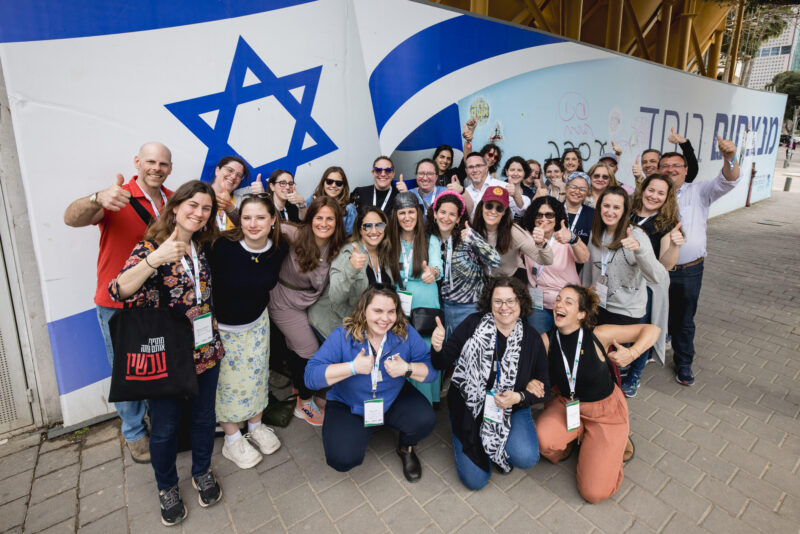
Courtesy/The Jewish Education Project.
Educators on a professional development tour in Israel, March 2024.
Over the past 18 months, at the request of the Jim Joseph Foundation and Charles and Lynn Schusterman Family Philanthropies, The Jewish Education Project coordinated research and dozens of in-person and online meetings across the U.S. and in Israel seeking answers to these questions. We engaged more than 400 stakeholders, collecting grassroots input and working with leading practitioners, to reimagine Israel education for a new era. In particular, two advisory committees, comprised of 25 experts and organizational leaders representing day schools, camps, college campuses, academic institutions and other entities, were critical in amplifying current effective practices and thinking together about how to make them even more relevant and resonant. We had leading educators in the field conduct comprehensive literature and curriculum reviews, and nine practitioners served as fellows to develop new, research-based theories of Israel education.
The result of these efforts is Reimagining Israel Education, which provides the field of Jewish education with data-driven conclusions about challenges and opportunities, recommendations for change and a strategic framework for growth and impact. New educational principles rooted in this framework will cultivate in learners a powerful, resilient and enduring connection to Israel.
From our research and meetings, we know that many talented educators want to deliver excellent, meaningful Israel education. We need to fully leverage this existing talent and the many assets in the field today. Too often, educators say they feel confused, overwhelmed and anxious. To be clear, this is not their failing; it is ours. Educators bear the brunt of a field that lacks unified goals, strategies and resources and is filled with competing messages. They are afraid of making mistakes and of angering stakeholders.
While we cannot capture here all that Reimagining encompasses, there are a few key points that we want to elevate with leaders, educators, funders, researchers and others:
First, Israel education should have a clear and connected strategy from the very first time a learner encounters an educator. That’s why the framework will foster learners’ deep, critical and resilient connections to Israel throughout their lifetimes.
When a 5-year-old learns about Israel, that is the starting point for a coherent Israel educational journey that progresses as they age. A Hillel educator should know what a college student has already experienced and learned about at a camp or day school, in a teen youth group or on an organized Israel trip. Educational standards within the framework — what students experience, conversations they have and content they engage with — will start early and continue throughout the child’s life with a full and intentional arc of learning. Educators in different settings will offer learning experiences that share a common language and that build on each other.
Second, following in the footsteps of The iCenter, we believe that good Israel education is good Jewish education, and good Jewish education is good education. This means pedagogy that treats children and teens with respect, presenting different narratives and viewpoints about the country and its many diverse peoples. We must trust learners with this complexity. They need space to hold multiple truths and to understand there can be multiple “right answers.” Good Israel education welcomes curiosity and critique and creates space for respectful disagreement.
Specifically, education does not exist to clone younger generations into mirror images of their elders. Education should support learners to wrestle, wonder, question and build. It prepares learners to advance content for the world they will inherit — a world that is fundamentally different from our world today.
Third, the best Israel education engages the whole human being: head (cognitive, knowing), heart (affective, feeling) and hands (behavioral, doing). If we miss any of these, Israel education as a project collapses. Learners must have ample opportunity as they grow up to deepen, shift, iterate and mature their relationships with Israel. At different ages, in different ways, they can explore material using their heads through questions, study and conversation, and then experience it through song, art or prayer. Being in Israel and being with Israelis, learning firsthand and through experience, matters to ongoing engagement and ultimate ownership. Learners are rarely a blank slate. They arrive with identities, values, social media feeds, moral instincts and lived experiences. We don’t want educators to try to erase those; we want educators to engage them honestly and responsibly.
And fourth, Israel’s 3,000 years of history cannot be an “add-on” to Jewish education. If Israel is integral to Jewish life, it must be integrated throughout Jewish educational experiences. And integrating Israel throughout Jewish education demands — appropriately — that we teach our full history, Israel throughout 3,000 years. This includes reclaiming the variety of Zionisms in all their diversity, not as a slogan or a shibboleth, but as the national aspiration of the Jewish people, alive, evolving and deeply human. When we teach only about the modern state, we fail our mission. When learners understand Israel in its full past and future potential, they understand their tradition and themselves more fully. “Israel” is already woven into our tradition, in our prayer language, our sacred texts, our cultural artifacts and more. Exploration of Israel should and can be elevated in all of those experiences.
It’s clear to us that educators want this evolution, that learners will benefit from it and that our community will become stronger as a result (join a webinar to learn more about Reimagining on May 19 or June 3). We are enthusiastic about the early momentum to ensure that this framework catalyzes more professional development opportunities and educational resources for Jewish educators.
Implementing a field-wide strategy and support systems is the only way to advance Israel education so it resonates with and is meaningful to today’s learners. We are grateful to everyone who helped make this project possible and brought us to this point. Let’s reimagine and write this critical next chapter together.
David Bryfman is the CEO of The Jewish Education Project.
Rabbi Dena Klein is the chief Jewish education officer of The Jewish Education Project.
Beth Cousens, principal of Beth Cousens Consulting, served as the lead consultant on the initiative.