
For the first time in decades, representatives of both the Republic of Lebanon and the State of Israel are engaged in bilateral talks, held in Washington DC, and mediated by top officials from the current US Administration. The mere presence of Lebanese Ambassador Nada Hamadeh Moawad, alongside her Israeli counterpart Yechiel Leiter in the Oval Office, engaging in direct dialogue under the auspices of President Trump himself, as well as Vice President Vance and Secretary Rubio, is a cause for great relief.
The Lebanese political leadership is finally betting on diplomacy with Israel, which effectively means stripping Hezbollah off of its ability to avoid, obstruct, or nullify a political solution favorable to the Lebanese state and its sovereignty, as the country deals with the devastating aftermath of an umpteenth military confrontation initiated by the terror group against Lebanon’s southern neighbor.
Amidst the ground battles, targeted airstrikes, and missile launches, a diplomatic rapprochement between the two nations seemed further than ever. Nevertheless, Lebanon’s history of diplomacy with the Jewish state proves very timely today, as both nations prepare to embark on a long journey towards peace.
The signing of the 1949 Armistice between Lebanon and Israel, technically still in effect to this day, secured at least two decades of relative calm alongside the border separating the two young countries. Although there were no mutual recognition between both states, the Lebanese Armed Forces and Israel Defense Forces maintained order and security on each side of the border, just as neighboring Arab countries were engaged in constant warfare and military offensives against the Jewish state.
The incursion of the PLO into Lebanon, legitimized by the 1969 Cairo Agreement, perturbed the tranquility along Israel’s northern border, and ignited hostilities that culminated towards the 1978 invasion of South Lebanon. The region, transformed into a platform for Palestinian ‘armed struggle’, fell victim to a Lebanese political establishment’s disposition to willingly surrender sovereignty over its lands, in favor of a ‘Palestinian cause’ which was weaponized by Egyptian President Nasser and harnessed by local factions loyal to foreign agendas.
Hezbollah’s modus operandi during the past couple of decades has been no different. As a foreign implant on Lebanese soil, it acts and behaves in perfect compliance and obedience to the organization which birthed, bred, and nurtured it all these years: the Iranian Revolutionary Guard Corps. In the early 1980’s Iranian officers founded and developed the nascent Islamic Republic’s branch in Lebanon, slowly taking the Shia sect hostage, and eventually turning the entire Lebanese nation into a subsidiary to Tehran’s own Wali el-Faqih.
During summer 2006, then again on the 8th of October 2023 and 1st of March 2026, Hezbollah has been setting the Lebanese southern front ablaze, initiating offensives against Israel and dragging the country into devastating military confrontations that have led to nothing but bloodshed and displacement for its Shia community, death and damage upon many Lebanese regions, all the while keeping the whole country in a general economic slump and political gridlock that has rendered any punitive action against the terror group unachievable, for fear of being labeled ‘traitors’ or instigators of ‘civil strife’.
Despite all odds, Lebanon’s current President, former Army Commander Joseph Aoun, has vowed to pursue a diplomatic solution with the Israelis, facilitated by the United States, one that eventually would lead towards lasting peace between the two nations. “I am ready to go anywhere necessary to liberate my land, protect my people and save my country”, he claimed in a televised speech he made last week, echoing Anwar Sadat’s similar, bold message to Egyptian parliamentarians before his historic trip to Jerusalem to address the Knesset.
Lebanon’s leadership knows full well that disarming Hezbollah and asserting the state’s sovereignty over the entirety of the national territory is a crucial and fundamental move that precedes any permanent agreement with Israel. They have taken all the right decisions so far, and made all the needed statements in that direction; what remains is the effective and material dismantling of Hezbollah’s illicit guerrilla arsenal by the LAF. The choice has already been made by the Nawaf Salam cabinet, backed by the President, and supported by the US and Lebanon’s Arab allies.
Israel remains reluctant to move forward on the discussions with Lebanon without its government having full control of its land, and rightfully so: it would not, and should not, venture into a bilateral effort with Lebanon, no matter the American guarantees, if Hezbollah still maintains its grip, both physical and psychological, on the Lebanese leaders. But Israel wants peace with Lebanon, and the Lebanese overwhelmingly support ending the state of war with Israel, with the recent deathly quagmires convincing more citizens of the necessity of taking such an unprecedented step.
Today, and as a result of the most recent war, the IDF has imposed a reinforced security “buffer zone” reaching no less than 10 kilometers into Lebanese territory. The heavily monitored area aims to prevent attacks on communities in northern Israel, while dismantling Hezbollah infrastructure and military sites. The occupied zone currently serves a dual purpose: first, it is a temporary military solution to the direct threats posed by the terror group on the Lebanese front. Second, it is Israel’s concrete political leverage entering the negotiations with its Lebanese counterpart, which is insisting on a complete withdrawal as a precondition to any talks.
Israel should not repeat the mistakes of the past. Its unilateral withdrawal in 2000, enacted by then-Prime Minister Ehud Barak, proved consequential in turning the Lebanese South into Hezbollah-controlled territory, particularly under the supervision of Assadist Syria and the command of the IRGC from Tehran. The Lebanese political leadership at the time, from former President Lahoud to the majority of representatives in Parliament, were completely in sync with Hezbollah’s stated military mission and facilitated its political project and eventual overhaul of the country.
This time around, Israel should only hand back the occupied zone to a sovereign Lebanese state, one that would be determined to neutralize Hezbollah and face the hostile group’s detrimental existential threat it poses on the country. Israel and Lebanon should thus cooperate on this matter, finally having the courage to address the issue head-on, putting an end to more death and destruction, privileging diplomacy and partnership. Both countries share a common enemy, and would best collaborate by finding ways to eliminating this stumbling block which still hinders the path towards peace between the two nations.
Only then can the two neighbors establish diplomatic relations that clearly define a roadmap towards lasting peace between them. As they were outlined as part of the May 17 1983 Agreement, ‘good faith’ measures could include the decriminalization of communication between citizens of both countries, ensuring the free movement of peoples on both sides of the border and on vital spots such as Ras al-Naqoura/Rosh HaNikra and Mount Hermon, but also securing the fundamental right of Lebanese nationals of both Christian and Muslim faiths to visit their historic pilgrimage sites in Jerusalem, as well as allowing members of the Druze community to reunite with their brothers in faith in visiting the shrine of Nabi Shu’ayb in the Galilee.
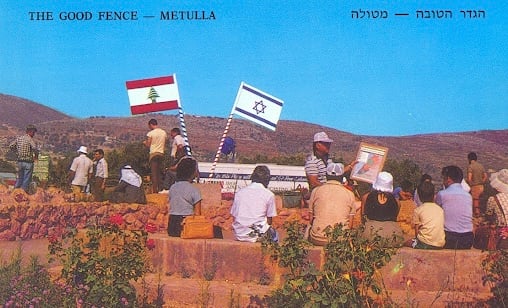
In the late 1970’s, late Israeli Defense Minister Shimon Peres elaborated the “Good Fence” policy, which established a number of gates alongside the Israel-Lebanon border, facilitating the movement and meeting of people from both sides, and allowing Lebanese citizens to cross over the border in order to receive medical care, essential supplies, and other services from the Israeli side, at absolutely no cost. This humanitarian plan proved highly successful, as it showed Israeli hospitality to a population which suffered under Lebanese official negligence, as well as Palestinian terrorism and land grabs.
Peres and PM Yitzhak Rabin, who led Israel at the time, knew all too well that a mighty military defensive strategy in the North cannot be devoid of a humanitarian model component, which served as an act of good faith to a skeptical Lebanese population that had been spoonfed antizionist propaganda for decades.
The 1,000-mile road towards peace between nations starts with small, incremental steps that bring two hostile peoples closer by the day. The destinies of the Lebanese and Israelis have never been more tightly connected: joined by grief, united by core values, they have long been divided by regional considerations and political ideologies, most recently with the death-grip imposed by Hezbollah on the Lebanese nation.
A Lebanon free from Hezbollah’s fanaticism and terrorist enterprise can only accept Israel’s extended hand if it expresses a good faith desire of building a common, peaceful future together. Undetermined, neverending occupations are no remedies to the military situation in South Lebanon, and the Lebanese state must urgently prove itself capable of handling the governance of a region kept under militia rule for far too long.
The “Good Fence” precedent can serve as a political model, a lasting solution for a conflict nearing its 80-year anniversary. Israel and Lebanon still stand out as exceptions in the modern history of nations on Earth, as two neighborly peoples which have yet struggled to come to terms with their difficult past, and charting a common way forward. As the Lebanese saying goes, “the neighbor [must come] before the home”: in order to reclaim their home, the Lebanese must finally encounter their neighbors, before the golden opportunity for peace slips away.