
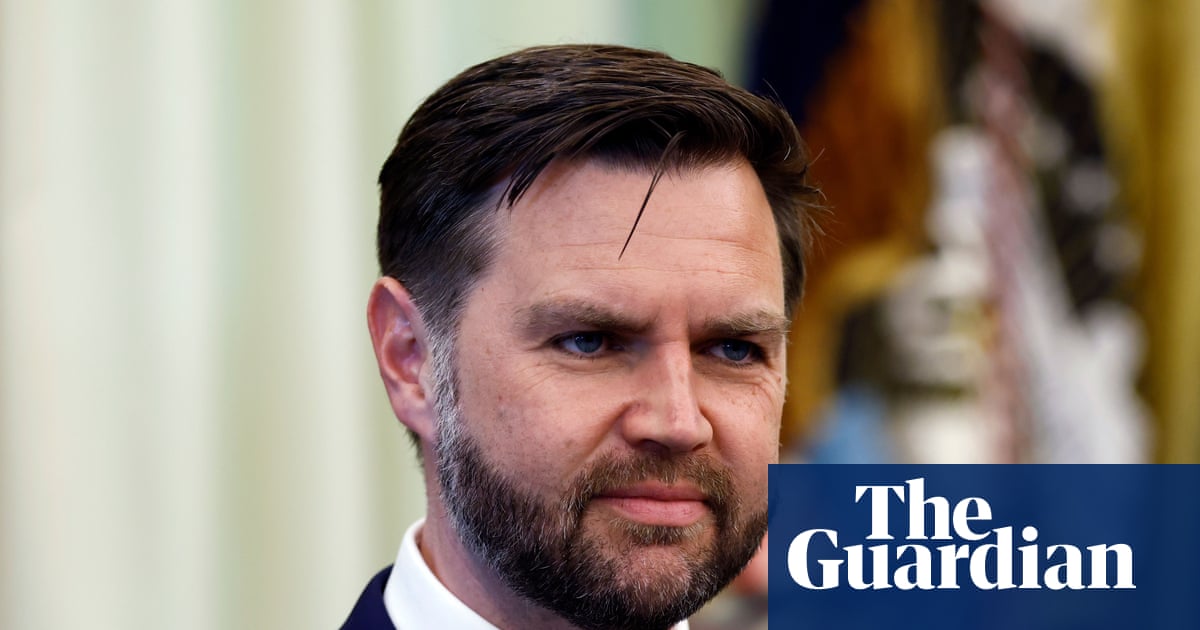
As a man who wears his Christian beliefs on his sleeve, JD Vance is no doubt acutely conscious of Jesus Christ’s dictum from his sermon on the mount declaring that “blessed are the peacemakers”.
Yet the US vice-president, a Catholic convert who recently found himself at odds with Pope Leo, is discovering the difficulties of living up to that standard while serving a mercurial political master who is waging a war Vance once cautioned against.
“Jesus Christ does not support genocide,” a heckler shouted as Vance spoke during a meeting of the rightwing Turning Point USA group at the University of Georgia this month.
The episode illustrated the predicament facing the vice-president as he seeks to keep younger voters opposed to overseas military adventures on board while eyeing up a run for the presidency in 2028.
The challenge is only getting tougher for Vance as he assumes the potential role of point man in an endeavor to bring an early end to the war with Iran that he previously warned for years that the US should avoid.
With hostilities suspended yet nascent peace talks at an impasse, the vice-president’s role may become pivotal after Iranian regime insiders identified him as the person in the Trump administration they needed to reach to conclude a negotiated settlement.
Last week, Vance – a sworn opponent of “forever wars” – had been about to embark on his second diplomatic mission to Islamabad to face off against Iranian negotiators.
The trip was scheduled to take place on Monday, then Tuesday, before being called off altogether. It would have followed the previous week’s 21-hour session in the Pakistani capital with the Islamic regime’s top level negotiating team, which reportedly made significant progress before before the Iranian side baulked and re-closed the strait of Hormuz – apparently offended by Trump’s declaration of victory in a series of triumphalist social media posts.
Amid fears that fighting was about to resume after a two-week pause in hostilities, Trump instead surprised almost everyone by declaring an indefinite ceasefire extension, saying that he was giving Tehran’s “seriously fractured” leadership time to come up with a “unified proposal”.
Vance’s centrality to what lies ahead appeared to be further underlined at the weekend after the White House announced that a renewed round of talks would go ahead without him. Trump’s personal envoy Steve Witkoff, and his son-in-law, Jared Kushner, were to be dispatched instead to meet a less high-powered Iranian team than the broad-based delegation that attended the previous week’s session. That trip, too, was subsequently cancelled, with Trump dubbing it a “waste of time”.
Thus Vance’s re-entry to the diplomatic arena – while on hold – may be only a matter of time.
His 17 and 18 April meetings with Mohammad Bagher Ghalibaf, the Iranian parliament speaker and former revolutionary guard commander who has emerged as the regime’s chief negotiator, has already made history as the highest level encounter between the US and Iran since Jimmy Carter toasted the last shah, Mohammad Reza Pahlavi, in an ill-fated gesture in Tehran on new year’s eve of 1977. Ghalibaf – who has emerged as the one of the regime’s most powerful figures since the outbreak of war – had not been due to attend Saturday’s aborted talks, which may partly explain why they did not happen.
In the meantime, Vance has reportedly voiced concerns within the administration about the Pentagon’s portrayal of the war and questioned whether it has accurately described the depletion of US missile stockpiles.
Vance – who has publicly supported the war effort despite having advised against starting it – is widely seen as having been put in an invidious position by Trump. That impression has been bolstered by comments from the president himself, who said of the peace mission: “If it doesn’t happen, I’m blaming JD Vance. If it does happen, I’m taking full credit.”
Overlooked, however, is the fact that the Iranians requested that Vance lead the US side, seeing him as a more promising interlocutor than Witkoff and Kushner, two real estate moguls who led two previous rounds of negotiations in the days before the US and Israel attacked Iran last June and again on 28 February.
“Witkoff and Kushner are seen in Tehran as very much aligned with Israel and Netanyahu,” said Alex Vatanka, head of the Iran program at the Middle East Institute. “Why negotiate with these two guys that don’t seem to be the most serious of figures Washington could have sent, and the fact that twice, right after meeting with them, they got bombed? Not only did Witkoff and Kushner not build trust at a time where trust is essential for the process to move forward, they achieved the opposite
“Contrast that to the clean slate that is JD Vance, this young American vice-president, 41 years of age, fresh relatively, someone known to be against these forever wars in the Middle East, and who seems to be on the critical side of Israel.
“If you’re Iran, this guy is maybe going to be the next president. He’s not going to undo something,” like how Trump abandoned the nuclear deal Iran signed with Barack Obama’s administration, Vatanka added.
It is not the first time Tehran has requested a particular individual to lead the negotiations on the US side.
The Iranians previously asked for Witkoff’s presence in the 2025 talks, led on Iran’s side by the foreign minister, Abbas Araghchi, over the regime’s uranium enrichment program, according to Nate Swanson, a former member of the US negotiating team under Trump, Obama and Joe Biden.
The Iranian calculus then, said Swanson – now a fellow at the Atlantic Council – was that Witkoff was Trump’s personal representative and an accurate gauge of the president’s thinking.
“They thought Witkoff was going to be good and they liked him,” said Swanson. “Ultimately they were very disappointed but initially they had high hopes.”
The White House readiness to draft Vance may reflect Trump’s urgency in wanting to bring the war to an end as the continued closure of the strait of Hormuz plays havoc with the US and global economy.
“I perceived Vance being there as changing the urgency of the Trump administration to wanting to get a deal done,” Swanson said. “I don’t know if it’s playing out that way.”
If Vance is to make future headway, he will have to strike up a rapport with Ghalibaf, a 64-year-old former presidential candidate who, as mayor of Tehran, gained a reputation as an effective retail politician who could improve public services.
Far from the “fractured” leadership of Trump’s description, Ghalibaf is the front man for a system united in its distrust of Trump, according to Vali Nasr, international relations professor at Johns Hopkins University.
After Trump’s ceasefire extension declaration last week, Ghalibaf’s personal adviser dismissed the move on social media as “a ploy to buy time for a surprise strike”, adding that Iran was preparing to “take the initiative”.
“It is not like Ghalibaf is freelancing. Every tweet, every position is a regime position,” said Nasr. “He took a huge delegation to Islamabad because the goal is representing the system.”
Trump further fueled suspicions with last Friday’s fusillade of posts on his Truth Social platform proclaiming that Iran had agreed to open the strait and hand over its enriched uranium, without financial incentives. For Iranian negotiators convinced that they had stopped the US from achieving its war aims, that was trust-destroying – if not an outright deal breaker.
“There isn’t a division in Iran over the war or over the nuclear issue,” Nasr said. “The division has been over Trump’s behavior. There’s a real argument in Tehran – is he serious about a deal? Is he just being a tough negotiator, or erratic showmanship for the [oil] market, or are we wasting our time and might as well prepare for a third round of war.
“The upper hand in Tehran is that he’s lying.”
Vance’s challenge, if and when negotiations resume, is to persuade Ghalibaf and his broad-based team of negotiators that his boss is a man worth trusting.
After 47 years of estrangement, and two previous negotiating rounds that presaged devastating attacks, it will be no easy sell.