
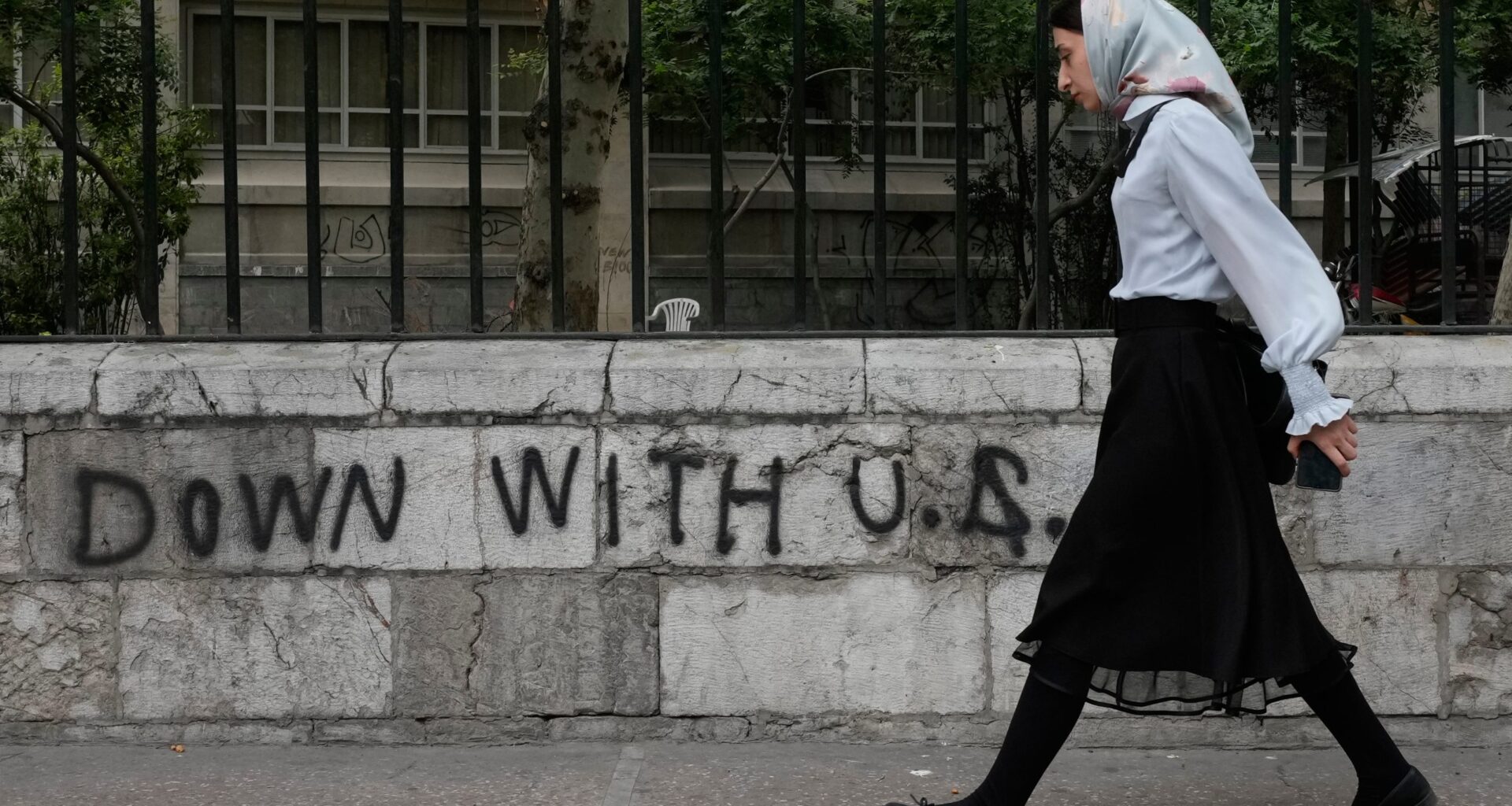
(AP Photo/Vahid Salemi)
Bottom Line Up Front:
Another anticipated round of U.S.-Iran talks in Islamabad was canceled Saturday, as both sides maneuver for an advantage in a possible settlement, but further diplomacy is more likely than a return to combat.
President Trump and his team calculate that the U.S. blockade of Iranian ports will soon force Iranian leaders to capitulate to core U.S. demands for strict limits on Iran’s nuclear program.
Iranian leaders believe their resistance ideology, coupled with an ability to absorb economic and military setbacks, enables them to resist Trump’s pressure for an “unconditional surrender.”
Iran has more than 160 million barrels of oil afloat, awaiting delivery, which will earn Tehran oil revenue well into the summer, even if the U.S. blockade remains in place.
On Saturday, for the second time in a week, U.S. negotiators were set to travel to Islamabad to continue talks with their Iranian counterparts, only to have their departure canceled as Tehran pulled back or set new conditions for the meeting. The discussions were to take place at a lower level of representation than the first round of wartime talks on April 11-12, a downgrade that had already dampened expectations of a breakthrough. The initial round, headed on the U.S. side by Vice President JD Vance and on Iran’s side by Majles (parliament) Speaker Mohammad Bagher Ghalibaf, was the highest-level U.S.-Iran talks since Iran’s 1979 Islamic revolution. The failure to reconvene, even at lower levels, sets the diplomatic track toward ending the war back, while the prospects for the U.S. to break the logjam through kinetic escalation are heightened. But Trump has not signaled that active combat will resume, and regional and global leaders still view a diplomatic solution as the more likely outcome than escalation. Experts note that all the rounds of previous talks, including the discussions held on the eve of Trump’s decision to launch Epic Fury, narrowed the gaps between the two adversaries on the core issues surrounding Iran’s nuclear program and U.S. sanctions relief.
At “Iran’s request,” according to White House spokesperson Karoline Leavitt, U.S. negotiators Jared Kushner, Trump’s son-in-law, and Steve Witkoff, Trump’s Middle East special envoy, were to depart Washington on Saturday to meet with Iranian Foreign Minister Abbas Araghchi the following day. The minister was already in Islamabad, reportedly presenting Pakistani mediators with an amended offer of U.S.-Iran settlement terms. Pakistan was the first stop on Araghchi’s tour to shore up support from several friendly states, including Oman, a key U.S.-Iran broker, and Russia, which might play a key role in implementing a nuclear agreement between Washington and Tehran by reprocessing Iran’s stockpile of highly enriched uranium.
Prior to the departure of the U.S. team, Araghchi was apparently pressured by Iranian hardliners to conceal any sign of diminished Iranian leverage. Araghchi denied that Iran had requested these talks with the U.S. and left Islamabad on Saturday. Trump subsequently canceled the U.S. team’s travel, telling journalists the U.S. officials did not need to make the long flight to Pakistan “to sit around talking about nothing.” Amid Iran’s threats not to resume talks with the U.S. until it ends its blockade of Iranian ports, Araghchi nonetheless returned to Islamabad on Sunday, reportedly to present amended Iranian settlement points for passage through the Straight of Hormuz to Washington.
The second consecutive cancellation of U.S.-Iran talks reflects competing calculations of their relative leverage. Iranian leaders believe that the rise in global oil prices and impending global shortages of key oil byproducts, such as fertilizer and jet fuel, are putting significant pressure on President Trump to accept a settlement far short of his demand for “unconditional surrender.” Iranian leaders want an agreement similar to the 2015 multilateral Iran nuclear agreement (JCPOA), which exchanged broad U.S. sanctions relief for limiting Iran’s enrichment of uranium to 3.67 percent purity — suitable for use in a civilian power reactor. That pact enabled Iran to argue it had preserved its “right” to enrich uranium as a party to the Nuclear Non-Proliferation Treaty (NPT). Iranian officials have categorically rejected Trump’s insistence that it permanently forgo all uranium enrichment as depriving Iran of its legitimate rights. According to Pakistani mediators and officials close to the talks, compromises on the core nuclear issues are within reach. The Trump team reportedly would accept a long-term (20-year) moratorium on all uranium enrichment, dropping the demand for permanent termination. However, Iran also wants the permanent ability to charge fees for safe passage through the Strait of Hormuz — a demand the U.S. and its allies in the Gulf, Europe, and Asia firmly reject.
Trump and his team appear to calculate — incorrectly, according to many experts — that the tightening U.S. blockade of Iran’s ports will soon compel regime leaders to core U.S. demands. Trump has kept the U.S. naval blockade in place despite the ceasefire, which Trump has extended several times since its expiration last Wednesday. U.S. Secretary of Defense Pete Hegseth briefed reporters Friday that the U.S. quarantine would remain in place until Iran accepts U.S. terms for a new agreement. Leaders of the Islamic Revolutionary Guard Corps (IRGC), calling the blockade a ceasefire violation and an act of war, have threatened to challenge the blockade by attacking U.S. ships, but experts agree that both Iran and the U.S. would prefer to de-escalate rather than return to active combat. Iran has continued to block commercial traffic through the Strait by attacking tankers and other ships with IRGC Navy fast-attack craft, including firing on two ships last week. Earlier in the month, IRGC commanders, who control the key levers of power, countermanded a confidence-building gesture by pragmatic Iranian leaders by announcing the Strait was fully open to all commercial traffic.
The U.S. blockade is damaging Iran economically, but its strategic effect on the dominant actors within Iran’s regime appears to be limited. More than 90 percent of Iran’s annual trade passes through the Strait, cutting off 70 percent of Iran’s export revenues, according to an expert at Oxford Economics. Since the imposition of the blockade on April 13, the U.S. Navy has turned back at least 34 ships leaving Iranian ports with oil and other goods and has seized four Iranian vessels. Two were sailing to deliver oil to Iran’s main oil customer, China, and two brought goods for Iran. One of the seized ships reportedly was carrying Chinese chemicals useful for solid-fueled ballistic missiles. Trump claims that Iran is losing nearly $500 million per day in revenue for each day the blockade is in place, most of which presumably consists of lost oil sales. Iran’s dependence on imports is widening shortages of goods, including intermediate inputs for Iranian industries.
Suggesting that U.S. pressure is impacting the population, Iranian President Masoud Pezeshkian said Saturday that U.S. and Israeli strikes had damaged Iran’s energy infrastructure, and he appealed to the public to reduce electricity and energy consumption. Corroborating the growing alarm among civilian leaders, Central Bank of Iran Governor Abdolnaser Hemmati reportedly urged Pezeshkian to take urgent steps to stabilize the economy, including restoring full Internet access and pursuing a peace deal with the U.S.
But many experts assert that the hardliners who dominate Iran’s regime have a high tolerance for hardship, and they are implacably opposed to bending under Trump’s pressure. Ghalibaf and the IRGC commanders who arguably control Iranian strategy are all veterans of the 1980-88 Iran-Iraq war, during which Iraqi attacks reduced Iran’s oil exports to nearly zero at times, forcing the Islamic Republic to institute rationing of goods. On the other hand, experts note the government was far more popular during that war than it is now, and the regime has reportedly flooded big cities with security forces to prevent a renewed uprising.
The hardliners in Iran also argue they are partially mitigating the economic effects of the U.S. blockade. Prior to its imposition, Iran had put nearly 170 million barrels of crude oil afloat on National Iranian Tankers Company (NITC) and dark-fleet tankers, awaiting delivery primarily to China. According to Muyu Xu, of the commodities analysis firm Kpler, the vast bulk of the Iranian oil afloat is positioned “around the Malacca Strait, the South China Sea, and areas closer to China.” Deliveries of that oil will provide Tehran with its pre-war oil revenue levels at least until August, according to experts close to Iran’s government. On Thursday, Iran’s deputy Majles speaker Hamidreza Haji-Babaei said Tehran’s central bank had received the first revenues from tolls imposed since the start of the war on commercial traffic through the Strait, according to the semiofficial Tasnim news agency.
Still, Xu and other experts argue the current U.S. enforcement effort will slow future Iranian loadings and exports, adding pressure on Iran’s onshore inventories and eventually forcing production cuts. Iran is said to be running low on repurposed empty oil tankers and other facilities to store unsold oil. Xu told journalists, “…given there is still available storage capacity onshore (roughly covering 20 days of Iran’s current production), we expect any production reduction to be gradual over the coming week, with a higher likelihood of acceleration into May.” Production cuts threaten to damage Iran’s oil fields and reduce Iran’s overall production capacity.
Meanwhile, the U.S. effort to cripple Iran’s economy is continuing to expand. Secretary of War Hegseth said last week that the U.S. planned to expand enforcement of the blockade to tankers far afield of the Strait of Hormuz, rendering unclear whether all of the Iranian oil afloat in East Asian waters might yet be seized by U.S. forces. Friday, the U.S. Treasury Department froze $344 million in cryptocurrency assets linked to Iran and imposed sweeping sanctions on 40 shipping firms and vessels, as well as a Chinese oil refinery. Still, no signs have appeared, to date, that Tehran is willing to sign an agreement that Trump can advertise as justifying the economic and other consequences of launching Operation Epic Fury.