
This transcript was created using speech recognition software. While it has been reviewed by human transcribers, it may contain errors. Please review the episode audio before quoting from this transcript and email transcripts@nytimes.com with any questions.
natalie kitroeff
From The New York Times, I’m Natalie Kitroeff. This is “The Daily.”
[THEME MUSIC]
archived recording 1
Starting right here in California, these billionaires are going to learn that we are still living in a democratic society where the people have some power.
natalie kitroeff
A landmark proposal for a one-time tax on billionaires in California reached a milestone this week. It got enough signatures to put the measure to a vote.
archived recording 2
Those who have prospered from here in California can afford to invest a little more in keeping California running.
natalie kitroeff
Proponents say it’s necessary to right the wrongs of an unequal system.
archived recording 3
It’s like the Democrats are doing everything they can to get me to leave the state. I don’t want to.
natalie kitroeff
Opponents say it’s going to drive rich taxpayers out of the state.
archived recording 4
It’s an idiotic concept that is nothing more than political positioning.
natalie kitroeff
But it’s not just Republicans and the ultra wealthy who are against it. It’s also a surprising group of Democrats. Today, my colleague, Laurel Rosenhall lays out how California arrived at this moment and what it might mean for the fight over inequality nationwide.
It’s Wednesday, April 29.
[THEME MUSIC]
Laurel, welcome back to the show. It’s great to have you here.
laurel rosenhall
Great to be here. Thank you.
natalie kitroeff
So we have here because we got word this week that a historic tax on billionaires appears to have gotten enough signatures to be put to voters in California in November. So just tell us why that matters at a fundamental level.
laurel rosenhall
Well, this is coming at a moment when there is a lot of anxiety about economic inequality. A lot of people are feeling squeezed about affordability. In California, the electorate is very anti-Trump and feeling somewhat angry about some of the cuts that he’s done and the ways that he seems to be favoring billionaires. And so people are feeling emotional about that. And this tax has ignited a big pushback from many billionaires, who are spending tens of millions of dollars to fight it. And the scope of this tax and the structure of this tax is very unusual, and that’s part of the reason it’s just generating such a firestorm.
natalie kitroeff
OK. Let’s start there, with the unusual structure of it. Just explain what the measure would do.
laurel rosenhall
So this would place a 5 percent tax on the net worth of any billionaires who are California residents as of January 1 of this year. The money would go into a special fund at the state level and would have to be spent on healthcare services. It’s unusual to tax the assets of a person as opposed to their income. So their assets would be their stocks, the jewelry they own, the cars in their garage, the paintings, anything that contributes to their wealth.
Notably, it does not include residential property, so that’s kind of an interesting exemption. And then it’s also unusual, on the revenue side, to create a special fund where the money would go and that it could only be used for this one purpose. So unlike most of the tax dollars that the state collects, which go into what’s called the general fund, and then the elected leaders of the state government decide how to spend it, this is requiring that 90 percent of it be spent specifically on health care.
natalie kitroeff
What does that actually mean? Does that go to the money that people are spending on their health care?
laurel rosenhall
The concept is that the supporters of this tax want to make up for the massive amount of funding that has been cut by the federal government through what Republicans called their Big Beautiful Bill. The cuts that were in that bill that Trump signed last year were related to Medicaid and Obamacare subsidies. And those health insurance programs pumped a huge amount of money into the healthcare system writ large.
So for the supporters of this tax, they say this money is essential to keep hospitals open, to keep emergency rooms operating, and to keep the healthcare system that Californians rely on operating at the same level that it has been before these cuts go into place.
natalie kitroeff
So just to put a fine point on it, what’s unusual about this initiative is that, one, it’s taxing assets, and that’s really different. Normally, the way people raise taxes on rich people is to tax their income. And the other thing that’s unusual is that the vast majority of it, 90 percent of the money, would go to this one purpose, health care.
laurel rosenhall
Right. And this is happening in a state that has more billionaires than any other state. So the supporters of this tax say that it would affect about 200 people. However, there are various wealth management experts that I’ve interviewed over the last few months, and they’ve told me they think the number is probably higher. But right now, no one has an exact count on how many people would have to pay this.
natalie kitroeff
And so how has this been received in California?
laurel rosenhall
Well, it got 1.5 million signatures. So there were at least that many people who liked the idea enough to sign a petition. I’ve been out with different petition circulators, watching this thing in public parks and in front of grocery stores. And the idea of taxing billionaires, especially when you just say it in one sentence like that, it’s real easy for people to sign on the dotted line.
And polling shows that more than half of voters support it. More than 70 percent of Democrats support it in California. But even though it has a lot of support, seemingly, from the public, there are a lot of high-profile Democrats who have come out against it and a lot of unions who are just sitting on the sidelines. And some of that has to do with how this whole thing came about.
natalie kitroeff
Interesting. So how did it come about?
laurel rosenhall
This tax is being proposed by a specific union called the SEIU-UHW, stands for Service Employees International Union United Healthcare Workers West — kind of a mouthful. This union represents hospital workers, including janitors, cooks, and various healthcare technicians. And they’re really concerned that the Medicaid cuts from President Trump last year are going to lead to widespread closures of ER rooms and hospitals in the places where they work.
And the leader of the union is named Dave Regan. And he has a real long history of using ballot initiatives in his labor negotiation process. And he came up with this idea for this billionaire tax and teamed up with some very respected economists from different universities around the country and put this proposal together, really on his own.
natalie kitroeff
Basically, this is coming from something like a maverick operator in the world of unions. And when he starts this thing, it’s not like he has a huge coalition behind him.
laurel rosenhall
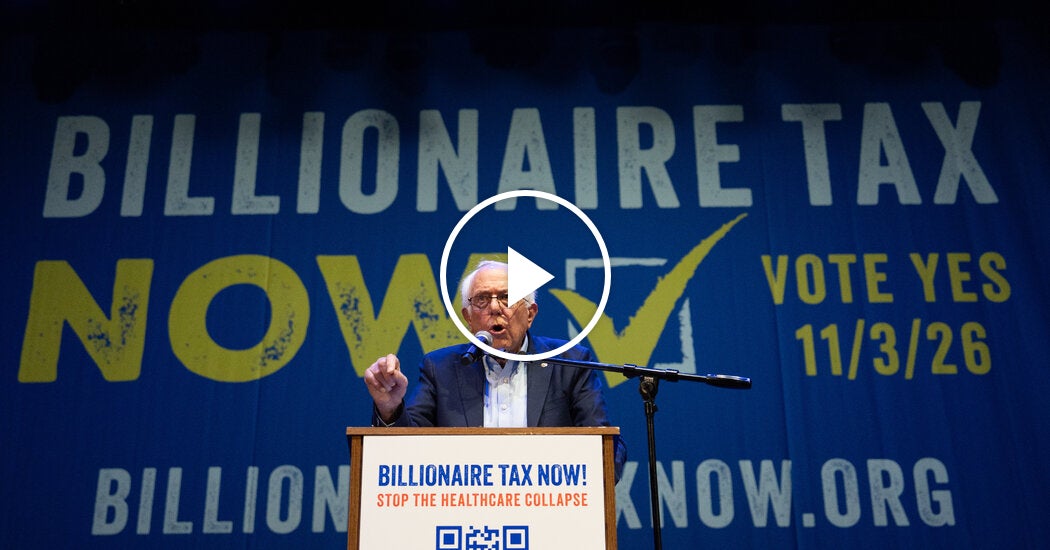
Yeah. So they’re working on building a coalition. They got the support of Bernie Sanders. He flew out to LA and led this rally that was really well attended and energetic. And the union started pouring millions of dollars into gathering these signatures. They trained a bunch of volunteers. And pretty much anyone who’s been at a farmer’s market or grocery store in California over the last few months has probably seen someone with a clipboard asking them for a signature on the billionaire tax.
natalie kitroeff
And my understanding is the billionaires did not respond well to all this momentum.
laurel rosenhall
So they started freaking out late last year in advance of this January 1 deadline, because the ballot measure says that anyone who was a resident of California on January 1 of this year could be subject to this tax. So at the end of the year, there was a lot of jockeying, and there were a few pretty high-profile billionaires who made moves to leave the state to change their official residency.
A couple of the founders of Google relocated. Sergey Brin moved to the Nevada side of Lake Tahoe. Larry Page left for Florida. And then also, some of the people who are really influential in the world of investing in technology left. David Sacks moved to Texas, and Peter Thiel moved to Miami.
natalie kitroeff
I have to say, this is always something that wealthy people threaten, to leave at any prospect of a tax increase, but they don’t always follow through. In this case, you’re saying they actually did it.
laurel rosenhall
At least a handful of them did. So they did relocate. A lot of them have multiple properties. So they still have homes in California, but they did change their official residence. And then meanwhile, the billionaires who want to remain in California have been plotting about how to adjust to this thing and how to basically mitigate or reduce their tax liability if it passes.
natalie kitroeff
By what, moving their jewels and boats and paintings and stuff? What are we talking?
laurel rosenhall
Yes, exactly that.
natalie kitroeff
Whoa.
laurel rosenhall
It was kind of wild. I went to this conference in Orange County a couple of months ago, where a bunch of tax advisors and wealth managers were meeting. And one of the sessions they had was basically like how to help your clients reduce their net worth, so suggestions that were like, oh, move your Picasso out of your house in Beverly Hills to your house in Aspen.
Or if you were carrying more insurance than you needed on your wife’s six-figure diamond necklace, just reduced the insurance policy to what it’s actually worth, because that’s what you’ll be taxed on. But to be fair, there are people who are just like, OK, fine. We live in California. This state has been wonderful to us. If we have to pay more, we will.
natalie kitroeff
For those who are fighting it, what is their argument for why this tax is such a bad idea, beyond just, don’t take my money. I want it?
laurel rosenhall
So they’re really drilling into the specifics of the way that it’s structured, just the idea of taxing assets and the requirement that if this thing passes, every taxpayer in California will have to declare if they’re a billionaire or not. And then, if so, they will have to declare the value of all of their property and assets. And so there are people who just feel that that is wrong.
They’re arguing that a retroactive tax, because it would tax people who were in the state as of January one, is unconstitutional. And a major argument from Silicon Valley is that this tax would absolutely devastate California’s ability to continue dominating in the world of innovation.
natalie kitroeff
Their argument is basically that the state has a lot to lose from this tax, not just the billionaires.
laurel rosenhall
Absolutely. All of those billionaires who would have to pay this wealth tax on their assets, they already pay lots of income tax. And that income tax is what keeps most of the state of California running. It pays for schools and public safety and roads and all of the other things that the state funds. And that is one of the reasons that Governor Gavin Newsom is so vocally against this tax.
He’s very concerned about a short-term bump in tax revenue from the billionaire tax, but a longterm loss from that ongoing loss of income taxes from people who leave. Meanwhile, some of the most influential unions in the state, the teachers’ union, the umbrella group for SEIU they haven’t publicly taken a position. And privately, they’re concerned about the idea of a tax that gets locked up in this special box and doesn’t fund the programs that most tax dollars do.
So there’s a lot of different angles of potential concern, and that’s also why many of the Democratic candidates who are running for governor have expressed some reservations. Even while they’re saying, we think that rich people should pay more, they are raising concerns about the structure of this thing, again, getting into the weeds about how the money is spent.
natalie kitroeff
So even though this initiative seems like it would go a long way toward establishing, potentially, a new precedent, a new way to tax the very rich and redistribute that money, things that these folks generally may agree with, they aren’t on board, it seems like, in part because of the particularities of how this bill came about and who specifically benefits from it.
laurel rosenhall
Right.
And so, depending on how far this thing goes, we may wind up seeing a situation where the billionaires luck out if they can form an alliance with other groups that are much more sympathetic to the voters. I also want to say that this thing has a lot of different potential outcomes, but there is the possibility here for a really strange bedfellows kind of coalition to come together.
[INTRIGUING MUSIC]
natalie kitroeff
We’ll be right back.
Laurel, you said it was possible that the billionaires could assemble a strange bedfellows coalition to fight this tax. Just talk about how exactly that would work.
laurel rosenhall
Well, I think we have to start off by acknowledging that there are a lot of chess pieces on this board, and we just don’t exactly how it’s going to play out. California has this ballot initiative system that a lot of political actors use as leverage to get what they want out of the legislature and the governor. And so now that this thing has qualified for the ballot, this is a period over the next couple months where there could be some backroom negotiations to try to get this thing off the ballot.
Sergey Brin and the committee that he created, they have put money into a couple of ballot measures that would negate the billionaires tax. And it’s possible that those could be used as leverage. Perhaps Governor Newsom gets involved. And he could try to help negotiate something that would keep this from going on the ballot.
And then there’s another path, which is, these things all go on the ballot, and they duke it out in front of the voters. And that would become a very expensive campaign season, where voters are subjected to conflicting ballot measures on these tax issues.
natalie kitroeff
Let’s talk about Newsom here, because I think he’s in a really interesting position. On the one hand, it makes sense that a potential 2028 contender for the presidency doesn’t want to alienate billionaires. But it would also seem perilous for him to stake out a position that, at least on the surface, might paint him as not wanting to tax the wealthy at this moment when economic populism is so potent. So talk to me about his motivations and the position he finds himself in.
laurel rosenhall
Well, I think you summarized it exactly right. And that’s why, when he does talk about this, he really focuses on his objection to a state-specific wealth tax. And he does frequently say, we ought to have a conversation about a national wealth tax, leaving the door open to the idea of a wealth tax if it was applied evenly across the country.
natalie kitroeff
He’s trying to thread a needle there, right? He’s saying, I’m not opposed to this thing, but I’m opposed to a version that puts California at a disadvantage. And the way to handle this is at the national level. That’s the way to go about this.
laurel rosenhall
Right, without fully committing that he would do it at the national level, but say, if we were going to do it, that’s what we should explore. And it is worth noting that he has opposed many wealth taxes in the past when they’ve come up in the California legislature. The other thing he focuses on is that California has a very progressive income tax structure, and the state does levy a lot of taxes on the wealthiest earners and saying that he agrees with the moral argument to tax the rich.
natalie kitroeff
He’s again threading the needle, whereas on the more progressive side of the Democratic Party, you have people like Bernie Sanders saying, look, don’t let the perfect be the enemy of the good here. Taxing billionaires is good. Maybe this isn’t going to solve all of our problems, solve inequality writ large, but overall, we support this concept. Obviously, Bernie Sanders doesn’t have to be the governor of California, but you see the contrast there.
laurel rosenhall
Exactly. And so for Bernie Sanders, who is deeply invested in the idea of taxing billionaires and fighting the oligarchy, the particulars are of less concern to him. The point is, levying a tax on the people who have so much to help people who have less, he doesn’t see any problem with that.
natalie kitroeff
What is the message, do you think, of this fight in California for other states that are pursuing populist policies like this? I’m thinking of New York, where Governor Hochul is proposing a pied-à-terre tax. Because on the one hand, this tax, you said, has a lot of support. And on the other, there is this very loud opposition that seems to be rooted in a fear of alienating billionaires or losing them because the state has become very reliant on these ultra-wealthy people.
laurel rosenhall
Well, I think there’s a couple of lessons we can take away from this. One is that the idea of sticking it to the rich is very popular. The other lesson is that it’s still really hard to pass and get across the finish line because of all of the particulars involved, because of the way that this tax is structured, and because of how influential the billionaire class is in our society.
The third lesson is that because it’s so hard, people who want to do this kind of thing need a really broad base of support to push it across the finish line. And I think that is what we’re going to be seeing in California that will be tested over the next few months — how strong the support is for this idea, given how hard it is to go up against these opponents.
natalie kitroeff
Can I just step back and ask, given how imperfect this measure is, why have the billionaires been so freaked out about it? Because from what you said, it sounds like it may have actually been relatively straightforward for them to move some of their wealth elsewhere for a single year. It’s also just a one-time 5 percent tax. So what about this proposal is so scary to them?
laurel rosenhall
For the billionaires, and also many tech leaders who are not billionaires but who are aspirational, they see this as a kind of an existential threat, that it really would set a precedent of going after the wealth that people have earned and taxing their possessions in a way that really has never been done before.
On the other side, that is also part of the motivation for this thing, to really shift the paradigm in how the government taxes wealth and how the government gets people to contribute to society. And in a time when many wealthy people have shifted their assets into various accounts for tax dodging, this would be another way to go after the real wealth that people have and try to provide more for people in society who have so little.
I think this measure is forcing a lot of people into the uncomfortable territory of reckoning with the moment we’re in. It’s pushing the whole anxiety about the billionaire class and economic inequality right to the forefront.
[CONTEMPLATIVE MUSIC]
natalie kitroeff
Well, Laurel, thank you so much.
laurel rosenhall
Thanks for having me.
[CONTEMPLATIVE MUSIC]
natalie kitroeff
We’ll be right back.
Here’s what else you need to today.
archived recording 5
Earlier today, a grand jury in the Eastern District of North Carolina returned a true bill indicting Mr. James Comey with committing two felonies.
natalie kitroeff
The Trump administration has secured a new indictment against one of the president’s biggest enemies, former FBI Director James Comey, months after its last indictment against Comey ended in failure.
archived recording 6
He knowingly and willfully making a threat to take the life of and to inflict bodily harm upon the president of the United States, count 2.
natalie kitroeff
This time, the Justice Department charged Comey with making a threat against Trump because of a photo Comey shared on social media of seashells arranged on a beach to say 8647. Since 86 can be slang for removing something and Trump is the 47th president, allies of the president have construed the photo as a threat to kill Trump.
archived recording 7
Threatening the life of the president of the United States will never be tolerated by the Department of Justice.
natalie kitroeff
Comey has repeatedly denied threatening to harm the president.
archived recording (james comey)
I’m still innocent. I’m still not afraid. And I still believe in the independent federal judiciary, so let’s go.
natalie kitroeff
And —
archived recording 8
Mr. Speaker, their majesties, King Charles III and Queen Camilla.
natalie kitroeff
— in a speech to Congress on Tuesday, King Charles delivered an optimistic assessment of the relationship between the US and Britain at a moment in which that relationship is arguably at its lowest point in decades.
archived recording (king charles)
With the spirit of 1776 in our minds, we can perhaps agree that we do not always agree.
natalie kitroeff
In his speech, Charles declared that disputes between the two nations have defined their shared history, dating back to the American Revolution against Britain in the 1770s.
archived recording (king charles)
Indeed, the very principle on which your Congress was founded, no taxation without representation, was at once a fundamental disagreement between us and, at the same time, a shared democratic value, which you inherited from us. Ours is a partnership born out of dispute but no less strong for it.
natalie kitroeff
After the speech, President Trump hosted Charles and his wife, Camilla, for dinner at the White House.
archived recording (donald trump)
Before we really begin, I want to congratulate Charles on having made a fantastic speech today at Congress. He got the Democrats to stand. I’ve never been able to do that.
I couldn’t believe it.
natalie kitroeff
Today’s episode was produced by Olivia Natt, Shannon Lin, Claire Toeniskoetter, and Jack D’Isidoro. It was edited by Paige Cowett and Patricia Willens. Contains music by Marion Lozano. Our theme music is by Wonderly. This episode was engineered by Chris Wood.
[THEME MUSIC]
That’s it for “The Daily.” I’m Natalie Kitroeff. See you tomorrow.
[THEME MUSIC]