

One spring day, when American politics felt polarized and Israelis were still catching their breath from a punishing and controversial war in Gaza, 329 members of the US Congress sent a letter to the president calling on him to remain a “devoted friend to Israel.”
The lead signatories were members of the House leadership, one Republican and one Democrat. The list of signatures, comprising more than three-quarters of the House of Representatives, was about evenly split between the two parties.
The year was 2009, and the letter’s sponsor was the American Israel Public Affairs Committee, AIPAC.
Around the same time, another letter said Israel and the Palestinians could not make peace by themselves, and that “American leadership is essential to achieving meaningful progress.”
That letter came from a new organization, J Street, founded the previous year as a liberal, dovish alternative to AIPAC. Of the 435 members of the US House, it got just 87 signatures.
Get The Times of Israel’s Daily Edition
by email and never miss our top stories
By signing up, you agree to the terms
Was J Street pro-Israel enough? Or pro-Israel at all? Not just Republicans but Democrats were asking the question, and for many, the answer was no.
New York senators Chuck Schumer and Kirsten Gillibrand, both Democrats from a blue state, pulled out of its first conference. The group endorsed 41 candidates in its first year — but not the Democratic House speaker or majority leader.
Meanwhile, AIPAC’s former director derided the group as the “blame Israel first” lobby, and Israel’s US ambassador at the time, Michael Oren, lamented that J Street was “a unique problem in that it not only opposes one policy of one Israeli government, it opposes all policies of all Israeli governments.” He declined an invitation to the conference.
Seventeen years later, times have and haven’t changed. To many on the right, J Street is hardly pro-Israel. If anything, it has moved much further left, and away from the views of the average Israeli, taking positions opposed by the vast majority of the country it says it supports.
But among US Democrats, the picture has flipped. AIPAC, formerly a powerhouse in the party, is now anathema, while J Street, once seen as too far to the left, is becoming the redoubt of Democrats who aren’t ready to abandon Israel. Israel’s fiercest critics, meanwhile, have no problem lumping the two Israel lobbies together — never mind how much the two disagree with each other.
Eighty percent of Democratic voters view Israel negatively. But the majority of their congresspeople — including the top three House Democrats — are now endorsed by a group that functions as the liberal Zionist flagship. In the Democratic Party, at least in Washington, J Street has become Main Street.
“We endorse the overwhelming majority of elected Democrats at the federal level,” J Street’s founder and longtime president, Jeremy Ben-Ami, told The Times of Israel in an interview this week. “They are not running away from us and viewing our support as toxic. They are coming to us and seeking our support.”
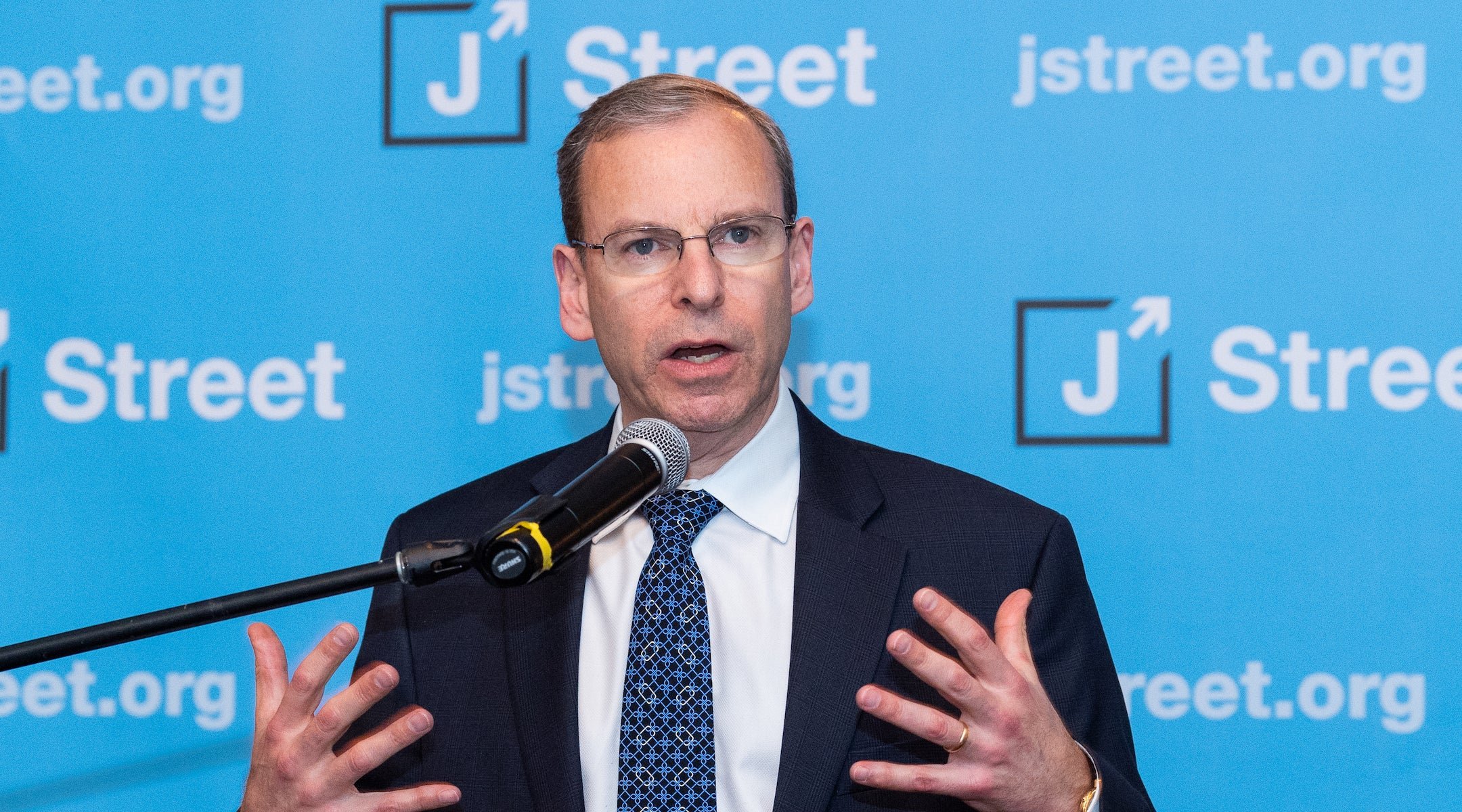
Jeremy Ben-Ami, president of J Street. (Michael Brochstein/SOPA Images/LightRocket via Getty Images)
Supporting Israel, opposing the views of Israelis
For Israelis who hope to preserve bipartisan support in the US, this presents an awkward situation. J Street is now the mainstream Israel lobby among Democrats, endorsing more of them in the House and Senate than AIPAC’s PAC does.
But the group that has long described itself as “pro-Israel, pro-peace” has also consistently opposed the views of the vast majority of Israelis on both sides of the Knesset aisle.
To take a few examples: 85% of Israeli Jews (a solid majority of the country overall) supported US President Donald Trump’s 2017 recognition of Jerusalem as Israel’s capital and the US moving its embassy there. Opposition MKs praised it. But Ben-Ami called the recognition “reckless.”
More recently, the group said it was “appalled” by the start of the recent war with Iran, which, at its outset, had the backing of more than 80% of all Israelis — including a large majority of the Jewish left. And J Street has long supported the establishment of a Palestinian state at peace with Israel, something just 26% of Israelis said was realistic in 2024.
Ben-Ami noted that J Street has pivoted to stressing a regional normalization deal rather than a two-state solution, and pointed to polling suggesting Israeli support for Palestinian statehood shoots up if it comes along with full acceptance by the Arab and Muslim world.
But he also stressed that he isn’t bothered by the gulf between his group and Israelis. The polls he cares about are the ones J Street commissions, which unfailingly reflect Democratic, liberal majorities among US Jews; a recent one showed that American Jews broadly sympathize with Israel but opposed the Iran war.
“Our role is not to represent the Israeli Jewish population, our role is to represent the American Jewish population,” he said, adding later, “We don’t exist to have conversations with Israelis. Our conversation day in and day out is in the United States.”
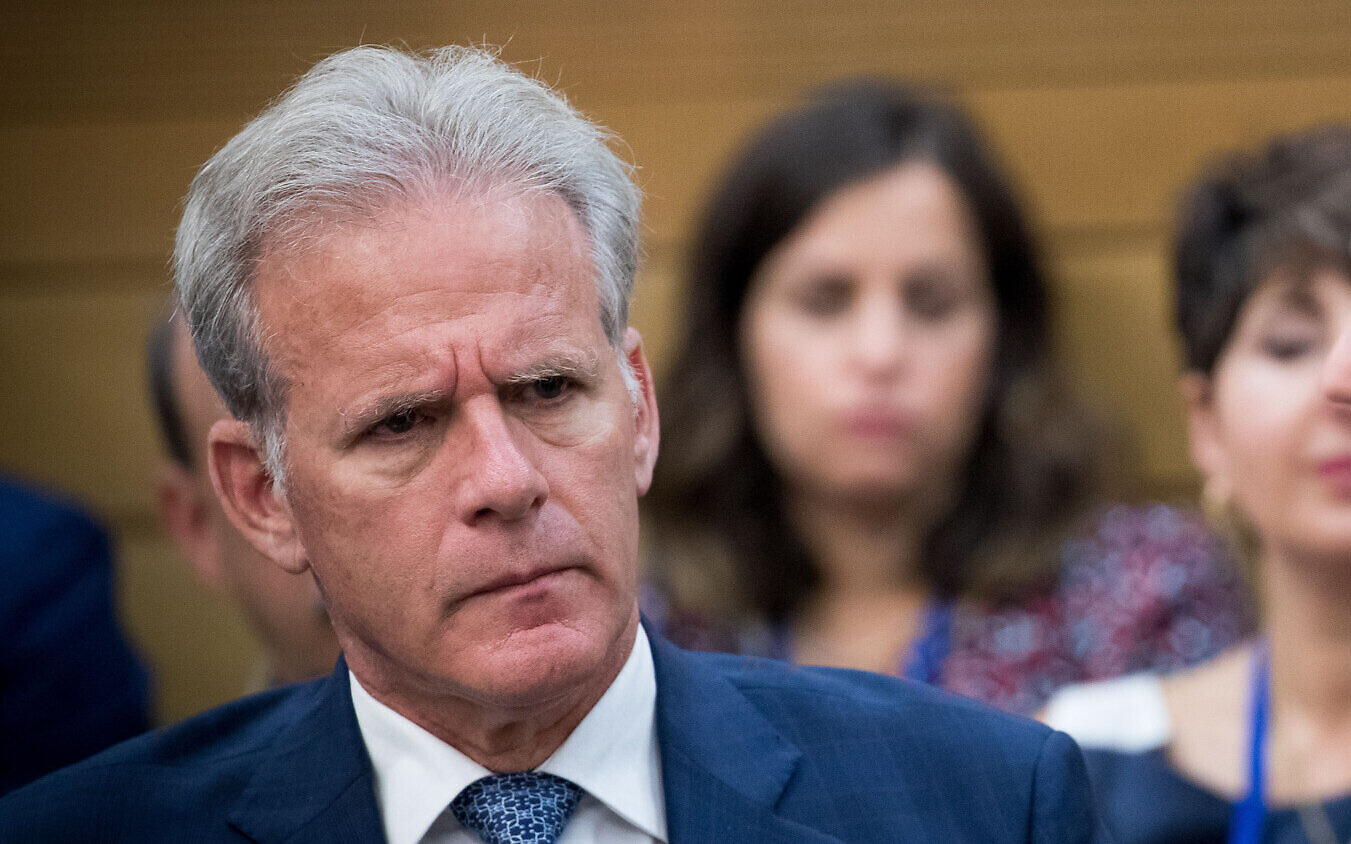
Then-deputy minister for diplomacy Michael Oren at a meeting at the Knesset, June 27, 2017. (Yonatan Sindel/Flash90)
He went on to compare his group’s support for Israel to providing tough love to a relative making a harmful life choice, such as drunk driving or drug addiction.
“If you have a family member who is doing something that you think is exceedingly self-destructive, that in the long run is going to lead them down a path that will harm them physically, mentally — you intervene,” he said. “That person may say, well, you know, I don’t really look at you right now as a friend, right? Because you’re telling me to stop drinking and driving. You’re telling me to stop doing drugs… And I say no, I am doing this because I love you.”
‘Now you’re in the mainstream’
AIPAC, for its part, has striven to continue presenting J Street as an opponent of Israel. It tweeted the phrase “J Street is many things, but it’s not pro-Israel,” five times in April alone.
Another organization, the Democratic Majority for Israel, aims in its words to “maintain and strengthen support for Israel,” and takes positions that are much closer to those of Israelis. When the US-Israeli war with Iran began, it said that ending Iran’s nuclear threat, missile program and support for terror proxies “is unequivocally a positive development and will make the world a safer place.”
“DMFI is the home for pro-Israel Democrats who strongly support the security of the United States, support of our allies around the world, and in particular, Israel,” the group’s chair, former Democratic Rep. Kathy Manning, told The Times of Israel. “We have a deep understanding of the importance of the relationship between the US and Israel to the United States’ security.”
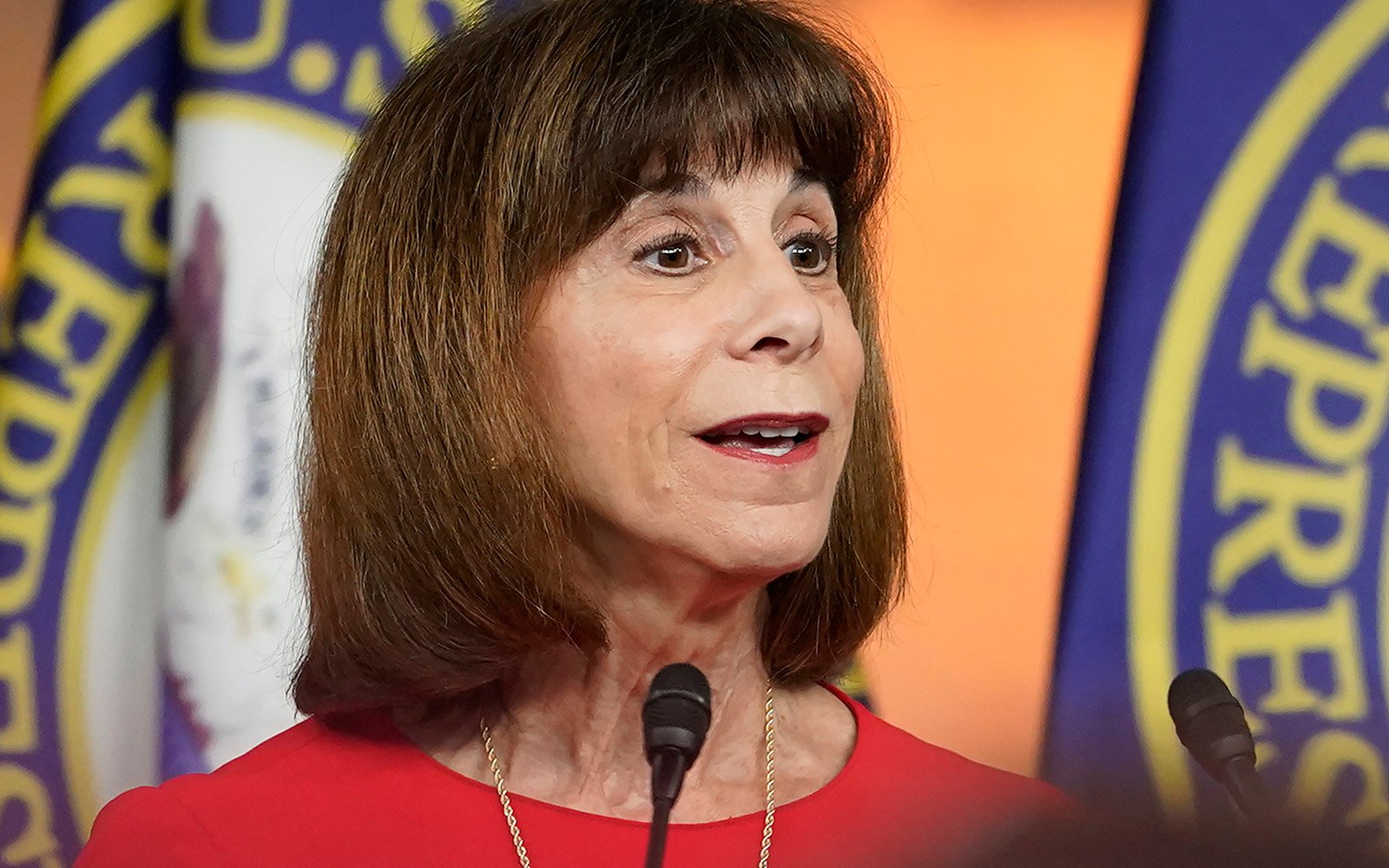
Then-US House Representative Kathy Manning at a news conference at the Capitol in Washington on July 19, 2022. (AP Photo/Mariam Zuhaib, File)
Oren, who ended his term as ambassador in 2013 and served for four years in the Knesset, feels J Street is “pro-Israel in name, not in deed.” He quipped that it “would be nice if they respected the life-and-death issues — not political issues, the life-and-death issues — that are supported by the vast majority of Israelis.” He counted backing the wars against Iran, Hezbollah, and Hamas in that category.
He also said J Street has contributed to Democrats’ push to curb military aid to Israel, as well as the sidelining of AIPAC.
“The fact that the Democratic Party today is increasingly committed to limiting if not ending American military aid to Israel, and opposed to taking any money from AIPAC, can be attributed to J Street,” he said.
But he also recognized that, as political norms have shifted, this organization — once considered left-wing — is now seen as relatively centrist.
“The fact that they say that they are still pro-Israel and pro-peace has moved them from the leftist fringe to the Zionist center,” Oren acknowledged.
He added, “I say to them jokingly, ‘My heart goes out to you. You used to be on the radical left, and now you’re in the mainstream.’”
I say to them jokingly, ‘My heart goes out to you. You used to be on the radical left, and now you’re in the mainstream.’
The Democratic Party has moved further to the left on Israel, with a growing number of officials voting to block arms sales to it, or accusing it of genocide in Gaza. At the same time, J Street has moved to the left, too.
In January 2024, J Street said it “rejects the allegation of genocide against the State of Israel,” which was brought by South Africa in the International Court of Justice. In August, Ben-Ami wrote that he “cannot and will not argue any more” against those who say Israel is committing genocide.
And last month, J Street published a new policy document on US aid to Israel: It now says that the US “should phase out direct financial support for arms sales to Israel” and condition future weapons sales on Israeli policy, though it stressed that the US should keep selling Israel parts for missile defense systems like Iron Dome.
J Street is hardly the only group to support ending US aid to Israel. Prime Minister Benjamin Netanyahu — no left-winger — said in January that he wants to “taper off the military aid within the next 10 years,” and Oren has long advocated weaning Israel off US military aid.
But when 40 Democratic senators recently voted to block some arms sales to Israel, Ben-Ami, in a statement, called it an “important step in opposing Netanyahu and Trump’s destructive policies that have devastated the region and done immense harm to Israel’s security and its global standing.”
DMFI has defended US military aid to Israel and, in a nod to Netanyahu’s statement, said proposals to phase out aid “should be considered carefully, with adequate planning, ensuring Israel’s security needs and US interests are upheld in a gradual transition. ”
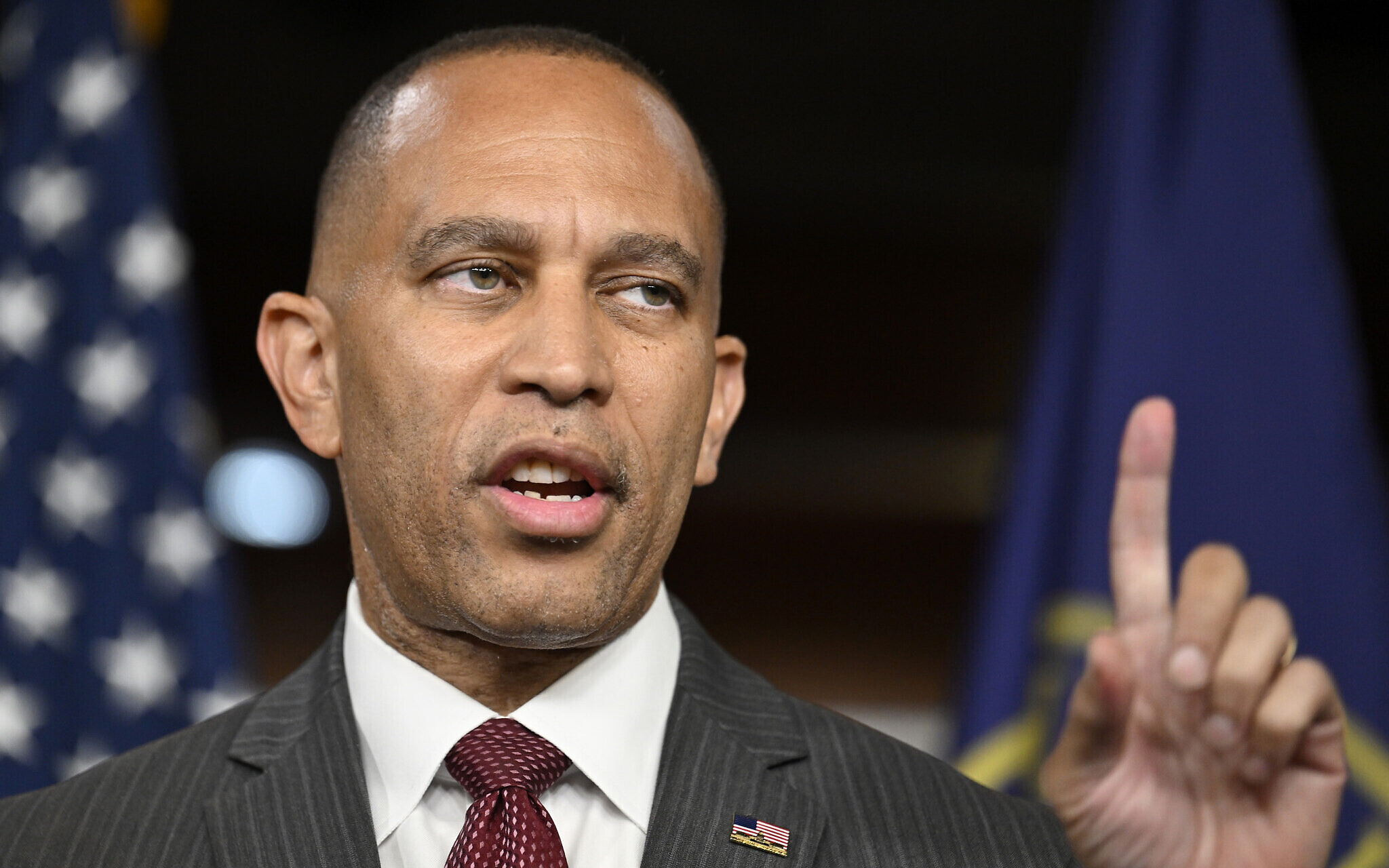
House Minority Leader Rep. Hakeem Jeffries speaks at his weekly press conference on Capitol Hill, July 11, 2024, in Washington D.C. (AP Photo/John McDonnell)
J Street’s policies have allowed the group’s PAC to endorse a vast range of Democratic officials. Among the group’s 2026 endorsees is House Minority Leader Hakeem Jeffries, also endorsed by AIPAC and long a presence at AIPAC conferences and trips. Another endorsee of J Street is Texas Rep. Greg Casar, a member of the far-left squad who has repeatedly accused Israel of genocide.
That range could, understandably, lead to confusion about where J Street stands on its core issue. Ben-Ami said that J Street does have red lines to its left: It won’t back anyone who calls for a full arms embargo on Israel, or “anyone who doesn’t want Israel to exist.”
Challengers to the left
For that reason, some Israel opponents have lumped J Street and AIPAC together as “pro-Israel lobby groups,” collapsing the distinction between them. And in a series of high-profile Democratic primaries, J Street has found itself backing the more moderate of the two options.
In recent primaries in Illinois and New Jersey, J Street’s PAC endorsed, respectively, Tom Malinowski and Daniel Biss, two candidates opposed by AIPAC who were contending against challengers even further to the left. Biss won in Illinois. New Jersey’s Malinowski, who faced significant opposition from AIPAC, lost to his far-left opponent Analila Mejia. J Street endorsed her in the general election against a Republican.
(To some hardline opponents of Israel, these distinctions don’t matter. An X account with hundreds of thousands of followers called “Track AIPAC” posted in February that Biss “has received >$155,000 from the Israel lobby.” When asked which lobby sent those funds, Track AIPAC replied, “J Street.”)
J Street provides a crucial option for Democrats who do not want to be anti-Israel but also can’t continue to support the AIPAC Israel-right-or-wrong, defend-at-all-costs line.
The same dynamic is playing out now in an especially hot-button primary between two Jews in New York City, where incumbent Rep. Dan Goldman is running against Brad Lander, a challenger to Goldman’s left who has called himself a “liberal Zionist” while also accusing Israel of genocide. Lander notably endorsed, and has been endorsed by, New York City Mayor Zohran Mamdani, a longtime staunch opponent of Israel.
Democratic mayoral candidate Brad Lander speaks during a Democratic mayoral primary debate, June 4, 2025, in New York. (AP Photo/Yuki Iwamura/Pool)
J Street PAC has endorsed Goldman (as has AIPAC), which means it has actively fundraised for him. But J Street doesn’t oppose Lander. It describes him as “primary approved,” which means that the candidate still qualifies for the group’s support and can still receive donations through its portal.
“There was nothing to our left when we started,” Ben-Ami said. “What’s changed is that there is a very angry, very vocal left that has made it very clear we are not left… It’s not that we’ve changed, it’s that the lay of the land has changed.”
There was nothing to our left when we started. What’s changed is that there is a very angry, very vocal left that has made it very clear we are not left… It’s not that we’ve changed, it’s that the lay of the land has changed.
Oren agrees.
“They have been outflanked significantly from the left by a procession, a cavalcade, of anti-Israel, anti-Zionist Jewish organizations,” he said, naming Jewish Voice for Peace as an example. “The map has shifted under J Street’s feet.”
‘There’s a danger of going too far’
Facing that landscape, J Street sees its goal as preserving core Democratic support for the US-Israel relationship, and for what it sees as democratic and liberal values in both countries, in the face of an unequivocally anti-Israel left, the Trump White House and a hardline right-wing Israeli government.
The group’s chief policy officer, Ilan Goldenberg, appeared last week on Pod Save America, a popular Democratic podcast whose hosts have criticized Israel and which recently hosted the vociferously anti-Zionist streamer Hasan Piker. Goldenberg argued in favor of “normalizing” the US relationship with Israel — that is, not treating it as exceptional — and pushed back against the far left of the Democratic Party.
“There’s still the majority of the Democratic Party that’s not necessarily there, despite those being the loudest voices, and certainly it’s not the majority of American voters,” said Goldenberg, who was the director of Jewish outreach for Kamala Harris’s 2024 presidential campaign. “There’s a danger of going too far.”
He said he hopes candidates can “express a position of not throwing the US-Israel relationship in the garbage and still recognizing that there’s potential value there, while at the same time saying the way this has been done in the past needs to end.”

Rabbi Jill Jacobs at a protest against the Israeli government’s proposed judicial reforms in New York City, February 21, 2023. (Luke Tress/Times of Israel)
Similarly, Rabbi Jill Jacobs, CEO of T’ruah, a liberal rabbinic human rights group that is an ally of J Street, views Israel’s plummeting popularity among Democrats as a critique of Netanyahu and his government, rather than as opposition to the state’s existence.
“Most people are not actually supportive of violence and actually want Israelis and Palestinians to both be safe,” she told The Times of Israel. “I think that most American Jews and also Democrats who have been supportive of Israel… are just increasingly frustrated by the direction that Netanyahu has taken Israel and are looking for a way to engage that recognizes that.”
She added later, “J Street provides a crucial option for Democrats who do not want to be anti-Israel but also can’t continue to support the AIPAC Israel-right-or-wrong, defend-at-all-costs line.”
J Street is not the window into the pro-Israel community, it’s the exit out. The next stop after J Street is not AIPAC. The next stop after J Street is JVP.
Oren worries, however, that J Street isn’t a bridge between Israel and Democrats, but rather a stepping stone to anti-Zionism.
“J Street is not the window into the pro-Israel community, it’s the exit out,” he said. “The next stop after J Street is not AIPAC. The next stop after J Street is JVP [Jewish Voice for Peace].”
Looking toward the election
The US isn’t the only country holding legislative elections this year. Ben-Ami made clear that he hopes Netanyahu loses Israel’s upcoming election (“We can pray,” he said). But just as most Israelis would likely be unhappy with J Street as their advocate, Ben-Ami understands that the man hoping to replace Netanyahu, former prime minister Naftali Bennett, is hardly J Street’s cup of tea.
“My diplomatic positions are known,” Bennett, who used to be firmly to Netanyahu’s right, said at an event this year. “My diplomatic positions are right-wing. I’m against a Palestinian state. I’m against giving away a centimeter of the Land of Israel.”

Opposition Leader Yair Lapid, right, and former prime minister Naftali Bennett at a press conference announcing a joint slate named “Together” ahead of upcoming elections in Herzliya, central Israel, April 26, 2026. (Chaim Goldberg/Flash90)
But even so, Ben-Ami is keeping up hope. He feels that if Netanyahu is defeated, the government that unseats him will be more palatable on issues such as combating settler violence or delivering aid to Gaza.
More broadly, he argues that his group is keeping support for Israel alive not just among Democrats but among American Jews — even if neither of the men who will lead Israel would likely call what he’s doing support.
“The State of Israel, the national homeland of the Jewish people, is rapidly losing support and connectivity with younger Jewish Americans and with more progressive Jewish Americans,” he said. “And those of us in J Street who are engaging, we’re doing it because we still want to be connected.”
He added, “We’re staying in the arena and fighting for a different future, a future of a state of the Jewish people that is democratic and lives up to our values. And we’re not going to give up on being pro-Israel. We’re not going to give up on being Zionist.”