
WASHINGTON — Many Democrats are seething over the Trump administration’s assertion that the law setting a deadline for how long a president can carry out military action abroad without Congress declaring war is not applicable to the conflict in Iran because of the current ceasefire.
What You Need To Know
The White House’s formal declaration in a letter to Congress on Friday that the hostilities, sparked when the U.S. and Israel struck Iran in late February, were “terminated” because of the April 7 ceasefire sent many Democratic lawmakers fuming
The exchange of fire between the U.S. and Iran on Monday over the Strait of Hormuz, appeared to escalate criticism
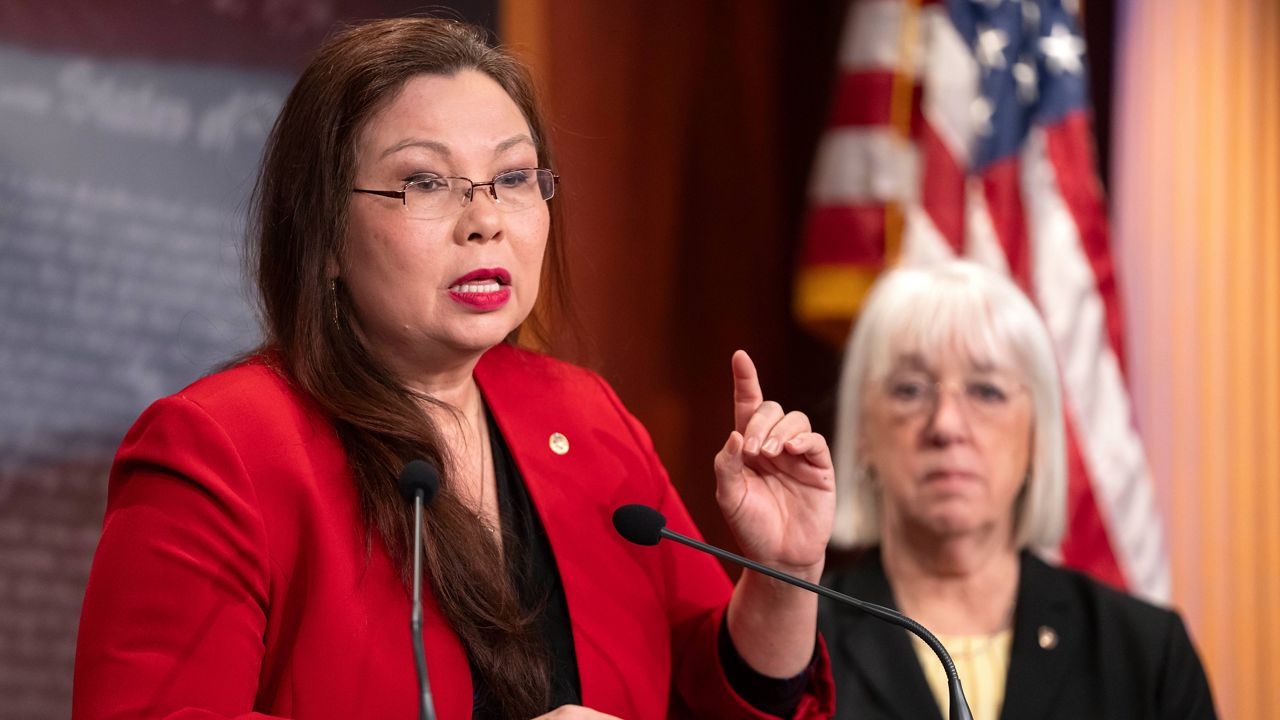
“He is lying to the American people and prolonging his disastrous war of choice—” Sen. Tammy Duckworth, D-Ill., wrote in a post on X. “And he’s doing it illegally.”
Defense Secretary Pete Hegseth argued during a press briefing Tuesday morning that the exchange of fire the day before between the U.S. and Iran over the critical waterway key for the global supply of oil was not a violation of the ceasefire and was part of a “separate and distinct” effort to secure free navigation through the strait
The White House’s formal declaration in a letter to Congress on Friday that the hostilities, sparked when the U.S. and Israel struck Iran in late February, were “terminated” because of the April 7 ceasefire had already sent many Democratic lawmakers fuming. But the exchange of fire between the U.S. and Iran Monday over the Strait of Hormuz, appeared to escalate their criticism.
Sen. Tammy Duckworth, D-Ill., took to X Monday to repost an article from the Associated Press reporting that the U.S. military said it had sunk six small Iranian boats, writing that “[President Donald] Trump’s claims that hostilities have ceased were bulls—.”
“He is lying to the American people and prolonging his disastrous war of choice—” Duckworth added. “And he’s doing it illegally.”
The administration’s notice to Congress came on the same day as a key deadline laid out in the War Powers Resolution, passed by lawmakers in 1973. The law established requirements that a president seeking to engage U.S. forces in armed conflicts abroad must follow to uphold Congress’ constitutional authority to declare war. Among the mandates is a requirement that any ongoing hostilities being carried out without Congress declaring a war must end within 60 days after the president notifies lawmakers of the action, which he formally did on March 2.
“That’s bulls—,” the Democratic leader in the Senate, Chuck Schumer of New York, wrote on X in response to the notification Friday from the administration. “This is an illegal war and every day Republicans remain complicit and allow it to continue is another day lives are endangered, chaos erupts, and prices increase, all while Americans foot the bill.”
The top Democratic member of the Senate Foreign Relations Committee, Sen. Jeanne Shaheen of New Hampshire, similarly criticized the White House’s declaration and noted that “tens of thousands of U.S. service members in the region are still in harm’s way.”
Defense Secretary Pete Hegseth argued during a press briefing Tuesday morning that the exchange of fire the day before between the U.S. and Iran over the critical waterway key to the global supply of oil was not a violation of the ceasefire, which he said still holds. He added that Trump’s newly announced effort to enable free navigation for ships through the Strait of Hormuz — dubbed “Project Freedom” — was a “separate and distinct” operation and thus so were hostilities over it.
Asked specifically about the War Powers Resolution on Tuesday, he reiterated the argument he expressed during a hearing on Capitol Hill on Thursday — the day before the White House formally notified Congress — when he said that the administration believes that “the 60-day clock pauses or stops in a ceasefire.”
“With the ceasefire, the clock stops,” Hegseth echoed Tuesday. “If it were to restart, that would be the president’s decision.”
During an event in the Oval Office on Tuesday, Trump appeared to side-step a question on what Iran would have to do to violate the ceasefire, telling reporters “you’ll find out.”
“They know what to do,” he said. “And they know what not to do, more importantly.”
Democrats in the upper chamber have sought to force a series of votes on war powers resolutions — based on the 1973 law — that aim to limit Trump’s ability to continue to unilaterally carry out actions in Iran without congressional approval. But a half a dozen of such measures have failed to move forward as most Senate Republicans have rejected the attempts.
According to the official website for U.S. federal legislative information, the War Powers Resolution does allow a president to extend the 60-day period for another month by certifying in writing to Congress the need for continued use of force.