
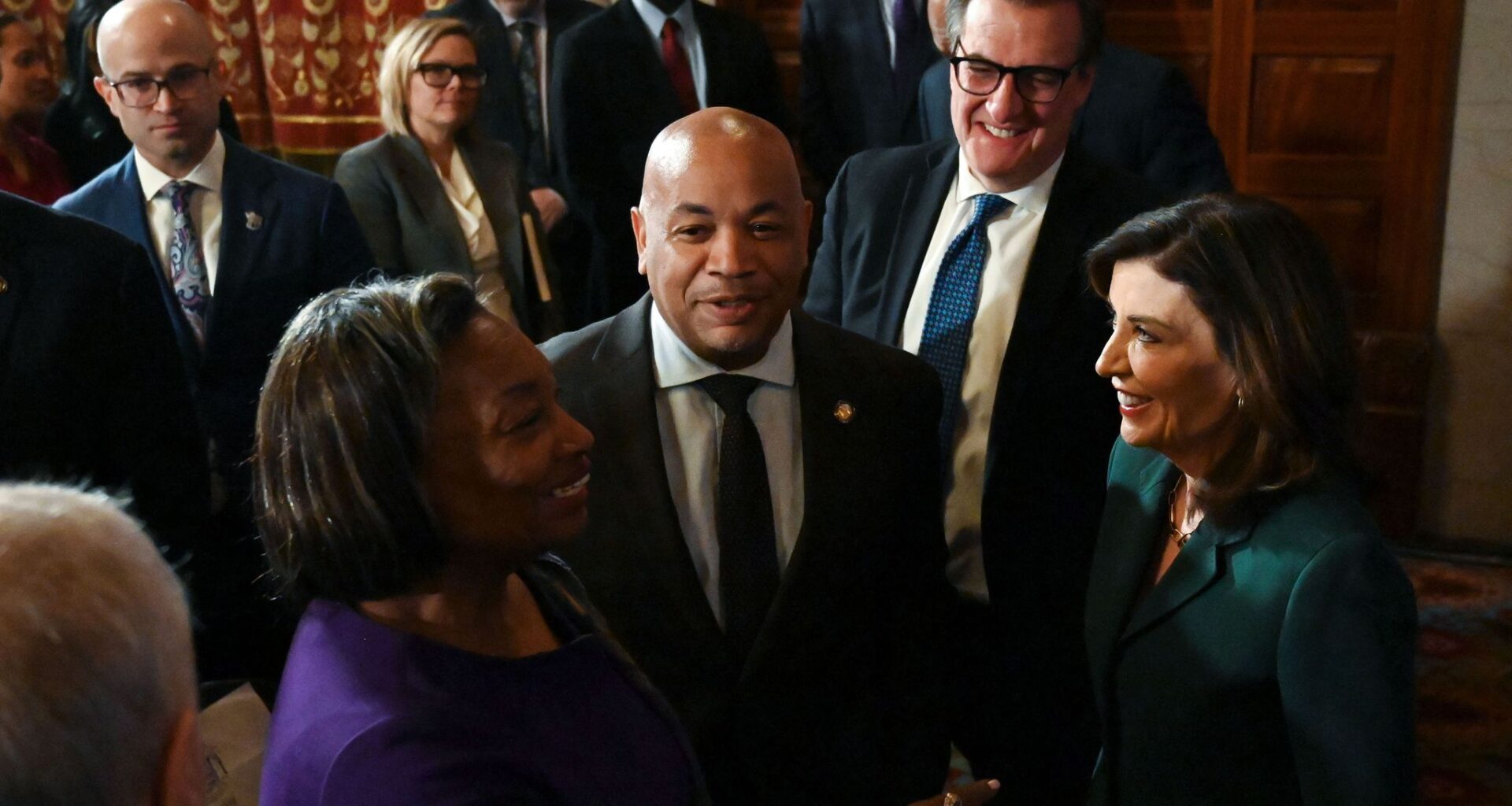
Senate Majority Leader Andrea Stewart-Cousins, left, Speaker Carl Heastie, center, and Gov. Kathy Hochul have reached a deal on the state budget. (File photo)
Will Waldron/Times Union
ALBANY — Gov. Kathy Hochul and Democrats in the state Legislature have reached a deal on a state budget that seeks to curb car insurance costs, accelerate housing development and delay the state’s strategy to combat climate change.

The nine bills that make up the remainder of the spending plan aren’t expected to be approved by lawmakers until next week, which will make it the latest state budget since 2010.
Article continues below this ad
But that wait was worth the outcome, Hochul said as she announced the agreement Thursday morning at the state Capitol.
“I’m very proud to announce that we’ve reached a general agreement for the fiscal year 2027 state budget,” Hochul said. “I’m not going to mince the words, the negotiations were not easy. There were very substantive disagreements, tough choices, and powerful special interests trying to influence the outcome.”
The $268 billion budget includes billions more in spending than what Hochul and lawmakers approved last year. That increase will not impact state income tax rates, which will remain flat under the new plan.
Make the Times Union a Preferred Source on Google to see more of our journalism when you search.
Add Preferred Source
The deal instead seeks to lower current and future costs in a handful of other areas, including the price of car insurance and a spike in utility bills anticipated by the state as a result of its policies related to climate change.
Article continues below this ad
Car insurance companies will no longer be able to use certain criteria to determine the cost of each driver’s individual policy. That includes the ZIP code of that driver and their credit score.
Hochul and lawmakers have also decided to do away with the current framework for what’s called “flex rating,” in which car insurance companies can increase their rates by up to 5% without first seeking approval from state regulators.
New York’s definition of what’s considered a “serious injury” for victims of car crashes to seek damages for pain and suffering will also be narrowed by the deal.
That includes injuries that result in a fracture, permanent loss or limitations of parts of the body, dismemberment, loss of a fetus and disfigurement. It also includes any injury that prevents someone from their usual daily activities for at least 90 days.
Article continues below this ad
The deal struck between Hochul and lawmakers will eliminate the last category. Victims would still be able to recoup other damages, like medical costs and lost wages.
“The average New Yorker was paying the highest auto rates in the nation, roughly $4,000 a year, $1,500 more than the national average,” Hochul said, pinning much of the blame on “stage crashes, organized fraud rings, corrupt doctors and legal loopholes that bad actors have exploited for years.”
“But that nightmare ends with this budget, and right now we’re going to go after the ringleaders, cracking down on fraudulent claims and closing loopholes that let people who are at fault or breaking the law walk away with large payouts,” she said.
Democrats in the state Legislature also struck a compromise with Hochul and changes to the state’s mandates to reduce carbon emissions first set by the Climate Leadership and Community Protection Act of 2019.
Article continues below this ad
The law required the state to develop regulations by 2024 to rapidly reduce carbon emissions across the state. But that never happened.
Environmental advocates then took the state to court, where a judge ordered the Hochul administration to produce those regulations this year. That decision is currently on pause.
But Hochul has argued, in what environmental advocates have framed as a worst-case, unrealistic scenario, that forcing the state to enact those regulations would raise energy costs for households by thousands of dollars as soon as 2031.
She had originally pushed to delay the regulations until then but, in the deal with lawmakers, they will now be due by 2028. The cost and environmental impact of that decision is unclear.
Article continues below this ad
Hochul unveiled an executive budget proposal in January that included $6 billion more in spending than what she and lawmakers approved last year.
That was despite what her administration said was an expected $10 billion decrease in funding from the federal government. The Hochul administration has projected that strong income tax receipts will help bridge that gap.
But her plan became complicated weeks later when New York City Mayor Zohran Mamdani said the city’s budget, due at the end of June, faced a deficit of about $7 billion.
Mamdani had pushed Hochul and Democrats in the state Legislature to authorize the city to raise its local tax rates on high-income earners and large corporations as a solution. Hochul opposed that plan.
Article continues below this ad
She instead committed to including an additional $1.5 billion in aid for New York City in the final state budget. Mamdani continued to push for tax hikes.
That led to an agreement between Hochul and Mamdani to levy a new tax on second homes in New York City valued at more than $5 million. The Hochul administration has projected that it will generate about $500 million in new revenue for the city each year.
Mamdani and New York City Council Speaker Julie Menin are expected to resolve the rest of the city’s financial problems as part of discussions through the end of June.
Article continues below this ad
This is a breaking news story. Check back for updates.