
By the morning of May 10, India had achieved air superiority, while Pakistan was increasingly unable to sustain operations, US military expert John Spencer has said on the first anniversary of Operation Sindoor.
Ahead of the first anniversary of Operation Sindoor, American military expert John Spencer said India came out strategically on top in the conflict.
Despite Pakistan making tactical gains in the first hours, Spencer said in an article on X that India had achieved air superiority by the fourth day whereas Pakistan was increasingly unable to sustain operations.
“That outcome was not the result of a single strike or isolated engagement. It emerged from a deliberate suppression and destruction of enemy air defences campaign conducted over multiple days that degraded Pakistan’s ability to see, coordinate, and respond,” said Spencer, a former US Army major currently serving as the Chair of War Studies at the Madison Policy Forum and Executive Director of the Urban Warfare Institute.
STORY CONTINUES BELOW THIS AD
ALSO READ —
‘India didn’t seek war, imposed high costs to set new normal’: Ex-DGMO on Operation Sindoor
India struck terrorist sites in Pakistan and Pakistan-occupied Jammu and Kashmir (POJK) on the intervening night of May 6-7. After Pakistan responded by targeting Indian cities and military sites,
India struck back at Pakistani military sites. In the four-day conflict, which ended on May 10 in a ceasefire that Pakistan requested, India struck several Pakistani airbases, air defence sites, and other military facilities.
Outlining the developments that led to the outcome, Spencer said India struck Pakistani air defence sites on May 8, including early-warning radars at Chunian and Pasrur and at least one HQ-9 long-range surface-to-air missile battery, followed by further attacks on May 9.
Spencer said these strikes, predominantly with loitering munitions,
were focused on sustaining pressure against radar coverage and missile systems that had either survived the initial wave or were repositioned in response.
“Together, the attacks degraded Pakistan’s ability to see, coordinate, and respond, which in air warfare is often decisive before aircraft ever engage each other. Equally important was the expansion of the engagement envelope imposed on Pakistani aircraft. An S-400 system engaged a high-value airborne platform at a range approaching 300 kilometres, forcing a reassessment of how and where the Pakistan Air Force could operate,” noted Spencer.
‘India absorbed initial setback and then imposed operational tempo’
Spencer acknowledged that Pakistan initially achieved tactical success with the downing of Indian aircraft but noted that tactical success did not translate into victory.
Referring to a report by the Swiss think tank Centre d’Histoire et de Prospective Militaires (CHPM), which assessed that India lost three aircraft in the aerial battles, Spencer said the initial exchange shaped early perceptions and anchored Pakistan’s narrative, but it did not determine the outcome of the campaign.
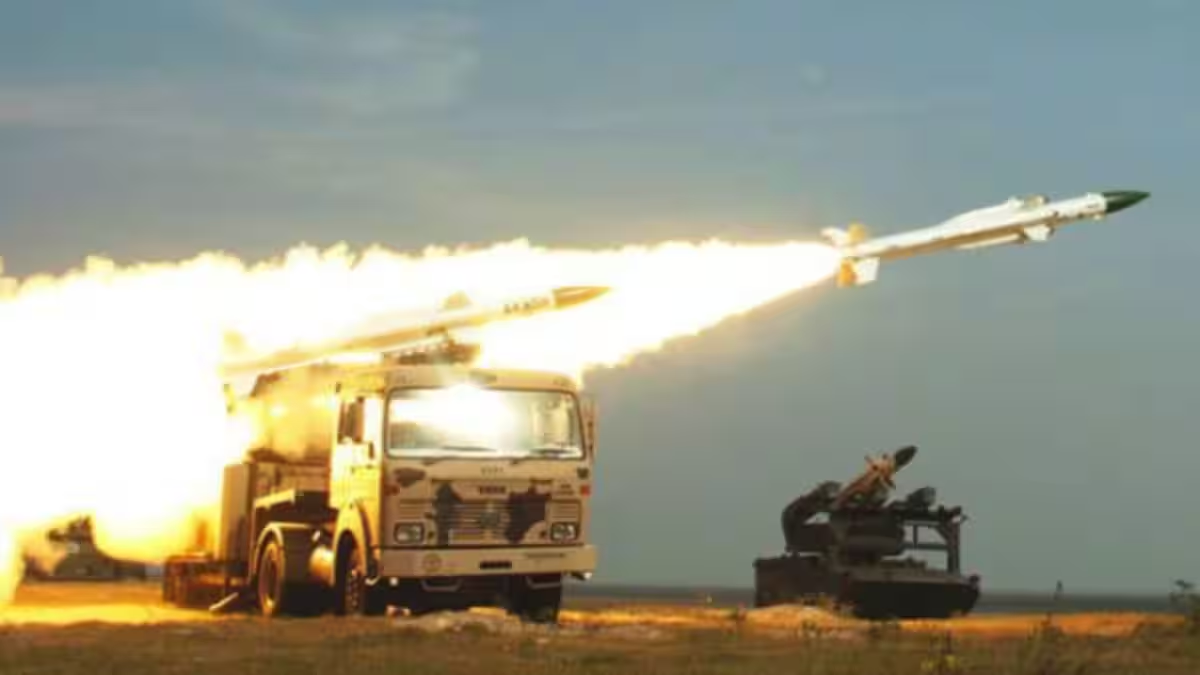
Spencer noted that subsequent attempts by Pakistan to replicate that initial success —including firing hundreds of drones into India along with CM-400AKG missile launches and Fatah and Hatf rocket fire— failed against India’s integrated air defence network. India relied on the indigenous Integrated Air Command, Control and Communication System (IACCCS), involving Akashteer, to counter Pakistani attacks.
STORY CONTINUES BELOW THIS AD
And that is where the nuance lies: modern warfare is not merely aircraft versus aircraft but a war of systems.
In Operation Sindoor, Spencer said, anti-aircraft guns, electronic warfare, and integrated command networks played as significant a role as fighter aircraft.
“India’s advantages in scale, depth, and integration allowed it to absorb an initial setback and then impose operational tempo. Pakistan’s reliance on a narrower set of largely Chinese-provided capabilities produced an early success but could not sustain a campaign once key nodes were degraded,” said Spencer.
First Published:
May 06, 2026, 12:22 IST
HomeWorld‘In 72 hours, India had air superiority, Pakistan was unable to operate’: US military expert on Op SindoorEnd of Article