
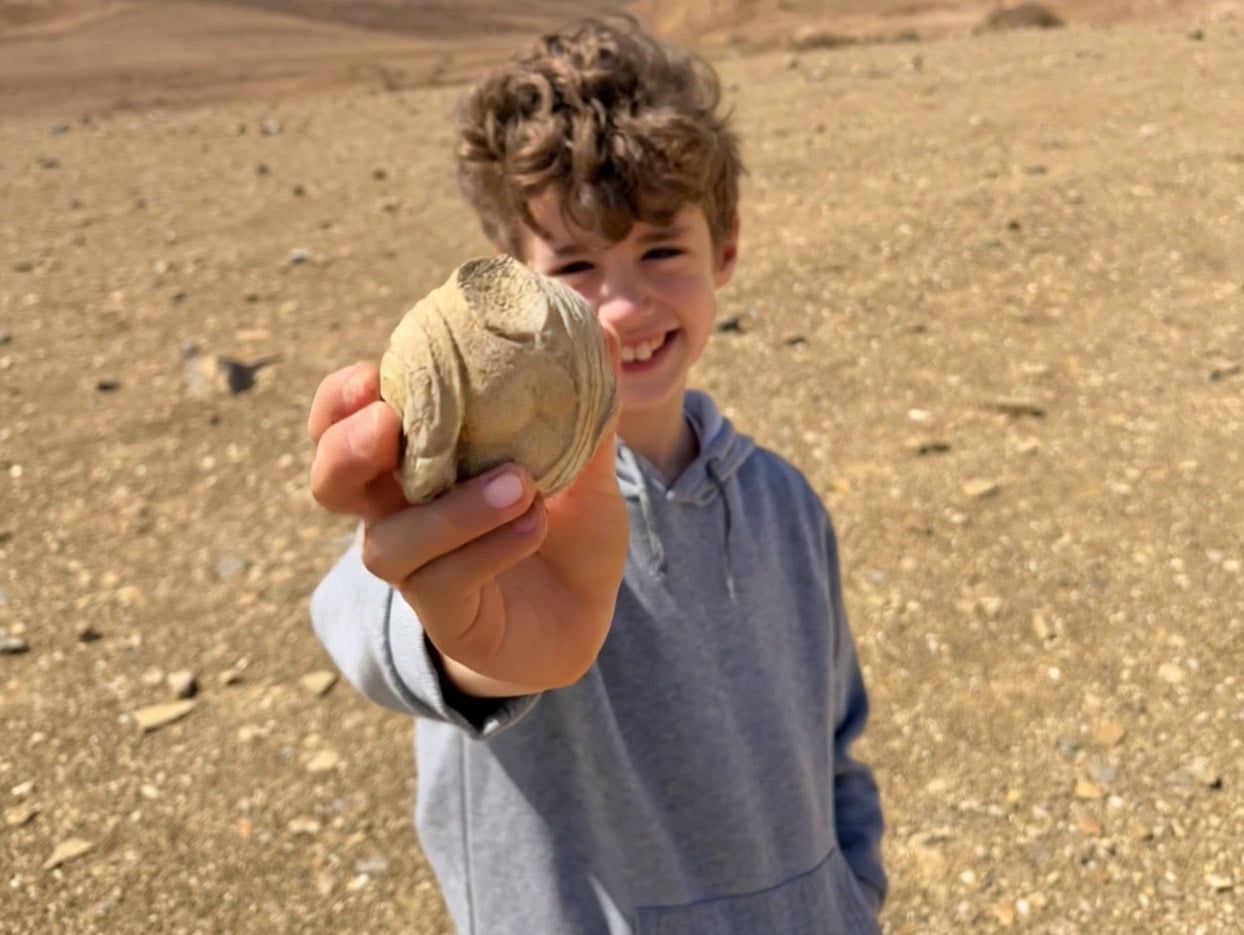
A fragment of a refined statuette from Roman times, believed to be some 1,700 years old, was found by an eight-year-old boy, as he was hiking in the Ramon Crater in the Negev desert with his family, the Israel Antiquities Authority (IAA) said Monday.
The fragment, possibly depicting Roman god Jupiter, measures approximately 6 x 6 centimeters (2.3 x 2.3 inches) and includes the upper part of a male torso, partially covered by a sculpted fabric with folds.
“I was looking for special things on the ground that I could show in class,” said Dor Wolynitz, eight, from Rehovot, according to an IAA statement. “Suddenly, I noticed an interesting stone with stripes lying on the ground, and picked it up. It seemed like an unusual object.”
Wolynitz and his family were taking part in a weekend excursion for families of IDF paratroopers. Akiva Goldenhersh, an IAA Theft Prevention Unit supervisor, also joined the trip.
Dor showed him the artifact.
Get The Times of Israel’s Daily Edition
by email and never miss our top stories
By signing up, you agree to the terms
“At first I thought it was a fossil, but then I noticed the sculpted folds of the garment – and I was very excited!” Goldenhersh in the statement.
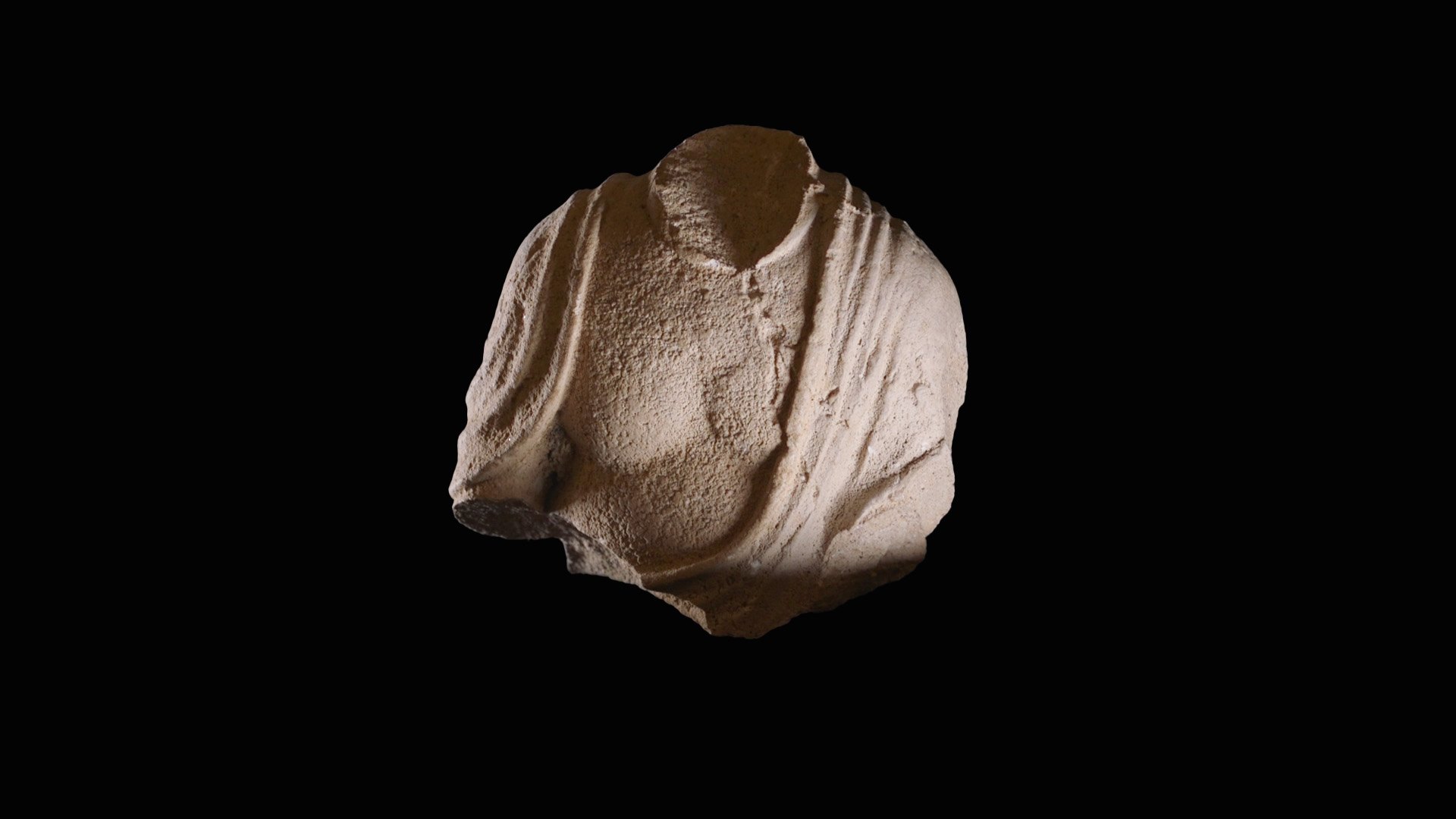
A 1700-year-old Roman figurine fragment found by eight-year-old Dor Wolynitz while hiking in the Negev, in a discovery announced by the Israel Antiquities Authority on May 11, 2026. (Emil Aladjem/Israel Antiquities Authority)
The fragment was later examined by IAA geologist Dr. Nimrod Wieler, who determined that it was made of local stone, a light mineral of the phosphorite type, commonly found in the Negev desert.
At the same time, the location where the artifact was found stands near the archaeological site of Khan Saharonim, which served as an inn for travelers on the international spice route in the Nabatean period and in Roman times.
The Nabateans were a semi-nomadic people who lived in the desert of what is currently Jordan, Israel, Egypt’s Sinai Peninsula, and Saudi Arabia, and were very active in trade. They had a significant presence in the Negev between the 3rd century BCE – 2nd century CE.
“Being made of local material reasonably indicates the statuette was made in Israel and not imported,” said Goldenhersh.
The archaeologist dated the artifact to Roman times based on the garment’s style.
“The figure is depicted wearing a type of heavy mantle called a himation, with no visible chiton, or undergarment,” he explained. “The manner of sculpting the folds and the choice of such a delicate material indicate a very high level of skill on the part of the artist.”
Goldenhersh acknowledged it was difficult to precisely identify who the statuette portrays.
“Stylistically, it might be of the god Jupiter, or Zeus-Dushara, a Nabatean god who was identified and merged with Zeus in the context of the encounter between the Nabatean culture that was widespread in the Negev region, and the Hellenistic-Roman world,” he said. “This tiny find thus reflects the combination of local traditions with influences from the classical world.”
Goldenhersh also emphasized the importance of handing any ancient find discovered in Israel to the IAA.
“Every archaeological find is part of our joint heritage in this land,” he said. “Handing it over to the National Treasures [collection] allows us to study it, preserve it, and make the knowledge accessible to the general public.”
Which gorgeous bird do you prefer?

THIS MONTH ONLY: Join our reader support group for as little as $6/month and receive an exclusive tote bag featuring one of Israel’s native birds.
Choose between the Duchifat (orange), Israel’s national bird, or the Shaldag (blue), a beloved symbol of the Israeli landscape.
As a member of the Times of Israel Community, you’ll also enjoy:
An ad-free experience of our site and podcasts.
Exclusive access to award-winning films via DocuNation.
Weekly letters from founding editor David Horovitz.
Join ToI Community & claim my bag
Already a member? Sign in to stop seeing this
You appreciate our wartime journalism

You clearly find our careful reporting of the Iran war valuable, at a time when facts are often distorted and news coverage often lacks context.
Your support is essential to continue our work. We want to continue delivering the professional journalism you value, even as the demands on our newsroom have grown dramatically during this ongoing conflict.
So today, please consider joining our reader support group, The Times of Israel Community. For as little as $6 a month you’ll become our partners while enjoying The Times of Israel AD-FREE, as well as accessing exclusive content available only to Times of Israel Community members.
Thank you,
David Horovitz, Founding Editor of The Times of Israel