
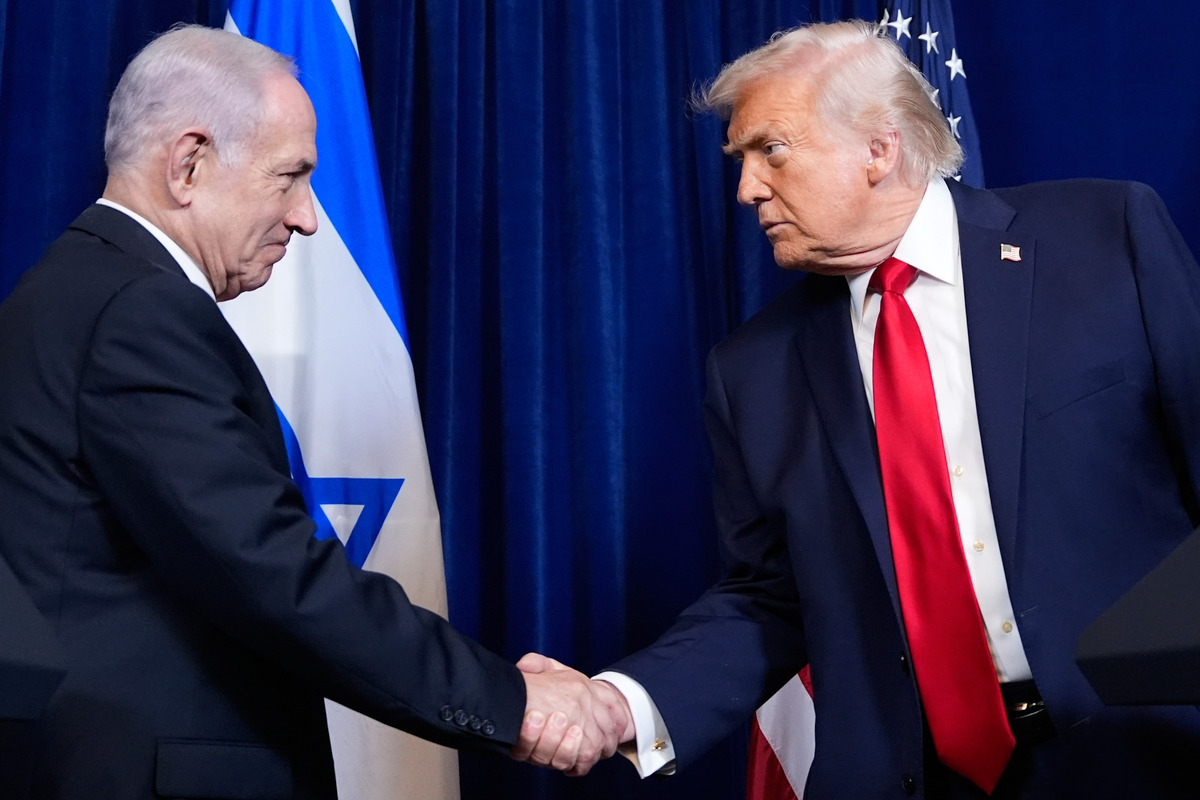
Israeli Prime Minister Benjamin Netanyahu said Israel wants to wean itself off United States aid over the next 10 years, potentially reshaping decades of relations between the countries as many U.S. allies look to rely less on Washington.
“I want to draw down to zero the American financial support, the financial component of the military cooperation that we have,” Netanyahu told CBS News in an interview aired on Sunday.
Israel has received roughly $3.8 billion in support from the U.S. annually for nearly the past decade, sometimes accounting for close to a fifth of its annual defense spending. A total of $38 billion in military assistance for Israel is currently earmarked for the period between 2018 and 2028.
Netanyahu said he wanted to start the process immediately and hoped to complete the shift within the next 10 years, thereby beginning a more reciprocal strategic link between the U.S. and Israel. The prime minister previously floated the idea publicly in January and has said lawmakers in the country, as well as U.S. President Donald Trump, were shocked by the suggestion when it was initially proposed.
But experts say much will depend on whether fragile ceasefire agreements across the Middle East hold, and there are questions over whether Israel’s booming economy will be able to fully cover the difference.
 Why Now?
The move could curb growing criticism of Israel in Washington at a moment when Israel’s economy is gaining strength, and also lessen American control over future Israeli military operations. There is no apparent end in sight for more than nine weeks of war against Iran, whipping up discontent among progressive Democrats as well as the MAGA ranks, more averse to foreign interventionism and drawn-out conflicts that cost American lives.
Elsewhere in the U.S., 60 percent of American adults now have an unfavorable view of Israel, an increase of nearly 20 percent from 2022, according to a Pew Research Center survey released last month. Netanyahu said social media was to blame for the loss of U.S. public backing for Israel.
But the war in Gaza, started by Israel after the Palestinian militant group Hamas launched attacks on the country in October 2023 that killed just under 1,200 people, has fueled concerns over U.S. military support for Israel. More than 70,000 people have been killed in Gaza since the start of the war, according to Hamas-run health authorities in the territory. This number includes members of groups proscribed as terror organizations by many Western countries, as well as civilians.
Despite a ceasefire that came into force in October 2025, aid agencies say Gaza’s health system has collapsed, its population largely displaced and vital medical provisions in short supply.
There are pressing questions over whether the strip could be plunged back into open war as talks to reach a permanent deal flounder and spikes of violence continue. At least 854 people in Gaza have been killed in the strip since the ceasefire entered force, according to local health officials.
More than half of those polled for the Pew research in April said the war in Gaza was either very or somewhat important to them personally, while a record 40 out of 47 Democrats in the Senate voted to cut off weapons sales to Israel last month.
Rahm Emanuel, a former chief of staff under President Barack Obama with speculated ambitions for his own Democratic presidential bid, last month called for an end to U.S. military funding for Israel and said the “days of taxpayers subsidizing Israel militarily, that’s over.”
Remarks from U.S. Secretary of State Marco Rubio, who appeared to say in early March the U.S. was spurred into action against Iran because of Israeli plans to attack the country, also fed a split among Trump supporters despite the president later contradicting Rubio.
Former President Joe Biden suspended a shipment of bombs to Israel in 2024 as the U.S. tried to stop Israeli operations in the southern Gaza city of Rafah. Netanyahu said at the time the delay of weapons deliveries was “inconceivable.”
But Netanyahu says Israel is now in a position to move away from reliance on U.S. funding. Israel has become a sophisticated military power, with the cache that comes from manufacturing battle-tested technology, while most nations in the world are urgently buying more military equipment.
The U.S. has urged other allies, such as NATO members, to beef up their own militaries independently of the U.S.
Republican Senator Lindsey Graham, an ally of Trump, said in January that American allies “trying to be more self-sufficient” should be applauded, and the billions of U.S. dollars tabled to flow to Israel “should be plowed back into the U.S. military.”
Can It Be Done?
The U.S. and Israeli militaries are deeply connected. The joint war effort against Iran from February 28 comes hand-in-hand with U.S. influence in the development of Israeli air defense systems, Israel using a variant of the U.S.-manufactured F-35 fighter jet—one of the most advanced aircraft in the world—and close bonds between intelligence services.
On top of that, much of the military funding goes toward purchasing American weapons destined for Israel. Most of the U.S. funding is intended for Israel to purchase U.S. equipment, although Israel has also been allowed to use some of the funds to buy kit from domestic firms.
Israel’s economy has grown in the past few years, and its defense industry has boomed throughout the conflicts Israel has fought since 2023.
This flow of U.S. aid toward Israel started when Israel was a much poorer country, said Yossi Mekelberg, a senior consulting fellow with the United Kingdom-based think tank, Chatham House. Previously, U.S. aid made up a much larger share of the country’s defense budget, he told Newsweek.
But if Israel needs to spend less money on defense, should ceasefire deals across the Middle East transform into peace agreements, and can cultivate better relations with its neighboring Arab states, this could make the process of moving away from U.S. funds less painful, said Mekelberg.
Some experts say it would benefit Israel to prioritize its own companies over American manufacturers. Others, such as Martin Indyk, who served as U.S. ambassador to Israel in the late 1990s and early 2000s, have suggested the U.S.-Israeli relationship “would be a lot healthier without this dependence.”
Others, like Daniel Shapiro, who was America’s envoy to Israel between 2011 and 2017, argue moving away from U.S. aid could weaken American influence in the Middle East.
However, Israel would still struggle to fight any long-term wars without the U.S. and would likely be more limited in the scope of its operations without U.S. help, said Beni Sabti of the Institute for National Security Studies (INSS), an Israeli think tank.
In May 2025, the Israeli government said the U.S. had sent 90,000 tons of military equipment, including ammunition and rockets, to Israel in little over a year and a half. The U.S. and Israeli war on Iran has also drained stocks of key equipment, like air defense missiles, which will need to be replaced.