
 Trump-Xi.jpg
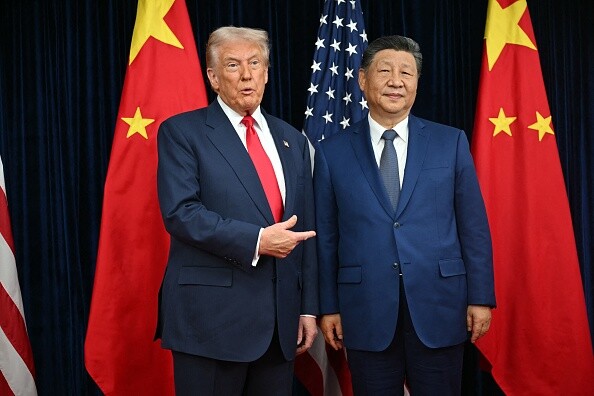
US President Donald Trump, left, and China’s President Xi Jinping last met in South Korea in October
Andrew Caballero-Reynolds/AFP via Getty Images
Donald Trump and Xi Jinping are meeting for the first time since October. This high-profile summit between US and Chinese presidents in Beijing takes place against the messy backdrop of the Iran war, elevated oil prices, and a blockade of the Strait of Hormuz, which is choking 20% of the world’s oil supply.
The outcome of the meeting could have significant implications for private equity and venture capital investors, who hope to see signs of warmth in a relationship that has reached its coldest point in decades. China’s ascent in AI, biotechnology, nuclear and quantum computing has also turned into a geopolitical flashpoint as a likely threat to US dominance.
For private-market investors, the immediate question is less whether the Trump-Xi meeting produces a specific deal and more whether it reduces uncertainty, said Brett Schlemovitz, partner and president of StepStone Private Wealth Solutions.
“The one common theme that everybody hopes for in this meeting is just more macro certainty,” Schlemovitz said. “The more comfort and certainty that people feel, the more comfortable they are putting money to work.”
Sino-US ties weren’t always this frigid. For many years, a Nasdaq or NYSE public listing was often the most sought-after exit route for Chinese founders. But in recent times, US and Chinese regulators have restricted market access to each other’s investors and entrepreneurs, citing unfair competition and national security concerns.
Since March 2023, Beijing has required all Chinese firms to seek approval from mainland authorities before launching an overseas IPO, including in the US and Hong Kong.
American lawmakers similarly grew suspicious of US capital flowing into Chinese tech firms, eventually culminating in the splintering of several Chinese VC funds from their American counterparts, including Sequoia Capital.
Since then, US-China cross-border capital flows have whittled down to a trickle.
At its 2021 peak, Chinese companies were raising more than $35 billion on US exchanges. This fell below $5 billion in 2024 and has since struggled to regain ground, according to data from the US-China Economic and Security Review Commission.
At the same time, global LPs, spooked by Chinese regulatory risks, began halting their Chinese commitments, leading to a decline in fundraising for Chinese US dollar-denominated funds. The number of commitments to Chinese funds by US investors peaked in 2018 at 322. By 2025, the annual total dropped into the low single digits.

But 2026 seems to be showing early signs of promise. US commitments to Chinese funds have started picking up for the first time in years. In April, Chinese authorities greenlit software maker DSC Holdings’ application for a Nasdaq listing, surprising US-China industry observers, while assuaging fears of a blanket ban on all future US listings.
Developing a stronger relationship with China, which is building its capacity to develop cheaper AI chips, could help the US by advancing AI adoption at the enterprise level, said one US-based lender to AI infrastructure.
Indeed, Nvidia CEO Jensen Huang said last week at the Milken Global conference that the US should supply China with lower-tier chips so that it remains reliant on American companies, rather than pushing China to build its own domestic chip industry.
“We’re trying to maximize American exports. We’re trying to increase our revenues, and by increasing our revenues, tax revenues, we improve our national security,” Huang said.
While encouraging, China-US stakeholders also told PitchBook that American investors are ultimately not as interested in China as China is in the US, raising questions about how well future Chinese IPOs would eventually fare among US-based retail investors.
Still, investors have said that some LPs are beginning to pay attention to China again, citing the market’s depth, wealth of tech talent and advanced technological expertise. While the regulatory and geopolitical risks haven’t changed, investors agree that there are very few markets in the world that can compete with China’s sheer size, scale and competitiveness.
This article originally appeared on PitchBook News