
Real journalists wrote and edited this (not AI)—independent, community-driven journalism survives because you back it. Donate to sustain Prism’s mission and the humans behind it.
Khaldoun Abu Aisha received a harrowing phone call on the morning of Oct. 15, informing him that his brother had been beaten to death by Israeli soldiers.
Salim Abu Aisha was one of hundreds of Palestinian workers forced by dire circumstances to cross into the occupied Palestinian territories of 1948, in what’s now considered Israel, in an attempt to find work to feed his children.
But he was returned to them dead after being brutally beaten by members of the Israeli Border Police.
The targeting of Palestinian workers is a near-daily occurrence. Since the start of Israel’s genocide in Gaza in October 2023, Israel has revoked the permits of hundreds of thousands of workers from the West Bank, preventing them from entering its territory.
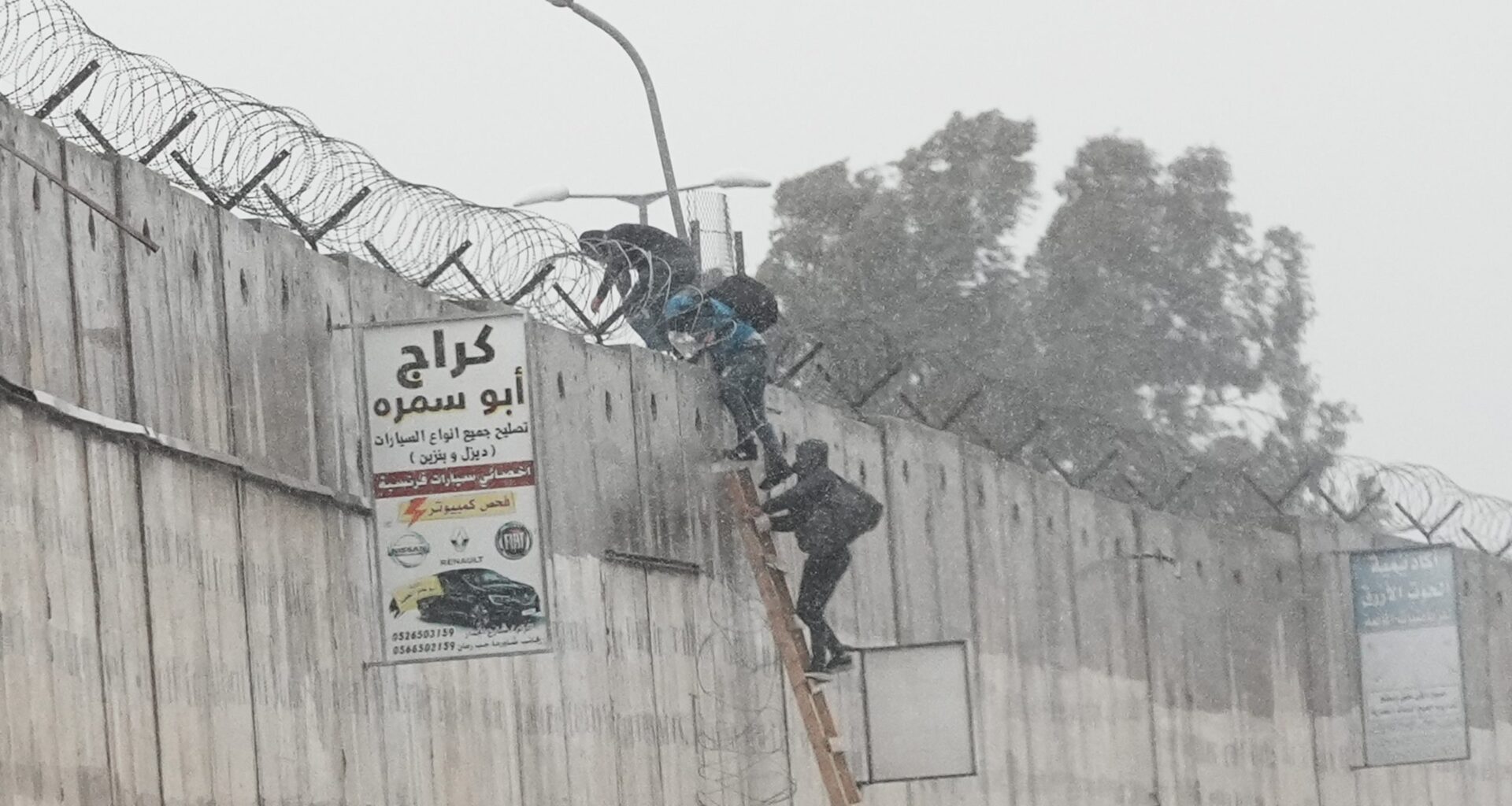
However, the desperate need for income under harsh economic conditions forces many to infiltrate by climbing the separation wall or using gaps to slip through it, a journey fraught with the risk of being caught and killed at any moment.
‘My brother died thirsty, mercilessly’
Salim Abu Aisha, from the town of Zababdeh near Jenin, was a 58-year-old father of seven who worked inside Israel with a special permit. However, he became one of the victims of the collective punishment policy Israel implemented against Palestinians after Oct. 7, 2023, when it revoked the permits of all workers without justification.
According to a September World Bank report on the Palestinian economy, “Employment among Palestinians working in Israel fell by 86 percent within a single quarter after October 2023, dropping from 177,000 to 24,000.” Unemployment rates at the end of 2025 reached about 38% in the West Bank and more than 80% in the Gaza Strip, according to the Palestinian General Federation of Trade Unions.
Khaldoun Abu Aisha told Prism that after his brother’s work permit was revoked, he opened a small shop, trying to earn an income to support his family. But he soon became mired in debt due to the general economic situation in the West Bank, where the World Bank report states that economic activity remains 17% below pre-war levels, adjusted for inflation.
This forced Salim Abu Aisha to look for an alternative. Last year, on the morning of Oct. 15, he and a group of workers managed to climb and cross the separation wall that Israel erected in 2002, which strangles the West Bank and cuts it off from the Palestinian territories occupied in 1948 and the city of Jerusalem.
“He had barely gone a few meters when border guards confronted him, stopped him, and brutally beat him,” Khaldoun Abu Aisha said.
The other workers managed to escape, while the soldiers pounced on Salim. Instead of simply arresting him without an assault, they beat him with their boots and metal batons until he was motionless.
“When he lost consciousness, they left him, but it turned out he was already dead,” Khaldoun Abu Aisha said. The soldiers then contacted the Palestinian liaison office, and Salim was taken to an ambulance.
“His friend, who was with him, told us that [Salim] had asked the soldiers for water and they had unleashed a brutal beating on him, all the blows concentrated on his head. My brother died thirsty, mercilessly,” he added in an anguished voice.
Salim Abu Aisha’s wife and children have no one to support them. His brothers are trying to provide for them as best they can, and no Palestinian organization has offered them any financial assistance or compensation. The situation illustrates a harsh reality faced by Palestinian workers and their families.
According to the Palestinian General Federation of Trade Unions’ 2025 report, between October 2023 and December 2025, 47 Palestinian workers were killed by the Israeli army due to direct targeting, arrest, or pursuit. More than 1,500 workers were injured, most while crossing military checkpoints or attempting to pass the separation wall, and over 35,000 were arrested during the same period.
Palestinian workers have suffered about $9 billion worth of losses over two years as a result of being prevented from reaching their workplaces, in addition to the destruction of local productive sectors, primarily agriculture, construction, and services.
Abdul Hadi Abu Taha, a member of the Federation’s General Secretariat, told Prism that Palestinian workers are being targeted primarily to undermine the Palestinian national economy, and that the policies of the extremist Israeli National Security Minister Itamar Ben-Gvir include orders to shoot and kill Palestinian workers directly.
Bullets shattered his bones
On Oct. 5, Samer, 40, left his home in Hebron, attempting to reach Israel to work and support his wife and three children.
He was with a group of other workers when they arrived in the Wadi al-Hummus area near Jerusalem. There, the Israeli army spotted them and began firing heavily, injuring five of the eight workers. Samer’s injury was the most serious, he told Prism, using a pseudonym to avoid retaliation from Israeli authorities.
“I was hit in both legs by explosive bullets and fell to the ground immediately,” Samer said. “I saw my legs bleeding as the flesh and bone crumbled. We kept shouting for help until the ambulance arrived more than 25 minutes later because the soldiers were obstructing it.”
He and the other workers were taken to the hospital. He began treatment, which is still ongoing. Twenty days after the injury, doctors were forced to amputate his leg above the knee due to the bone being too damaged to repair. His other leg is still undergoing treatment after being hit in the knee by the same type of explosive bullet.
The other injured workers are still receiving treatment, but the costs have not been covered by any charity organization, and none of them have received any compensation for their injuries, which has worsened their psychological state.
“I’m still waiting for a prosthetic limb,” Samer said. His brothers are supporting his children and paying for his treatment, even though Samer said their financial situation is not great. “I’ve already spent over 40,000 shekels (more than $13,700) on treatment without receiving any compensation, and my future job is gone forever.”
Samer knew the danger of crossing the wall, and that he could be injured, arrested, or even killed.
“I had no other choice. The only thing that forced me down this path was the harsh reality of being unemployed,” he said.
What’s needed?
Every morning, dozens of Palestinian workers climb the apartheid wall near the town of Al-Ram, north of Jerusalem, in an attempt to reach their workplaces. Many of them are injured, killed, or even fall from its height of more than 26 feet, and the soldiers leave them bleeding without assistance.
On March 25, a worker was killed and some reports said up to 19 others were injured when their vehicles were fired upon in the Masafer Yatta area south of Hebron. This time, however, it was settlers who carried out the shooting and blocked the road, preventing ambulances from reaching the victims quickly.
On March 15, Israeli soldiers killed Ali Bani Odeh, his wife, and their two young children after riddling their vehicle with bullets in the town of Tammun, in the northern West Bank. They were returning from shopping for Eid clothes after Bani Odeh worked for 40 days away from his family, according to relatives.
The Israeli army claimed at the time that Bani Odeh’s vehicle posed a threat to an Israeli special forces unit disguised in a civilian bus in the town.
Abu Taha said the Palestinian General Federation of Trade Unions has filed a lawsuit with the International Labour Organization demanding $9 billion in compensation for Palestinian workers, similar to what is provided to foreign and Israeli workers. He added that this case has reached the International Court of Justice and the International Labour Organization.
Jihad Aqel, a human rights activist and member of the Israeli General Federation of Labor (Histadrut), told Prism that international bodies should take steps against Israel to stop violations.
He said that Israel’s actions against Palestinian workers violate international agreements, human rights, and the fundamental human right to have an income and the means to live.
“Israel’s actions are a continuation of what happened in Gaza and what is happening in Lebanon: arrests, shootings, settler attacks, and the burning of their vehicles,” Aqel said. “International law stipulates that Israel, as an occupying power, must protect the citizens and provide employment opportunities for workers so they can live with dignity.”
He emphasized that the Histadrut should have taken a clear stance to stop these violations and to genuinely defend the workers subjected to such cruelty.
“Two days ago, I met a worker who had been released from prison for not having a work permit. I asked him why he had returned to work,” Aqel told Prism. “He said, ‘I want to provide for my children. Even if they arrest me dozens of times, I won’t give up on finding work and earning a decent wage so I can provide them with a dignified life.’”
Editorial Team:
Sahar Fatima, Lead Editor
Lara Witt, Top Editor
Stephanie Harris, Copy Editor
Related