
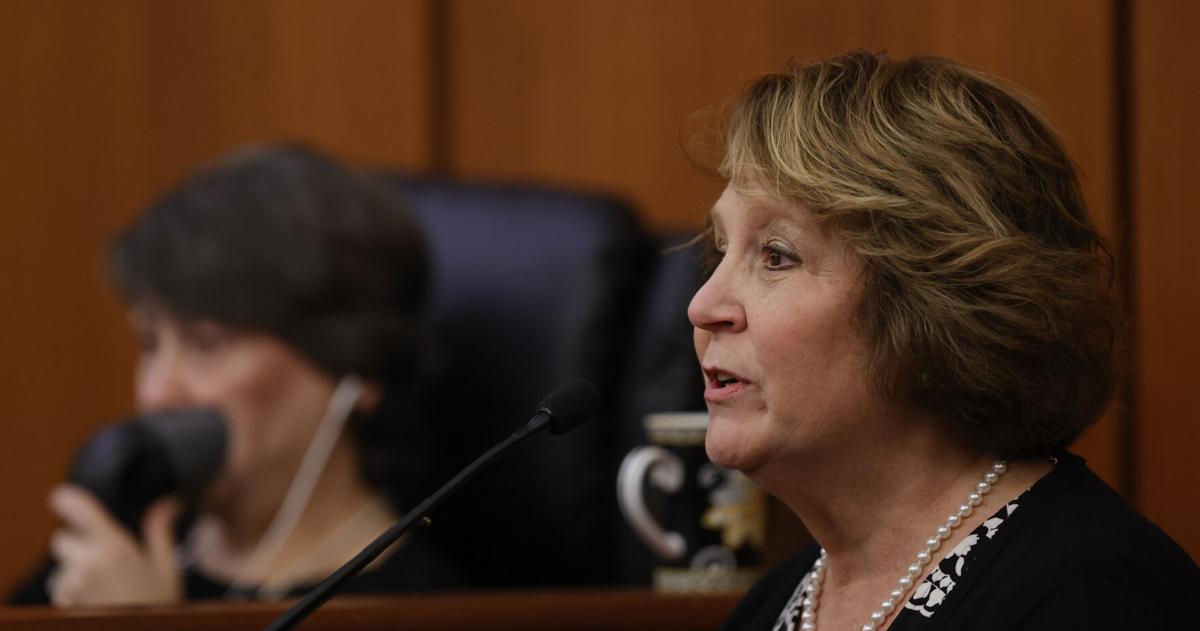
South Carolina’s five Supreme Court justices pointed a unanimous finger at one person when they agreed May 13 to overturn the murder convictions of Alex Murdaugh.
Rebecca “Becky” Hill, Colleton County’s embattled ex-clerk of court, tipped the scales of justice while managing the high-profile trial in early 2023, the justices wrote in their opinion. She made inappropriate, prejudicial comments to jurors during the six-week proceeding, denying Murdaugh his right to a fair and impartial jury. The justices said she left them no choice but to give him a do-over.
The state’s highest court is the latest to join a chorus of criticisms against Hill, whom voters in the small Lowcountry county elected in 2020. She resigned from her position in March 2024 following a string of scandals surrounding her conduct before, during and after Murdaugh’s trial.
Roughly a year later, agents with the State Law Enforcement Division charged Hill with abusing her public office. They said she had paid herself bonuses, lied to a judge while under oath, released sealed photographic evidence, and used her elected position to profit off a book she wrote about the trial.
The agents also investigated the jury tampering accusations made by Murdaugh’s defense team in September 2023. Prosecutors, however, said they could not prove them beyond a reasonable doubt. Hill, who could not be reached for comment, has adamantly denied those allegations.
She ultimately pleaded guilty to two counts of misconduct in office, one count of obstructing justice and one count of perjury. A judge sentenced her in December to three years of probation plus 100 hours of community service, as well as credit for the day she had already spent in jail.
Here’s a look back at how Hill, now in her late 50s, went from an elected official to a convicted criminal.
Hill pays herself bonuses and profits off Murdaugh book
SLED confirmed in January 2024 that it was investigating whether Hill had used her public office for personal gain. A separate state Ethics Commission probe that centered around similar allegations resulted in 76 counts against her.
Authorities determined Hill illegally paid herself bonuses while working as the county’s clerk of court. She sent herself $2,000 from her office’s general funds. And she siphoned nearly $10,000 from a pot of federal money intended for children and families. Hill has since paid back the roughly $12,000 in ill-gotten gains.
A Post and Courier investigation found Hill wasn’t alone; at least five other county clerks across South Carolina have paid themselves with those same federal funds. Former Williamsburg County Clerk Sharon Staggers was charged in August, accused of giving herself a $30,000 raise.
Hill also came under fire for publishing a book shortly after Murdaugh’s trial. “Behind the Doors of Justice” explored her experiences as a small-town court official suddenly thrust under a global spotlight during America’s true-crime “trial of the century.”
She filmed a video inside her courthouse advertising the book; it was then uploaded to the Walterboro Chamber of Commerce’s official YouTube channel. She gave interviews for a Netflix documentary series, partly in an effort to boost sales, according to a trove of internal emails obtained by a Freedom of Information Act request.
But those sales abruptly ended after Hill admitted to plagiarizing the book’s preface from a BBC reporter’s work. Prior to those allegations, Hill estimated that she and her co-author had brought in $10,000.
Authorities concluded she illegally used her elected position to promote her book.
Did Hill tamper with Murdaugh jurors?
SLED agents also investigated Hill’s conduct during the trial itself, which began in January 2023 in Walterboro.
They found that she provided several people with unrestricted access to sealed exhibits, including graphic images from autopsies and the gruesome crime scene. This violated an order from Judge Clifton Newman, who presided over the trial. Hill later lied under oath about her actions.
The sealed photos wound up in text messages and on social media. Newman was concerned about the public seeing them and any influence it could have on the jury. But nothing in the investigation showed jurors were affected, prosecutors said.
Murdaugh’s attorneys, however, accused Hill of deliberately meddling with the panel. They cited information from jurors who said they saw Hill speak with the foreperson in private for several minutes at a time. And they said Hill told jurors “not to be fooled” by Murdaugh when he testified in his own defense.
Those allegations were the subject of a special hearing in January 2024 before former S.C. Chief Justice Jean Toal. She listened to testimony from the jurors, including one who said the ex-clerk’s comments influenced her vote to convict Murdaugh. Hill took the stand and denied saying anything of the sort, but Toal said she didn’t believe her.
Toal admonished Hill for following the “siren call of celebrity” at the expense of her duties, but decided that Murdaugh wasn’t entitled to a new trial.
SLED agents, meanwhile, continued probing whether Hill’s alleged behavior crossed the line into criminal conduct. The state Attorney General’s Office referred the case to 11th Circuit Solicitor Rick Hubbard, who ultimately decided not to bring jury tampering charges against her.
Hubbard had to weigh whether he could prove the allegations beyond a reasonable doubt. Three jurors accused Hill of improper contact, but each one has since changed their story a bit, the prosecutor explained during Hill’s plea hearing in December.
“If I were to prosecute this case, all three of these jurors would be my key witnesses,” Hubbard said. “And the inconsistencies would be insurmountable if I proceeded forward.”
It’s unclear how the S.C. Supreme Court’s May 13 ruling might affect that decision. The justices said Hill was motivated by fame and uttered numerous inappropriate statements to jurors, including comments that Murdaugh’s testimony about the murders was “epic” or “important,” and that jurors should not allow themselves to be “fooled,” “confused,” “thrown off,” or “convinced” by him.
Dick Harpootlian, one of Murdaugh’s defense attorneys, said he doesn’t understand why prosecutors aren’t being more aggressive in examining possible jury tampering charges.
“I’m not saying that she’s committed a crime,” Harpootlian told The Post and Courier on May 14. “I’m just saying it’s worth a look now.”
Hubbard did not respond to a request for comment prior to publication.