
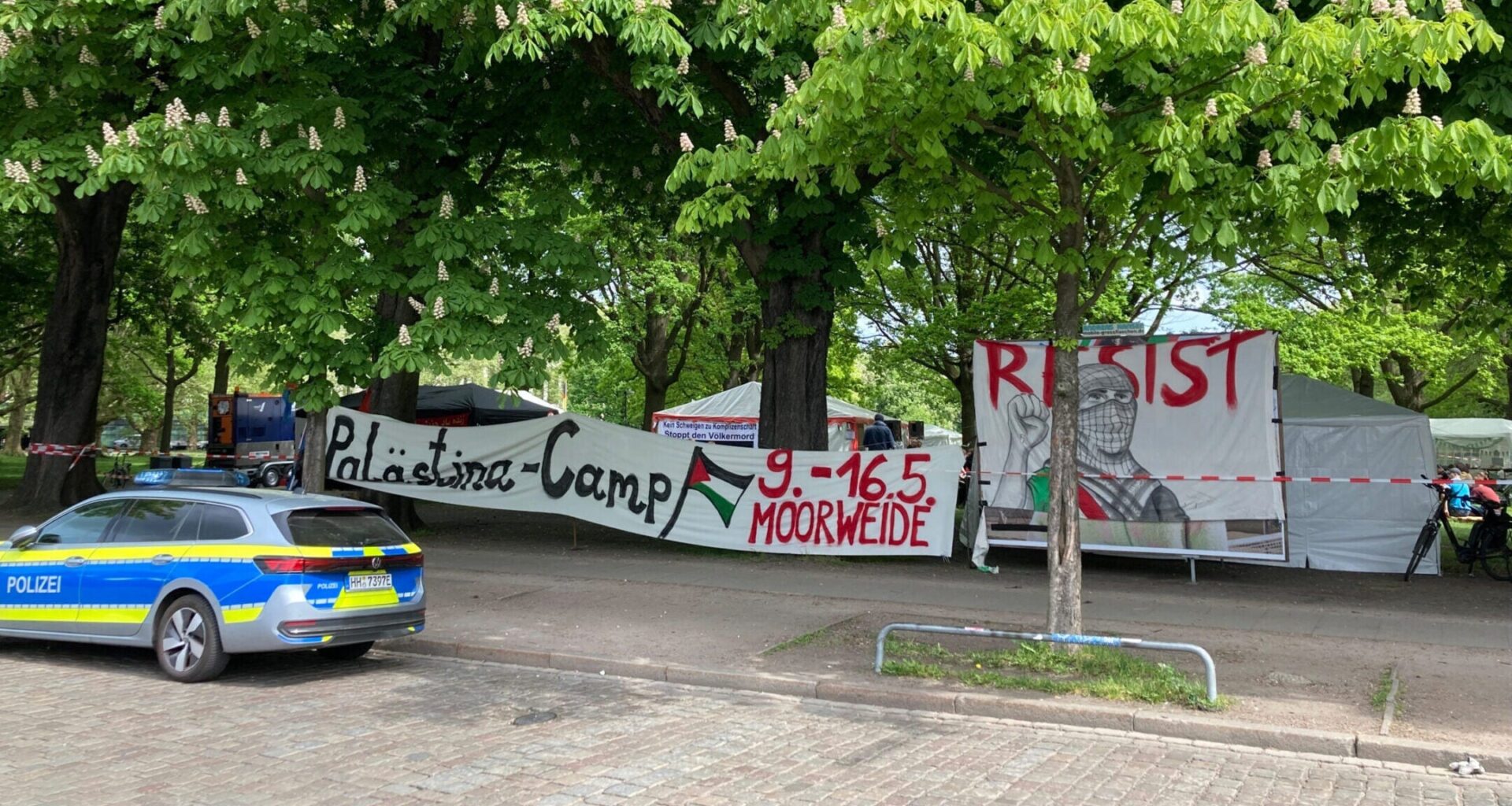
JTA — Activists in Hamburg are commemorating the displacement of Palestinians this week in a park where Jews were deported during World War II, following a legal fight that ended in their favor.
A German court allowed the “Bridges of Resistance” encampment to be set up from May 9 until Saturday in Moorweide, a public park where, according to the Hamburg Memorials Foundation, the Nazis rounded up more than 1,000 local Jews for deportation to the Łódź ghetto in October 1941.
The encampment will culminate on Saturday with a march from the park to Hamburg’s port, the organizers announced. The demonstration will be part of nationwide protests marking 78 years since the Nakba, the Arabic word for “catastrophe” used by Palestinians to describe their flight and expulsion from their homes when Israel was established in 1948.
A Bridges of Resistance spokesperson, Nikodem Kaddoura, told the German newspaper Die Tageszeitung that the encampment’s location was deliberate. Commemorating the displacement of Palestinians on a site where Jews were forced from their homes was not a “provocation,” said Kaddoura, but a choice pointing to historical “continuities.”
The encampment triggered an outcry from local Jews, who reportedly said in an open letter that its location constituted “a mockery of the victims” of the Holocaust.
Get The Times of Israel’s Daily Edition
by email and never miss our top stories
By signing up, you agree to the terms
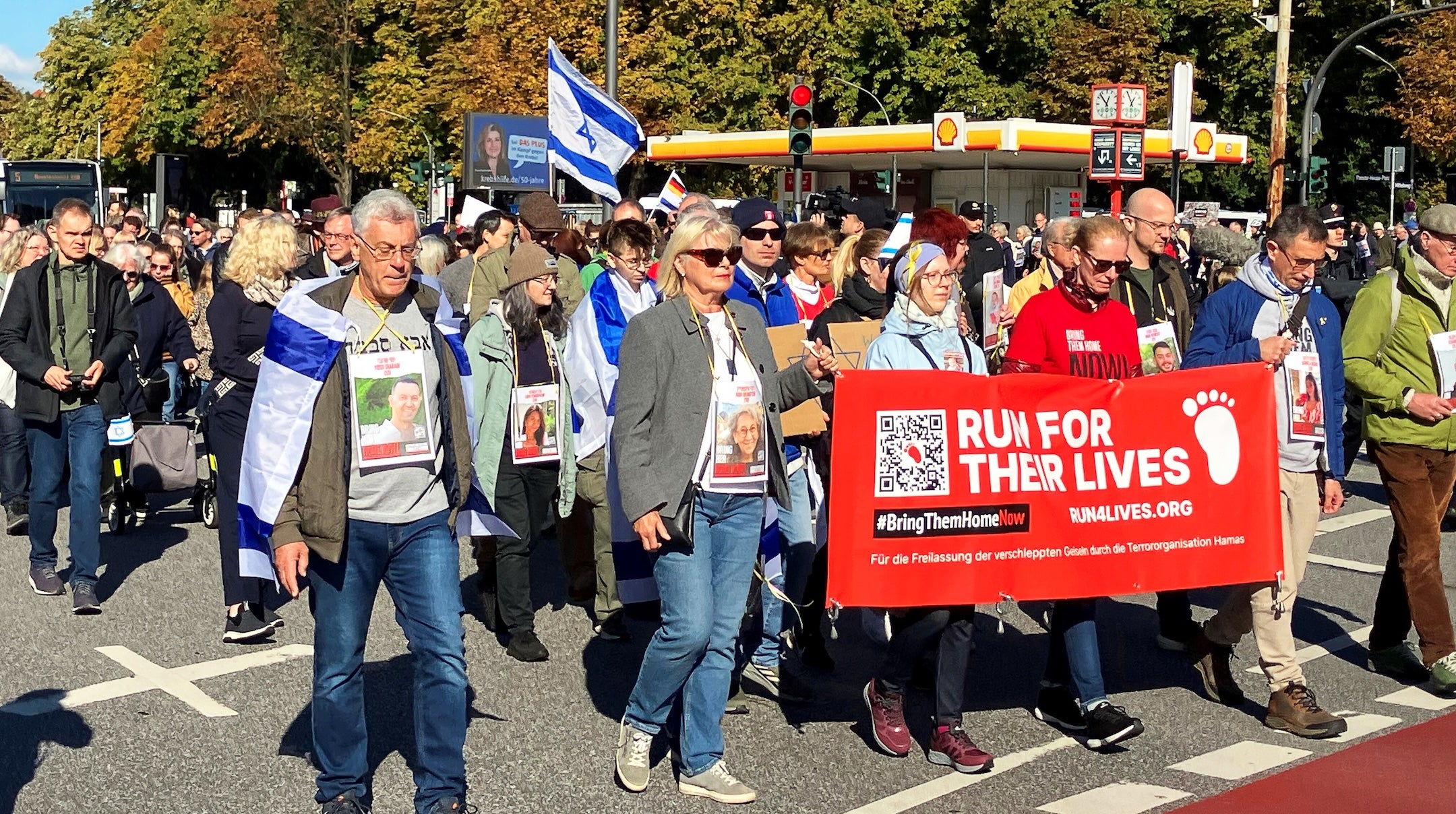
Hundreds of people demonstrate on the first anniversary of the Hamas onslaught on Israel with a banner reading ‘Run for their lives’ for the release of hostages held by Hamas in Gaza in Hamburg, Germany, October 6, 2024. (Markus Klemm/picture alliance via Getty Images via JTA)
The chief rabbi of Hamburg, Shlomo Bistritzky, urged local authorities to take action against the encampment and said on X, “We – the Jews of Hamburg – are deeply concerned about this.”
The city and police initially sought to relocate the protest last week, but after the organizers appealed, Hamburg courts ruled that it could continue.
Hamburg’s Higher Administrative Court determined that the Bridges of Resistance camp did not pose sufficient danger or risk of antisemitic incidents to justify a ban, according to regional broadcaster Norddeutscher Rundfunk.
The encampment in the southern part of Moorweide is not located in the same area as the historical deportation site in the park’s northwestern corner, according to Die Tageszeitung. The “Square of Jewish Deportees” is marked with a memorial plaque. It is separated from the encampment by the main building of the University of Hamburg.
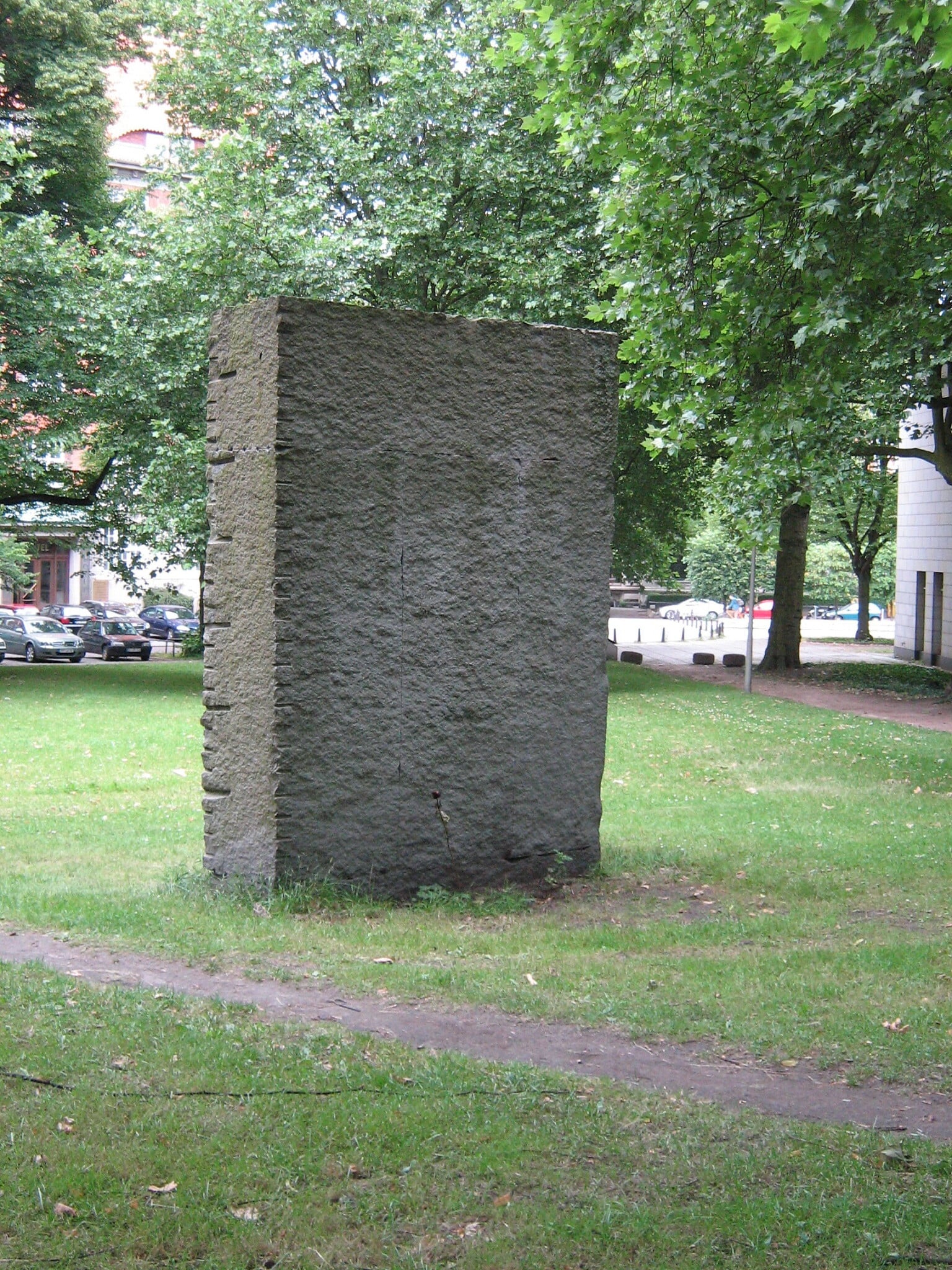
Memorial to the deportation of the Jews of Hamburg in Moorweide park, June 26, 2006. (CC SA 3.0/ Catrin Pieri)
The encampment includes over 10 tents and dozens of participants, with a schedule listing lectures and workshops about Palestinian history and culture, boycotts against Israel and what the activists identify as “German complicity” in “genocide” against the Palestinians. Israel rejects all claims of genocide, maintaining that its military goes to extreme measures to avoid civilian casualties, while Hamas and other terror groups use the local population as human shields and operate out of mosques, hospitals and schools.
The organizers also said Hamburg was a key location for protesting because its port was a “prime example of Germany’s role in the global arms trade.” Pro-Palestinian activists have previously targeted Hamburg’s port to protest arms shipments to Israel.
Bridges of Resistance did not respond to the Jewish Telegraphic Agency’s request for comment.
About 150 counterprotesters rallied against the encampment on Sunday, local media reported. Some held a sign that read, “There is no place for antisemitism and hatred of Israel in Hamburg.”
Stefan Hensel, Hamburg’s former antisemitism commissioner, said on Facebook that “many in Hamburg consider the anti-Israel agitation again taking place there, of all places, as political and moral bankruptcy.”
Hensel added that some of the activists were “accused of holding antisemitic and extremist positions.” One group involved in the encampment, Thawra Hamburg, is under surveillance by the Office for the Protection of the Constitution, Germany’s domestic intelligence agency, according to attorneys working on the group’s behalf.
Members of the Jewish community demanded in an open letter that “Hamburg’s politicians clearly distance themselves from the camp, end the open hatred against Israel and Jews, and permanently recognize Moorweide as a protected memorial site.”
For all of Moorweide to be permanently insulated from protests, it would have to meet the requirements of Germany’s Assembly Act, which includes a provision limiting the right to free assembly. The provision says memorial sites of “outstanding historical significance extending beyond the regional level” receive special protection to “protect the dignity of the victims of National Socialist violence and arbitrary rule.”
The Hamburg court’s ruling likely rested on the fact that only part of Moorweide is designated as a memorial site, according to William Nevin, a German history professor emeritus of Nottingham Trent University.

Illustrative: Prisoners at forced labor building the Dove-Elbe canal in southeast Hamburg, Germany, circa 1941-1942. (US Holocaust Memorial Museum, courtesy of KZ-Gedenkstatte Neuengamme)
“If one accepts that the protestors were not intending to demonstrate in the section of the park dedicated to the memory of those deported, or otherwise act in a disrespectful or antisemitic manner, then the court’s ruling can be understood,” Nevin told the Jewish Telegraphic Agency.
Germany’s Holocaust remembrance sites have become the center of fierce dispute between pro-Palestinian activists and state authorities.
German politicians have publicly reckoned with the country’s Nazi past by promising a special responsibility to Israel. Since the 2000s, many have identified the robustness of the Israeli state as part of Germany’s “Staatsräson,” or reason of state. Germany is a staunch ally of Israel and its second-largest arms supplier after the United States.
In April, the city of Weimar blocked a pro-Palestinian demonstration at the former Buchenwald concentration camp on the anniversary of its liberation, and a local court upheld the ban.
Judges decided that the Buchenwald rally would likely “violate the dignity of victims” of the Nazis. The activists argued that their planned rally was a vigil for all “victims of genocide and fascism,” saying they upheld the memory of the Holocaust by urging Germany not to be involved in another genocide.
You’re a dedicated reader

That’s why we started the Times of Israel – to provide discerning readers like you with must-read coverage of Israel and the Jewish world.
So now we have a request. Unlike other news outlets, we haven’t put up a paywall. But as the journalism we do is costly, we invite readers for whom The Times of Israel has become important to help support our work by joining The Times of Israel Community.
For as little as $6 a month you can help support our quality journalism while enjoying The Times of Israel AD-FREE, as well as accessing exclusive content available only to Times of Israel Community members.
Thank you,
David Horovitz, Founding Editor of The Times of Israel