
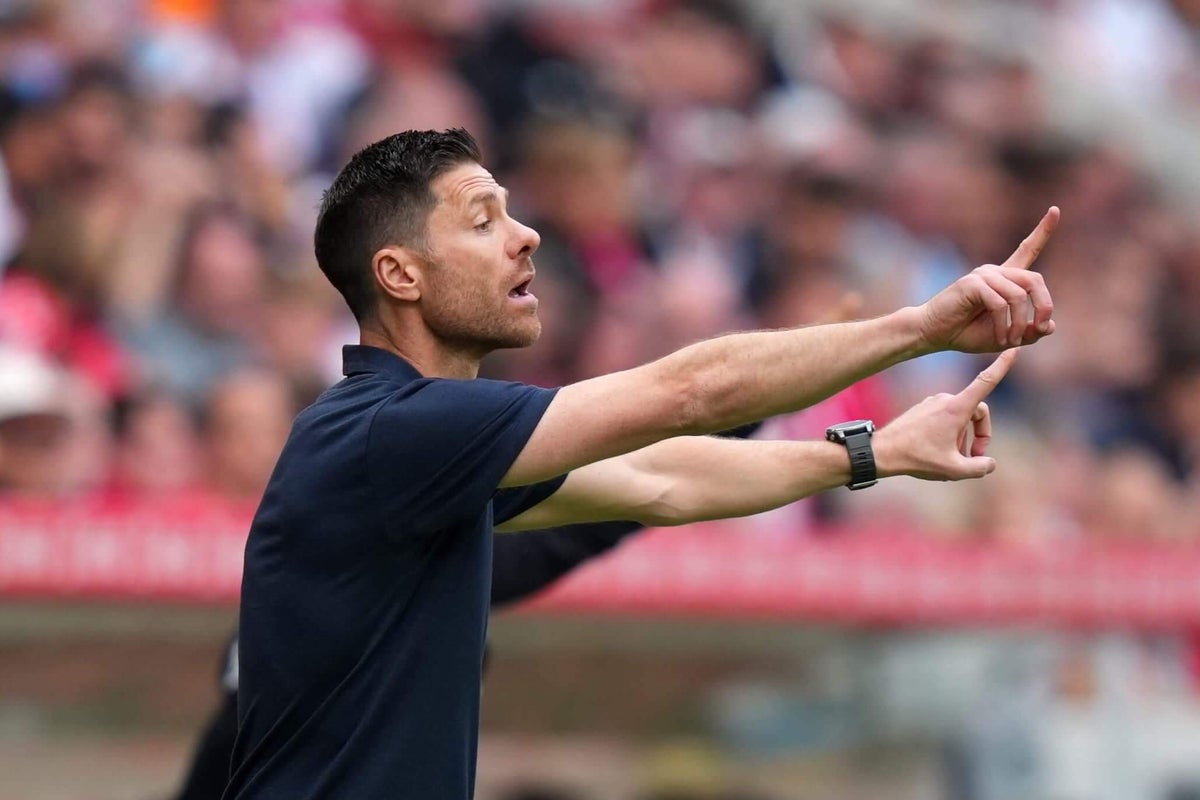
Xabi Alonso might have been more interested than most to see Chelsea’s starting formation in the FA Cup final on Saturday.
Chelsea’s incoming new manager made his reputation as one of Europe’s most coveted young coaches at Bayer Leverkusen, implementing a sophisticated 3-4-2-1 system that powered one of the most impressive seasons in the modern history of European club football in 2023-24. His dynamic young team claimed the Bundesliga title and DFB Pokal (Germany’s FA Cup equivalent) and lost just one of the 53 matches they played across all competitions: the Europa League final against Atalanta.
Interim head coach Calum McFarlane’s pragmatic game plan in a 1-0 defeat to Manchester City at Wembley yesterday did not quite give off Alonso-at-Leverkusen vibes, but his decision to line Chelsea up in a 3-4-2-1 formation did at least present an early opportunity for the Spaniard to see how suited various players in the current squad might be to similar roles in the Spaniard’s team next season.
Alonso’s football at Leverkusen was built upon the principles that many modern coaches embrace: aggressive pressing, with control and creation through possession dominance. But his team distinguished themselves through superior organisation with and without the ball, exploiting space to play to the specific strengths of their personnel.
His three-man defence regularly featured two ball-playing centre-backs either side of a more physical one, but the team as a whole was asymmetrical.
Alejandro Grimaldo, the left wing-back, functioned as one of the primary playmakers, dropping deep to make a back four if circumstances required and overlapping or underlapping when he attacked. Jeremie Frimpong, the right wing-back, was frequently the furthest man forward. The two men generated a combined 19 goals and 20 assists in the Bundesliga in 2023-24.
Despite being arguably the best long diagonal passer of his generation as a player, Alonso generally discourages that sort of ball as a coach, preferring to keep the distances between his players shorter in order to facilitate passing combinations and ensure his team are always in good position to counter-press if possession is lost.
Instead of being found by quick switches of play, Grimaldo and Frimpong would often become involved in moves higher up the pitch after the ball had worked its way through Alonso’s midfield box (consisting of the two deeper midfielders and two No 10s). Granit Xhaka was the midfielder primarily tasked with threading progressive passes through opposing lines, while Florian Wirtz would often receive these with space to turn and run towards goal.
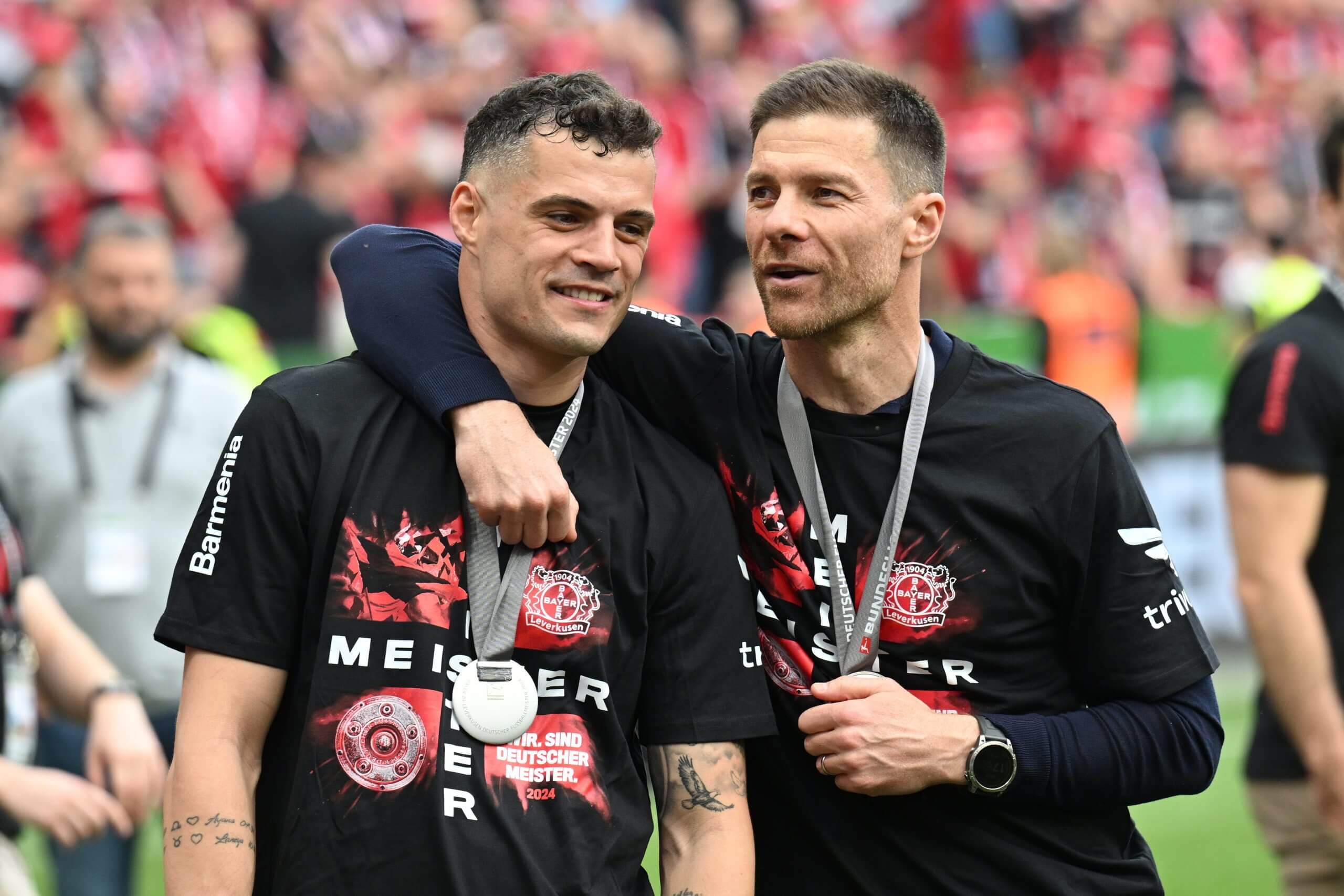
Xhaka was key to Alonso’s system (Photo: Stuart Franklin/Getty Images)
Leverkusen’s alignment in possession was essentially a 3-box-3, which will be familiar to Chelsea fans from Enzo Maresca’s tenure over the past two seasons. But instead of full-backs inverting into midfield and wingers hugging the touchline, that team featured attacking wing-backs carrying a level of threat in the final third much more akin to Marcos Alonso and Victor Moses under Antonio Conte, or (sadly all too briefly, due to injuries) Ben Chilwell and Reece James during Thomas Tuchel’s time at Stamford Bridge.
It is unclear whether James’ often-injured body will still allow him to perform a role which requires him to cover so much ground at high intensity. Malo Gusto is athletically capable of being the Frimpong at Chelsea, but has not demonstrated the same level of aptitude in front of goal. There is no analogous player in this squad to Grimaldo; Marc Cucurella, the man who has displaced him in the Spain team, is positionally smart but a more effective off-ball runner than on-ball playmaker.
Chelsea have lacked a truly elite goalkeeper since Thibaut Courtois’ departure in 2018, but encouragingly for them, Alonso succeeded without one at Leverkusen; Lukas Hradecky was widely regarded in Germany as good rather than great at the time, while being prone to the occasional error. Robert Sanchez has a similar reputation, and it is unreasonable to expect that 20-year-old Belgian prospect Mike Penders’ assimilation into English football will be seamless once his current loan at French side Strasbourg ends.

Can Cucurella play the Grimaldo role? (Photo: Alex Pantling/Getty Images)
A more physically dominant presence is needed in defence, where Chelsea can be bullied at times.
Wesley Fofana’s form this season has been very erratic. Tosin Adarabioyo’s lack of speed makes it hard for him to defend high up the pitch. Jorrel Hato and fellow 20-year-old Josh Acheampong are talented-but-raw youngsters. Trevoh Chalobah has also made defensive errors, but he has a rounded skill set and could even be recast as a Robert Andrich-style midfield destroyer from that Leverkusen team.
Alonso is blessed to inherit several excellent progressive passers at Chelsea. As he demonstrated at Wembley on Saturday, the fit-again Levi Colwill is exceptional at breaking opposition lines with balls out of defence. That is Romeo Lavia’s best quality in midfield, while Moises Caicedo, Andrey Santos and Enzo Fernandez can all see and play vertical passes into the final third — though the latter may well be better utilised as one of the No 10s.
There are few players in world football better suited to the Wirtz role than Cole Palmer, even if Chelsea’s talisman has struggled to find his best form this season. Joao Pedro also seems to be exactly what Alonso looks for in his striker: a No 9 with the skill set to become a No 10 depending on the situation, dropping deep to link play as well as running in behind.
Chelsea’s stable of wingers may be less confident of their future prospects if Alonso implements his Leverkusen system.
Estevao regards himself as much a No 10 as a winger, and perhaps Pedro Neto could be effective more centrally, but Alejandro Garnacho and Jamie Gittens look less suitable for such a transition. Could either of them or already-arranged summer 2026 arrival Geovany Quenda be reinvented as wing-backs, a la Moses a decade ago?

Can Estevao make himself central to Alonso’s team? (Photo: Bradley Collyer/PA Images via Getty Images)
The caveat to all of the above is that there is no guarantee that Alonso will try to implement his Leverkusen system at Chelsea.
He is too smart a football mind to be wedded to one formation, and there were times during his ill-fated brief tenure at Real Madrid in the first half of this season where he lined up with a four-man defence or a two-man attack — partly in recognition of the differing strengths of his players and partly, one suspects, because he was trying to compensate for the fact that some of them did not buy into his ideas.
Alonso was undone at Madrid by politics, not tactics. He thrived at Leverkusen, the now 44-year-old’s first job in senior management, leading a group of pliable, talented young footballers, then struggled to command a dressing room full of international superstars. Chelsea’s squad demographic falls somewhere in between but is probably closer to the former than the latter, and a football legend with his resume should not encounter the authority problems faced by owner BlueCo’s previous hires.
Next season, then, should be all about the football at Chelsea.
Alonso has plenty of good raw material to work with and, provided he is given the right support and empowered to build a team in his image, there is every reason for fans to be excited about the potential of this appointment.