
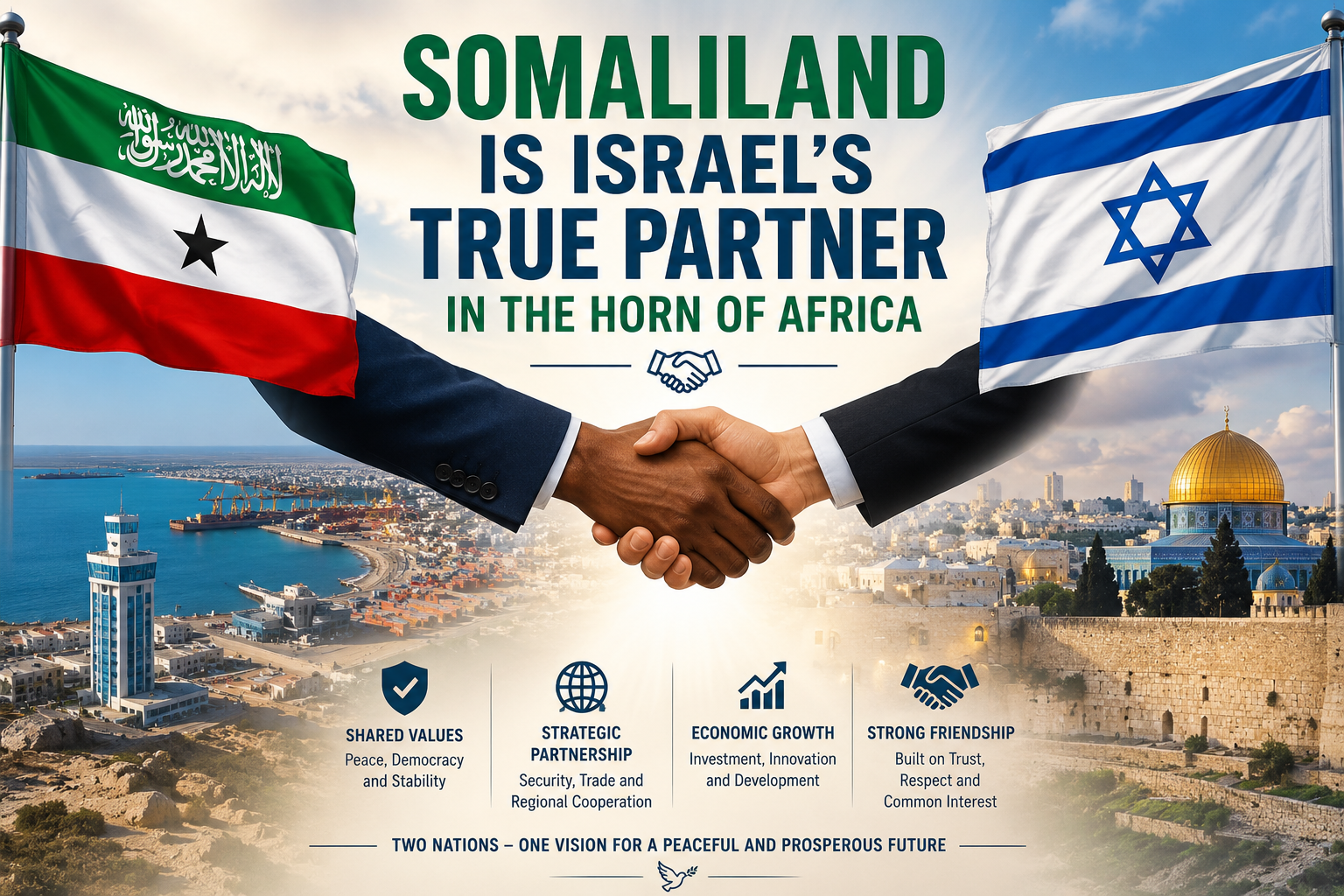
In a rapidly changing world where alliances are increasingly shaped by trust, stability, and strategic cooperation, the relationship between Somaliland and Israel stands out as one with genuine long-term potential. Though geographically distant, the two nations share important common interests: security, democracy, innovation, resilience, and the pursuit of international recognition and peace.
For decades, Somaliland has demonstrated that it is not merely seeking friendship based on temporary political calculations. Instead, it seeks meaningful partnerships built on mutual respect, cooperation, and shared strategic vision. In this regard, Somaliland is emerging as Israel’s most reliable and natural partner in the Horn of Africa.
A Region Searching for Stability
The Horn of Africa remains one of the world’s most strategically important regions. Positioned near the Red Sea and the Gulf of Aden, the region connects Africa, the Middle East, and global trade routes. Yet it has also faced decades of instability, extremism, piracy, and political uncertainty.
Amid this fragile environment, Somaliland has become an exceptional example of stability and democratic governance. Since restoring its sovereignty in 1991, Somaliland has built functioning institutions, conducted peaceful elections, maintained internal security, and fostered social cohesion without significant international assistance.
Unlike many fragile states in the region, Somaliland has shown political maturity and resilience. This stability makes it a credible and dependable ally for Israel, particularly at a time when regional security cooperation is becoming increasingly important.
Shared Security Interests
Both Somaliland and Israel understand the importance of security. Israel has long faced regional threats and has developed advanced expertise in intelligence, counterterrorism, cybersecurity, and defense innovation. Somaliland, located near some of the world’s most sensitive maritime routes, also faces security challenges linked to terrorism, arms trafficking, piracy, and regional instability.
The partnership between the two sides could contribute significantly to regional peace and maritime security. Somaliland’s strategic location near the Bab el-Mandeb Strait provides important geopolitical value, while Israel’s technological and security experience offers opportunities for cooperation in intelligence sharing, coastal security, and counter-extremism efforts.
This relationship should not be viewed solely through a military lens. Rather, it represents a partnership aimed at protecting trade routes, enhancing regional stability, and promoting peaceful cooperation.
Democracy and Resilience
One of the strongest foundations connecting Somaliland and Israel is their commitment to democratic governance. Both societies have demonstrated resilience under difficult regional circumstances.
Somaliland has repeatedly conducted competitive elections and peaceful transfers of power, despite lacking international recognition. Israel, despite facing continuous regional tensions, has maintained democratic institutions and a vibrant political system.
These shared democratic values create a strong basis for political understanding and diplomatic cooperation. In a region where democracy often struggles, the relationship between Somaliland and Israel symbolizes the possibility of governance based on public participation, accountability, and institutional development.
Economic and Technological Opportunities
The future of Somaliland-Israel relations extends beyond politics and security. Economic cooperation could become one of the most transformative aspects of the partnership.
Israel is globally recognized for innovation in agriculture, water management, renewable energy, health technology, and digital development. Somaliland, with its young population and growing economic ambitions, could benefit greatly from Israeli expertise and investment.
Cooperation in areas such as:
Water desalination
Climate adaptation
Smart agriculture
Renewable energy
Education and research
Port development
Digital technology
could accelerate Somaliland’s development and create mutually beneficial opportunities for both sides.
The Port of Berbera, for example, continues to gain strategic importance as a trade and logistics hub in the Red Sea corridor. Stronger economic engagement between Somaliland and Israel could open new commercial pathways connecting Africa and the Middle East.
A Partnership Based on Mutual Respect
What makes Somaliland a genuine partner for Israel is not only strategy, but sincerity. Somaliland’s leadership and people increasingly view relations with Israel through the lens of cooperation, innovation, and shared interests rather than ideological hostility.
At the same time, Israel has an opportunity to engage with a democratic and stable society in the Horn of Africa that values partnership and constructive diplomacy.
International relations today are shaped not only by formal recognition, but also by practical cooperation and trust. Somaliland has consistently demonstrated that it is prepared to contribute positively to regional peace, economic growth, and international collaboration.
Looking Toward the Future
The emerging relationship between Somaliland and Israel may become one of the most significant new partnerships in the Red Sea region. It has the potential to strengthen security cooperation, encourage economic growth, support democratic governance, and promote regional stability.
As global geopolitics continue to evolve, nations increasingly seek dependable allies rather than symbolic friendships. Somaliland has shown that it is capable of being a stable, pragmatic, and forward-looking partner.
For Israel, Somaliland represents more than a diplomatic opportunity. It represents a trusted ally in a strategically important region — a partner prepared to build a future grounded in cooperation, peace, and mutual progress.
Mohamed Abdi Idris is a Somaliland-based analyst specializing in international relations, geopolitics, and foreign policy. He holds a Master’s degree in International Relations and Diplomacy and is actively engaged in policy discussions on global security, regional geopolitics, and the evolving strategic dynamics of the Middle East and the Horn of Africa. He is also involved in initiatives promoting peacebuilding, climate awareness, and international cooperation through civil society platforms in Somaliland.