
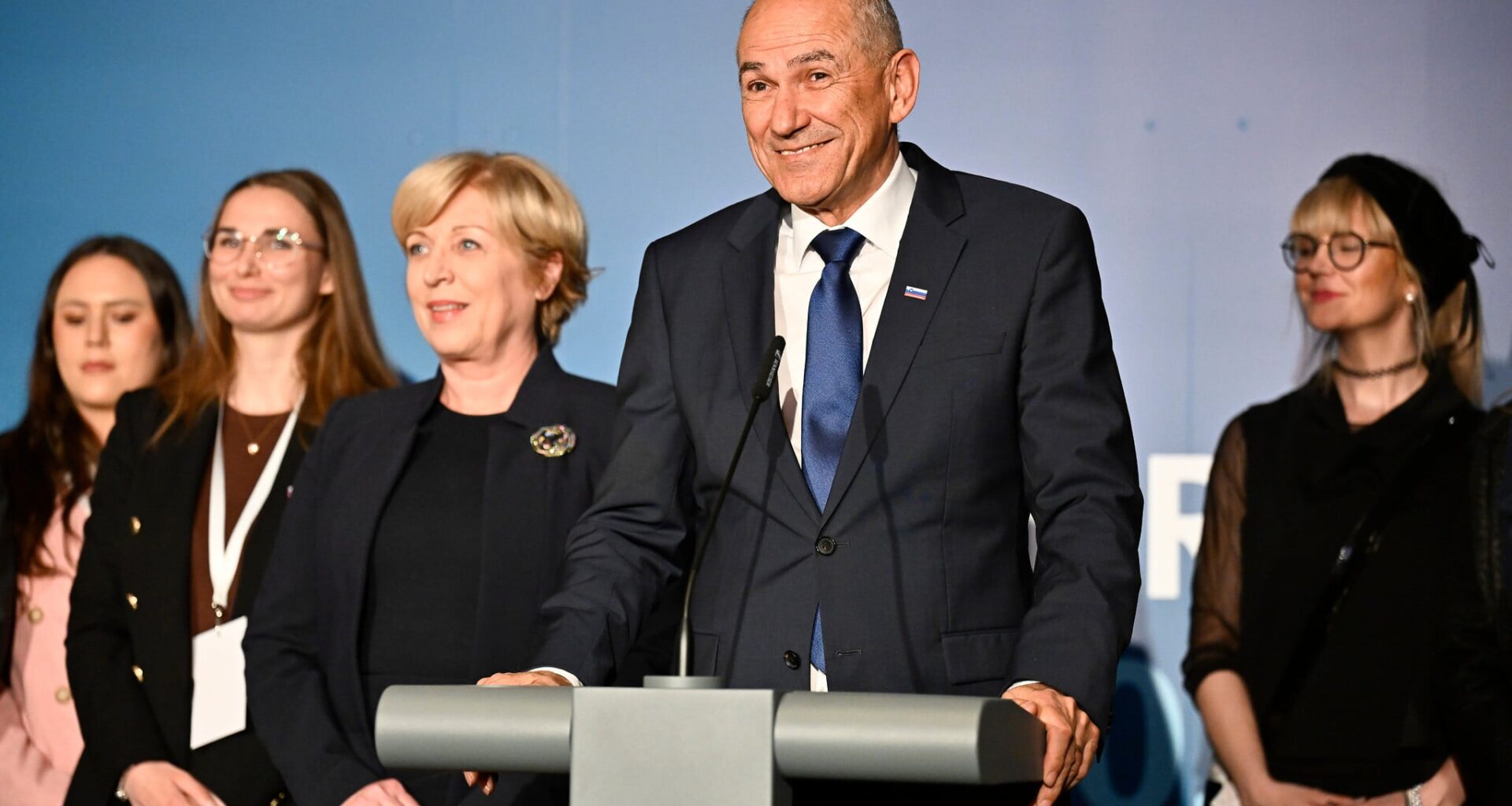
Slovenia’s parliament on Friday voted to bring back former nationalist premier Janez Jansa, electing him as prime minister once more in a move that could tilt the EU country away from Brussels.
Jansa — an admirer of US President Donald Trump and a supporter of Israel — was a three-time premier who had frequent run-ins with the European Union during his last stint in power, which ended in 2022.
But this week, he struck a coalition agreement to form a new government, after outgoing liberal Prime Minister Robert Golob failed to clinch a deal following parliamentary elections in March.
On Friday, 51 members of parliament voted to return Jansa to power while 36 voted against, according to results announced by the parliamentary speaker.
“The development and wealth of Slovenia are the top priorities of this coalition,” Jansa told parliament when presenting his candidature.
Get The Times of Israel’s Daily Edition
by email and never miss our top stories
By signing up, you agree to the terms
Golob, who came to power in 2022 on a wave of protests against Jansa’s crackdown on civil liberties, announced last month he could not form a government.
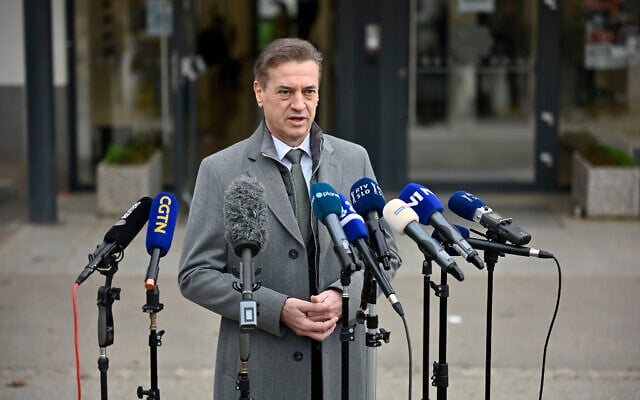
File: Prime Minister of Slovenia Robert Golob addressing the media after casting his vote at a polling station for parliamentary elections in Ljubljana, Slovenia, on Sunday, March 22, 2026. (Denes Erdos/AP)
Golob’s government recognized a Palestinian state in May 2024, becoming one of the few EU countries to claim Israel’s war against the Hamas terror group in Gaza was a “genocide,” a claim that Israel has strongly rejected.
Slovenian public broadcaster RTV was also the first in Europe to demand Israel’s exclusion from the 2025 Eurovision Song Contest and boycotted it in 2026, citing the ongoing war in Gaza.
Golob’s administration also banned imports from Jewish settlements in the West Bank in 2025, only a week after prohibiting all weapons trade with Israel, the first EU member to do so. That ruling followed on the heels of another one declaring National Security Minister Itamar Ben Gvir and Finance Minister Bezalel Smotrich persona non grata.
Slovenia also became the first EU country to impose a travel ban on Prime Minister Benjamin Netanyahu last September.
Jansa, meanwhile, previously said that if he returns to power, he will relocate Slovenia’s embassy from Tel Aviv to Jerusalem and rescind Ljubljana’s recognition of Palestine.
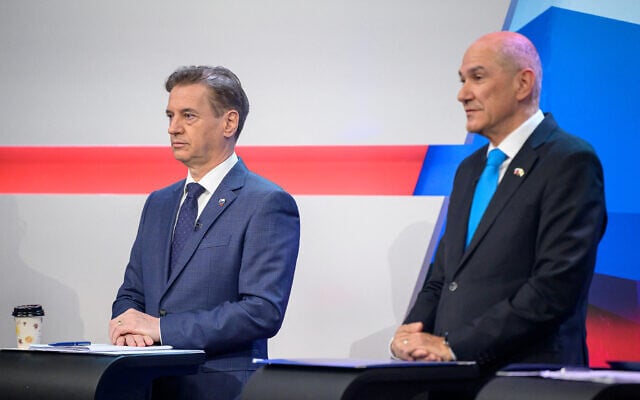
Slovenia’s liberal Prime Minister Robert Golob (L) and Slovenia’s opposition leader and nationalist former prime minister Janez Jansa attend the last televised political debate ahead of the parliamentary elections in Ljubljana on March 20, 2026. (Jure Makovec / AFP)
In 2021, Jansa was criticized for posting an antisemitic tweet after he accused several members of the European Parliament of being “puppets” of George Soros. The Hungarian-American billionaire investor, who is Jewish, has been the subject of antisemitic attacks and conspiracy theories for decades.
The European Union said at the time that antisemitism “has no place” in the 27-nation bloc.
Stability in doubt
Jansa swiftly launched coalition talks that ended on Monday with a deal between his Slovenian Democratic Party (SDS) and two center-right parties — Christian democratic party Nova Slovenija and his former close ally Anze Logar’s Democrats.
Combined, they hold 43 seats in parliament.
He ensured a majority with the votes of five lawmakers from the anti-establishment, pro-Russian party Resnica, created in 2021 by opponents of the state measures aimed at limiting the Covid-19 pandemic.
The coalition program priorities include reducing taxes and forging a more efficient state through decentralization and slashing bureaucracy.
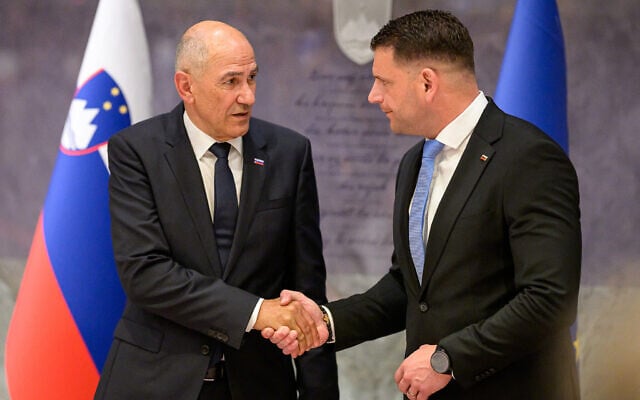
Right-wing Slovenian Democratic Party (SDS) leader Janez Jansa (L) and President of the Slovenian National Assembly Zoran Stevanovic shake hands after Jansa was chosen as Slovenia’s Prime Minister by the members of the National Assembly in Ljubljana on May 22, 2026. (Jure Makovec / AFP)
“We will ensure a cheaper state but with better quality,” Jansa told journalists earlier this month.
Jansa has repeatedly criticized spending by Golob’s center-left coalition government, while pledging to restore “Slovenian values,” such as the “traditional family.”
In his presentation speech, Jansa also announced his government would advocate for “a consistent control of legal migration and the prevention of illegal migration at the EU’s external borders.”
Resnica shares many points with the coalition program, but announced it will remain an opposition party, which might hamper the government’s stability, according to political commentator Aljaz Bitenc Pengov.
“In terms of a parliamentary majority, they won’t be stable, and internally they won’t be stable either, primarily because of Resnica… and Logar,” Bitenc Pengov told AFP.
The last days of campaigning ahead of the March 22 vote were overshadowed by claims of foreign interference, with authorities probing whether Israeli company Black Cube was behind secretly recorded videos alleging graft in Golob’s government.
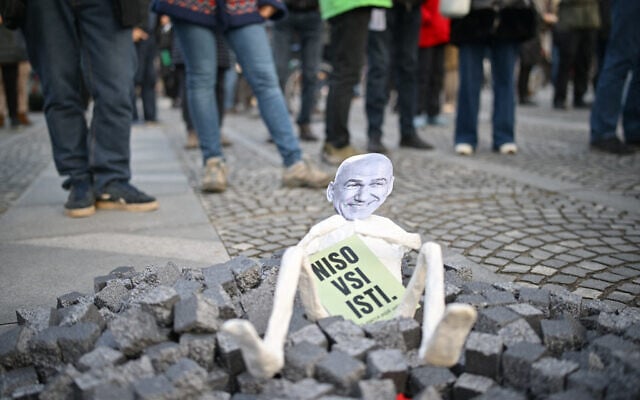
File: A paper figure depicting Slovenian opposition leader, nationalist former prime minister Janez Jansa, is placed on a pile of black cubes as demonstrators gather at a rally to urge citizens to vote in front of the Slovenian Parliament in Ljubljana on March 20, 2026, ahead of the parliamentary elections. (Jure Makovec / AFP)
Jansa — who faced accusations his party was linked to the videos — has admitted to meeting a Black Cube official, but denied being behind the videos.
The videos allegedly show the officials suggesting ways to influence decision-makers in Golob’s government to speed up procedures or win contracts.
During his third mandate as prime minister from 2020 to 2022, Jansa had frequent run-ins with the European Union and drew protests at home, with critics accusing him of attacking media freedom and the judiciary and undermining the rule of law.
He is expected to assume office in June after his ministers are also approved by parliament at a new session that has to be called within the next 15 days.
Which gorgeous bird do you prefer?

THIS MONTH ONLY: Join our reader support group for as little as $6/month and receive an exclusive tote bag featuring one of Israel’s native birds.
Choose between the Duchifat (orange), Israel’s national bird, or the Shaldag (blue), a beloved symbol of the Israeli landscape.
As a member of the Times of Israel Community, you’ll also enjoy:
An ad-free experience of our site and podcasts.
Exclusive access to award-winning films via DocuNation.
Weekly letters from founding editor David Horovitz.
Join ToI Community & claim my bag
Already a member? Sign in to stop seeing this
You’re a dedicated reader

That’s why we started the Times of Israel – to provide discerning readers like you with must-read coverage of Israel and the Jewish world.
So now we have a request. Unlike other news outlets, we haven’t put up a paywall. But as the journalism we do is costly, we invite readers for whom The Times of Israel has become important to help support our work by joining The Times of Israel Community.
For as little as $6 a month you can help support our quality journalism while enjoying The Times of Israel AD-FREE, as well as accessing exclusive content available only to Times of Israel Community members.
Thank you,
David Horovitz, Founding Editor of The Times of Israel