
One of the most corrosive dynamics in the Israel-Palestine discourse is the increasingly symbiotic relationship between opposing extremes – each side becoming so ideologically dependent on the moral monstrosity of the other that exaggeration, distortion, and performative outrage begin to feel politically necessary.
And the tragedy is: they do not actually need to invent horrors. Reality is already devastating enough.
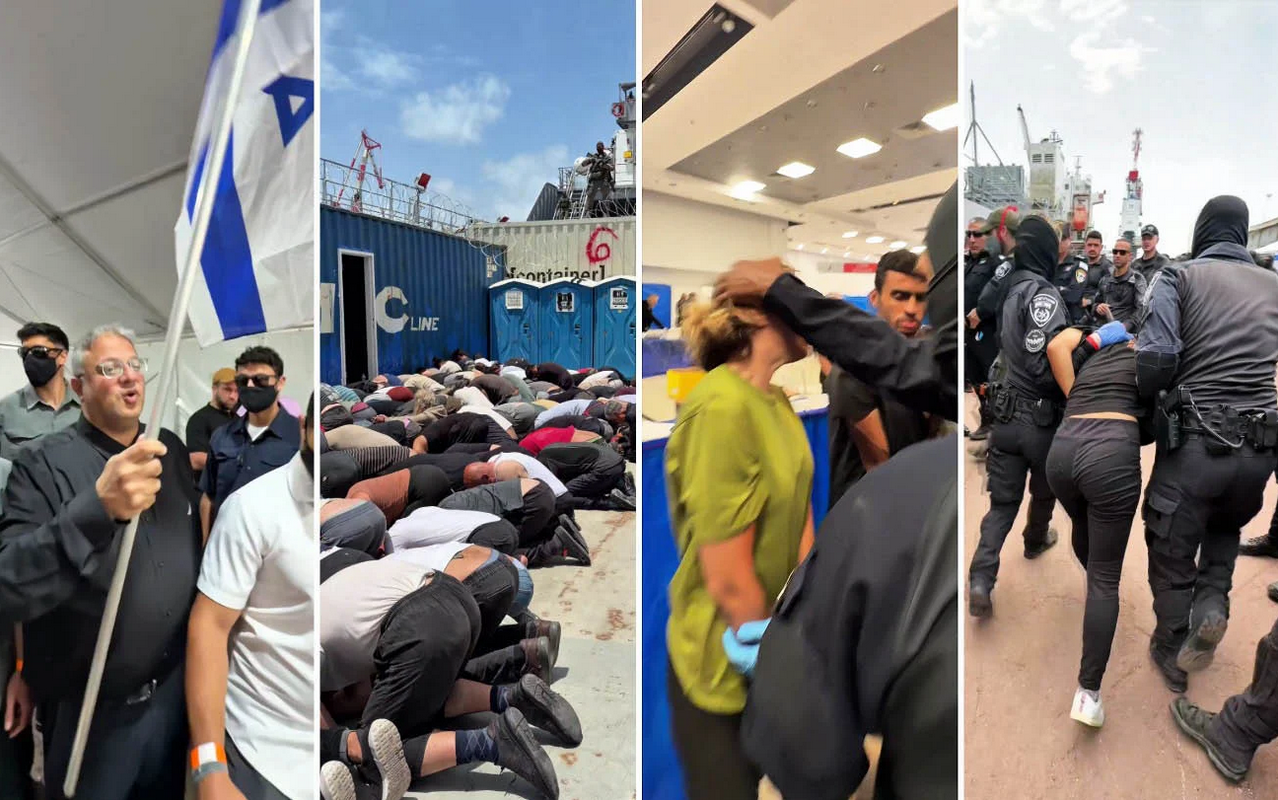
Having seen the footage of Itamar Ben Gvir with the detained flotilla activists, I am more convinced than ever that Ben Gvirism and global anti-Zionist activism exist in a deeply mutually reinforcing relationship – two antagonistic forces that increasingly sustain one another while pushing the actual Zionist project toward the abyss.
Ben Gvir’s ultranationalism depends on a world in which Israel is seen as permanently besieged, isolated, hated, and morally alone. His politics thrive when liberal restraint appears naive, when “the whole world is against us” feels emotionally true, and when criticism of Israeli policy can be collapsed into hostility toward Jewish sovereignty itself.
At the same time, anti-Zionist activist ecosystems increasingly thrive on imagery that presents Israel not as a complicated nation-state acting within a brutal conflict, but as inherently fascistic, supremacist, and irredeemably colonial in essence.
And so each side becomes indispensable to the other.
Ben Gvir provides precisely the imagery and symbolism anti-Zionist movements need in order to collapse Zionism itself into a project of domination and humiliation: bound detainees, nationalist triumphalism, humiliation as spectacle, the state as theatrical force rather than democratic responsibility.
The flotilla itself was strategically marginal. Ben Gvir transformed it into a civilizational performance.
And that is precisely the tragedy.
Because every such performance strengthens those around the world who argue that Zionism is not a national liberation movement with contradictions and moral complexity, but inherently chauvinistic and authoritarian. He narrows Israel until it becomes reducible to him.
But the feedback loop does not end there.
The more performative and inflammatory anti-Israel activism becomes, the easier it is for Israeli ultranationalists to claim that the world is irrationally antisemitic and that moral restraint is pointless. The more cruel, triumphalist, and dehumanizing Israeli rhetoric becomes, the easier it becomes for anti-Zionist movements to portray all Zionism as supremacism and domination.
Each side points to the worst examples of the other and says: “See? We were right all along.” “See? Coexistence is impossible.” “See? Restraint is weakness.”
And gradually, both sides begin to resemble rival propaganda ecosystems more than political communities searching for truth.
On one side, every Israeli action must become proof of uniquely evil intent. Claims escalate rapidly online – torture, deliberate starvation, genocidal sadism, organ harvesting – often shared globally before facts are established or verified. Images become symbols before they become evidence.
On the other side, there are Israelis and pro-Israel voices who reflexively dismiss every criticism as blood libel, every testimony as staged propaganda, every Palestinian injury as manipulation, every activist as a Hamas operative. Genuine suffering becomes impossible to acknowledge because acknowledgment itself is perceived as surrender.
And when everything becomes propaganda, actual human suffering disappears beneath the spectacle.
What horrifies me most about the Ben Gvir footage is not only the cruelty of the imagery, but the possibility that he no longer sees the distinction between strength and humiliation, between sovereignty and domination, between loving Israel and performing power.
The video looked almost algorithmically designed for the social media age: kneeling detainees, flags, chants, rage, humiliation, virality.
The medium rewards maximalism. Ben Gvir has mastered that language.
But every such performance deepens Israel’s isolation, weakens the moral foundations of Zionism, and hands Israel’s enemies precisely the evidence they seek.
And in the middle, the actual Zionist project – Jewish self-determination rooted in democracy, pluralism, moral responsibility, and a striving for peace – slowly suffocates.
Anton Marks is a British-born Israeli and a founder member of the largest urban kibbutz in Israel. He has been an informal educator for the last 35 years, and his passion for Zionist education, Tikkun Olam, peace activism, Jewish history, identity and culture are a recipe for engaging and challenging articles.