
English remains too freely available on Quebec government websites and should be sharply reduced, the province’s French language commissioner says.
Content on the websites of seven major government bodies should generally be offered in French only, except in narrowly defined cases covered by legal exemptions, the commissioner said in a report released Wednesday.
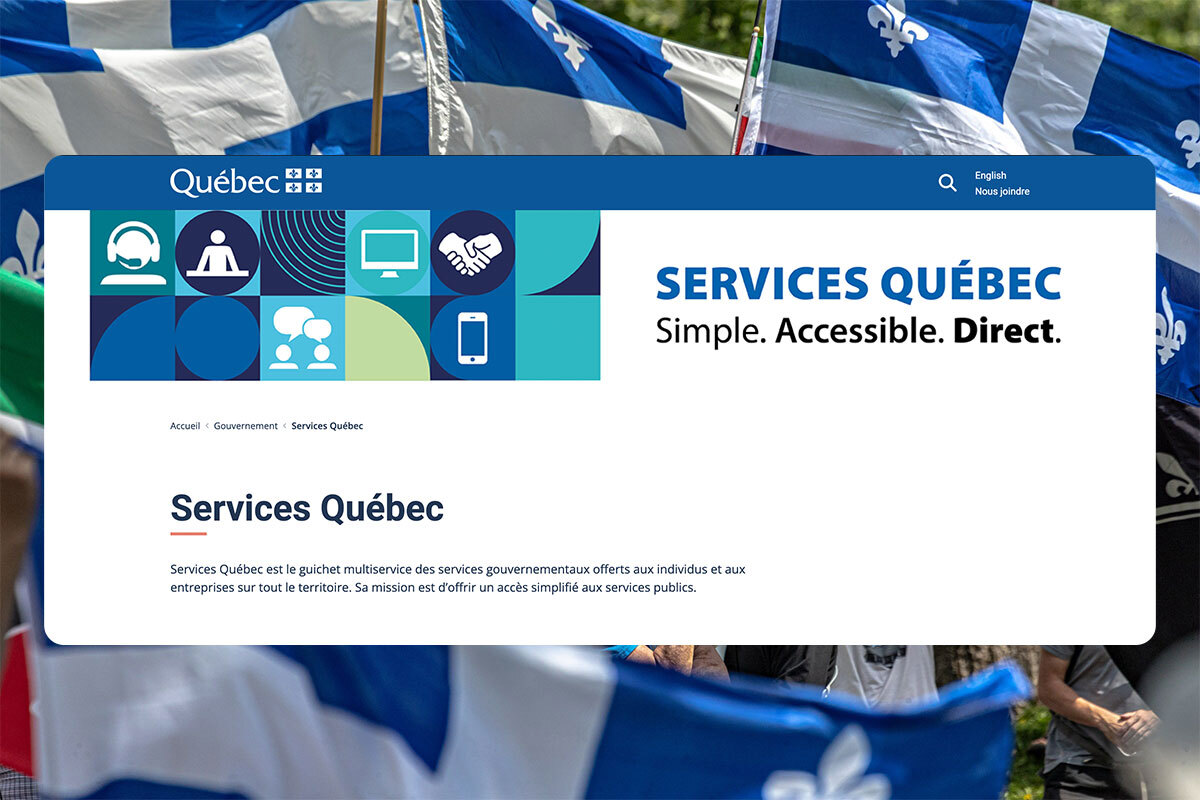
The recommendation follows an examination of how agencies, including Hydro-Québec, Revenu Québec, Services Québec and the workplace safety, auto insurance and health insurance boards, communicate with the public.
In a statement to The Gazette, the commissioner’s office said the websites of the organizations evaluated “are essentially bilingual (French and English), with a button allowing the user to switch from one language to the other.
“The government’s message appears contradictory: on the one hand, the Charter of the French Language establishes that French, as the official language, must be used exclusively; on the other, the administration operates essentially bilingual websites.”
That’s why it wants the Ministry of the French Language to review government guidelines.
“Except in the exceptional situations provided for by the charter, the websites of the organizations evaluated must be in French only,” the commissioner’s office said.
English content could still be provided in “secure areas of websites,” but only if the government body “can demonstrate that an exception applies.”
The Ministry of the French Language and the office of French Language Minister Jean-François Roberge did not respond to a request for comment.
The government’s ‘exemplary’ obligation
The Coalition Avenir Québec passed reforms in 2022 that strengthened the Charter of the French Language, commonly known as Bill 101, and imposed an “exemplary” duty on the state to prioritize French.
Since 2023, government websites have displayed banners stating that access to English content is intended only for eligible Quebecers, along with links explaining eligibility placed at the bottom of English-language pages.
But the commissioner’s report said the system effectively relies on an honour code that is not working.
Data from the agencies shows no consistent trend in the use of English pages since the changes were enacted, the commissioner’s report noted, concluding that the current measures have failed to deliver the intended shift.
As it stands, “anyone can consult the English pages of government agencies’ websites as often and for as long as they wish, without any action, even a symbolic one. This solution cannot allow the government to achieve the objectives of the charter.”
Under Bill 96, which amended the charter, certain groups are entitled to access English services in Quebec.
Among them are people eligible for English-language schooling, members of Indigenous nations and the Inuit, new arrivals in Quebec for less than six months and people outside Quebec.
Under the commissioner’s recommendation, websites of the government organizations studied should be in French only, “except when they relate exclusively to a situation provided for by an exception and are not otherwise relevant.”
As examples, it said English information could be freely available if it is related to:
Health or public safety requirements.
Only to people eligible for English-language education in Quebec or to Indigenous Peoples.
Exclusively to the reception of immigrants into Quebec society, exchanges with partners outside Quebec, or the provision of tourism services.
Anglophones push back
An anglophone rights group pushed back against the commissioner’s proposal.
“It’s just another attempt to diminish and minimize the English-speaking community and remove English from the public space,” said Eva Ludvig, president of TALQ, a coalition of anglophone groups.
“It’s unjustifiable to try to limit services for the English-speaking community. Government websites are not there to promote a government. They’re there to provide services to the public, and the public includes the English-speaking community.”
Even if anglophones are comfortable using French in daily life and at work, they still need access to specific government information in English, she said.
And that need goes beyond health and education — a wide range of government services should be equally accessible in English as in French, Ludvig added.
In 2023, Roberge said anglophones would just have to say they have existing language rights to receive government services in English, dismissing concerns that they would have to provide proof of eligibility.
“It will be self-identification,” he told The Gazette at the time. “We aren’t going into any kind of witch hunt. We are sticking with good faith.”
Ludvig said the commissioner’s recommendation would contradict that pledge.
“Minister Roberge said this would be by ‘good faith.’ Now, (the commissioner is) talking about monitoring websites, ensuring that people have the right to it. What happened to good faith and the honour system?”
The CAQ government appointed Benoît Dubreuil as Quebec’s first French language commissioner in 2023 to monitor the evolution of the language situation and oversee compliance with the charter.
Dubreuil’s role is separate from that of the Office québécois de la langue française, which is responsible for enforcing and monitoring compliance with language laws.
Editor’s Picks

A Montreal native, Andy Riga has reported for The Gazette since 1991, covering technology, transport, business, and now politics, language and other Quebec issues.
Montréalais d’origine, Andy Riga est journaliste à la Gazette depuis 1991. Après avoir couvert la technologie, le transport et les affaires, il traite aujourd’hui de la politique, des enjeux linguistiques et d’autres sujets d’actualité au Québec.
ariga@postmedia.com