
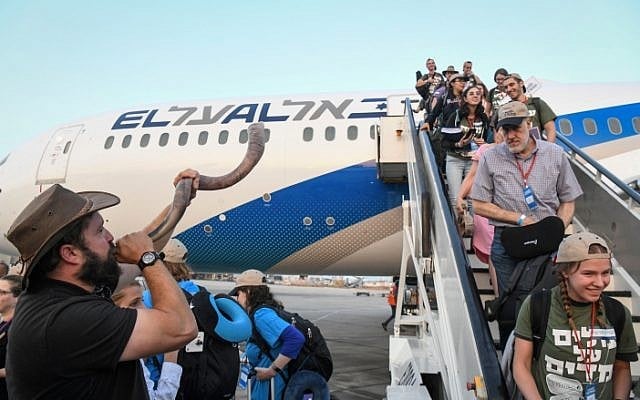
Israel absorbed nearly one million Jews from the former Soviet Union during the 1990s. That influx reshaped the country. Soviet émigrés arrived with engineers, scientists, physicians, entrepreneurs, and combat veterans who accelerated Israel’s technological rise, strengthened the Israel Defense Forces (IDF), and helped transform a small regional power into a global innovation hub. A similar moment is now emerging across the West—only this time the potential scale is even greater. The indicators are no longer anecdotal. They are statistical, visible, and accelerating. Thus, Israel must prepare now for a major wave of Western aliyah or risk missing one of the greatest strategic opportunities in its modern history.
The numbers alone are difficult to dismiss. The Anti-Defamation League recorded 8,873 antisemitic incidents across the United States in 2023, a 140 percent increase over the previous year. The figure climbed again in 2024 to 9,354 incidents. Even after partial moderation in 2025, antisemitic activity remained dramatically above pre-October 2023 levels.
In tandem, Canada experienced a similar rupture. Jews represent just 1.4 percent of the population yet accounted for nearly 70 percent of all religiously motivated hate crimes. Britain recorded its highest aliyah level in forty years, with hundreds of Jews relocating to Israel in 2025 alone. France, Germany, Belgium, and Australia reported parallel increases in antisemitic violence, intimidation, and social exclusion.
What once appeared episodic now feels structural. Synagogues require armed security. Jewish schools operate behind reinforced barriers. College campuses that once marketed themselves as bastions of tolerance increasingly tolerate open hostility toward Jewish students so long as it is framed as anti-Zionism. In the West, city after city, the distinction between anti-Israel activism and antisemitic intimidation has steadily eroded.
The violence has also intensified. Jewish worshippers were murdered during a Yom Kippur attack in Manchester. A Hanukkah gathering at Bondi Beach in Australia turned into a mass-casualty scene after a jihadist-inspired assault. Israeli embassy staff were killed in Washington, D.C. A pro-Israel marcher was murdered in Boulder, Colorado. Montreal synagogues endured repeated arson attempts while Jewish schools in Toronto became targets of drive-by shootings. Incidents that would have once triggered national moral shock now disappear into the weekly news cycle.
The symbolism surrounding these episodes reveals an even deeper decay. On May 24th, 2026, activists from Montreal4Palestine paraded hanging effigies of Israeli Prime Minister Benjamin Netanyahu and National Security Minister Itamar Ben-Gvir through downtown Montreal. Weeks earlier, the Spanish town of El Burgo detonated a giant Netanyahu effigy packed with explosives during an Easter festival celebration. Official condemnations were cautious, procedural, and quickly forgotten. Many Western Jews drew the same conclusion: the political and cultural institutions once trusted to defend them are losing either the will or the confidence to do so.
Jewish leaders across the diaspora have already begun responding accordingly. Jeremy Jacobs, the former head of Britain’s United Synagogue, publicly announced his family’s aliyah after concluding that long-term Jewish security in Britain could no longer be taken for granted. In the United States, prominent Reform Rabbi Ammiel Hirsch warned that rising anti-Zionism within younger progressive circles threatens the future cohesion of American Jewish life itself. Quietly, many Jewish professionals, business leaders, and communal figures across North America and Europe have begun securing Israeli citizenship, transferring assets, or preparing contingency plans for relocation.
The networks driving this hostility are also becoming more organized and entrenched. Students for Justice in Palestine now operates through hundreds of university chapters and has coordinated encampments that routinely target Jewish students with harassment and intimidation. Jewish Voice for Peace and Within Our Lifetime organize direct-action demonstrations that increasingly blur the boundary between activism and coercion. Together, these groups reflect a broader ideological alignment between radical left-wing movements and Islamist activism across Western societies.
For Israel, the geopolitical implications are enormous. An influx of several hundred thousand highly educated Western Jews would strengthen Israel’s demographic position, deepen the IDF’s talent pool, and inject elite human capital into the sectors most critical for twenty-first-century competition: cybersecurity, artificial intelligence, medicine, engineering, and defense technology. At a moment when Iran and its proxy network continue probing Israel’s vulnerabilities across multiple fronts, Western aliyah could become a decisive national advantage.
History rarely repeats itself in identical form, but it often rhymes with unsettling precision. In the 1930s, Europe dismissed escalating antisemitism until catastrophe arrived. Today, much of the West again normalizes hostility toward Jews under the language of anti-Zionism while its own social cohesion and political confidence steadily weaken. Jewish communities have historically functioned as an early-warning indicator for broader civilizational decline. When Jews begin leaving in large numbers, deeper fractures are usually already underway.
The current and future government of the State of Israel -regardless of political affiliation- must respond with urgency and clarity. Alongside the Jewish Agency, Jerusalem should expand housing construction in the Negev and Galilee, fast-track licensing for Western doctors, scientists, and engineers, and scale integration programs modeled on the successful Soviet aliyah absorption effort. States that recognize demographic and strategic opportunities early gain advantages that last for generations. Those who hesitate rarely get a second chance.
Jose Lev Alvarez is an American-Israeli scholar specializing in Middle Eastern security policy.
A multilingual veteran of both the IDF Special Forces and the U.S. Army, he holds a B.S. in Neuroscience with a Minor in Israel Studies from American University, three master’s degrees (international geostrategy, applied economics, and intelligence studies), and a medical degree. He is currently completing a Ph.D. in Intelligence and Global Security in the Washington, D.C. area.
In addition to blogging for the Times of Israel, he contributes to the Washington Examiner, is a writing fellow at the Middle East Forum, and regularly provides geopolitical analysis on Latin American television networks.