
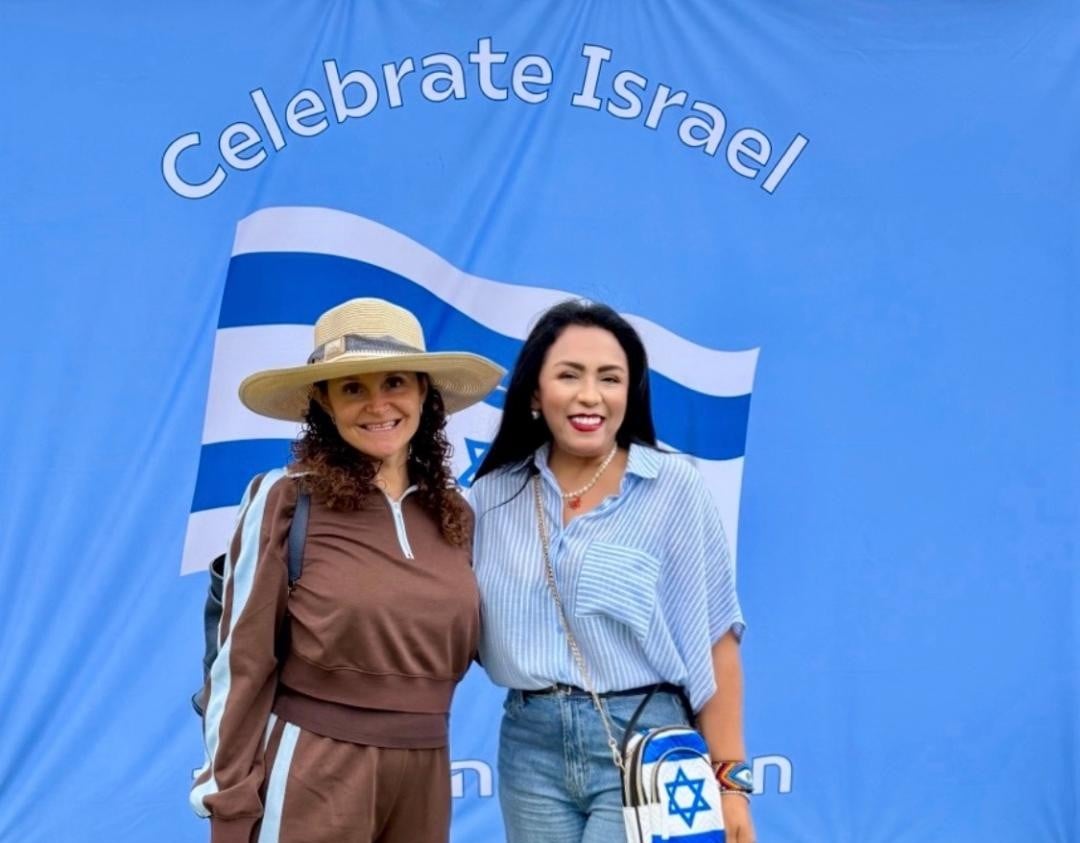
I did not grow up thinking Zionism would one day become a word that people whispered cautiously.
For much of my life, Zionism felt simple. It was connected to survival, language, prayer, peoplehood and longing. Zionism lived in stories told around family tables. It lived in songs about Jerusalem. It lived in the understanding that, after centuries of exile, persecution, expulsions, pogroms and genocide, the Jewish people had returned home and rebuilt.
As I grew older, Zionism became more personal. It became the feeling I experienced the first time I stood in Israel and realized that Jewish history was not abstract. It was all around me – in the stones of Jerusalem, the sound of Hebrew being spoken casually in coffee shops, the sight of Jewish children running freely through streets named after biblical prophets, medieval poets and modern Zionist figures.
But Zionism became even more real for me after I returned to Israel in the aftermath of the October 7, 2023, massacre.
What stayed with me most was seeing trauma and resilience exist side by side. I saw grief released openly in conversations, on faces, in photographs lining public spaces. I also saw people continuing to show up for one another with extraordinary tenderness and determination: nurses caring for patients after sleepless nights; young adults volunteering wherever they were needed; and parents still finding ways to comfort their children despite their own fears. I remember feeling both heartbroken and grounded at the same time.
For me, Zionism has never meant superiority over another people. It has never meant the absence of compassion, moral responsibility or accountability. It has meant the right of the Jewish people to exist safely and openly in their ancestral homeland, just as other people seek self-determination and cultural continuity. That definition should not be controversial. Yet today, it increasingly is.
In recent years, and especially after October 7, the word “Zionist” has often been flattened into a caricature. On social media, in activist spaces and sometimes even in academic settings, Zionism is frequently portrayed as synonymous with oppression, colonialism or racism. The result has been profound confusion, polarization and harm, particularly for Jewish youth trying to understand their identity in public spaces that often demand ideological purity. That harm is not theoretical.
According to Hadassah’s Everyday Antisemitism: Women’s Stories survey, two-thirds of Jewish women reported that antisemitism has negatively affected their relationships, work or daily lives following the rise in anti-Zionist hostility after October 7.
Many Jewish students now say they hide Star of David necklaces, avoid conversations about Israel or feel pressured to distance themselves from core parts of their identity to remain socially safe. Increasingly, Jews are told that participation in Jewish communal life is suspect if it includes any connection to Zionism. This is where nuance matters.
Criticism of Israeli policy is not inherently antisemitic. Democracies invite debate. Israelis themselves passionately debate the legitimacy of their government’s decisions every single day. Hadassah, The Women’s Zionist Organization of America, has acknowledged the importance of thoughtful dialogue while also recognizing the growing misuse of anti-Zionist rhetoric as a vehicle for antisemitism.
Denying just Jewish people the right to self-determination, applying standards to Israel not expected of any other nation or reducing Jewish identity to political affiliations crosses into dangerous territory. And for many Jews, especially younger generations, the emotional consequences are significant.
As a licensed clinical social worker and someone who works closely with trauma, resilience and identity development, I have watched these consequences unfold in real time. I have spoken with Jewish college students who feel emotionally fragmented as they try to hold multiple feelings simultaneously: compassion for innocent Palestinian civilians, grief for Israeli victims of terror, fear over rising antisemitism and confusion about whether they still belong in social justice spaces they once considered home.
Many feel they must choose between their Jewish identity and their universal moral identity. That is a false choice. Grounded Zionism can hold both a commitment to Jewish safety and a regard for the dignity and humanity of the Palestinians. At its healthiest, Zionism asks us to remain deeply connected to Jewish survival, continuity and peoplehood while also refusing to lose sight of our shared humanity. That balance matters deeply to me.
Perhaps that is one reason Hadassah resonates so strongly across generations. Since its founding by Henrietta Szold in 1912, Hadassah has modeled a Zionism rooted not only in nationhood, but in healing.
Long before Israel became a state, Hadassah women were building hospitals, training nurses, supporting public health initiatives and investing in children and families without regard to ethnicity or religion. Their Zionism was active. Practical. Human-centered. That legacy continues today.
At the Hadassah Medical Organization in Jerusalem, Jewish and Arab patients are treated side by side. Hadassah’s hospitals care for people regardless of religion, ethnicity or nationality. The organization also supports Youth Aliyah villages that serve immigrant youth, refugees and at-risk children, including Ethiopian Israelis, Druze youth, Bedouin students and survivors of abuse and poverty.
Many people outside the Jewish community – and even some within the Jewish community – are not aware of this side of Zionism. They don’t witness the trauma recovery services, coexistence initiatives, women’s health advocacy or youth leadership development programs. Their knowledge and subsequent views often come from highly condensed social media narratives that leave little room for historical context, important details or nuance.
For many Jews, their Zionism is not founded on or solidified by an abstract geopolitical argument. It is experienced as collective memory.
It is knowing that Jews were once stateless and vulnerable nearly everywhere in the world. It is understanding that the Holocaust occurred within living memory. It carries stories of expulsion from Arab countries, Europe, North Africa and elsewhere. It recognizes that Jewish indigeneity and historical connection to the land of Israel are ancient and well documented.
One of the most thoughtful conversations happening within Jewish spaces today centers on how to help younger generations develop a Zionism that is informed, ethical, emotionally resilient and intellectually honest. Hadassah has leaned into that challenge.
Programs within Young Judaea and at Youth Aliyah villages and various leadership development events encourage young people to engage thoughtfully and ask difficult questions, rather than simply defend Israel reflexively. That approach feels especially important right now.
Young people do not want sanitized narratives. They want honesty. They want space to wrestle. They want to understand complexity without being shamed for it. And they need mentors willing to model grounded conversation instead of ideological extremes.
I often think about what kind of Zionism we are handing to the next generation. Will Jewish youth become exhausted from defensiveness? Or will they demonstrate pride, literacy, compassion and resilience?
For me, the answer begins with relationship.
Relationship to history
Relationship to community
Relationship to grief
Relationship to truth and
Relationship to one another.
My own Zionism now feels more grounded in healing work and intergenerational survival. We can’t abandon Zionism because it has been distorted by others. We need to keep reclaiming it thoughtfully, honestly and responsibly.
At the same time, I believe deeply in preserving our humanity even during pain. Especially during pain. That may be the sacred work of this moment.
Zionism is not about domination. It is about belonging. It is about a people who carried memory across centuries and still chose life.
And, perhaps, most important, it is about ensuring that Jewish children and future generations inherit not only survival, but dignity, rootedness and hope.
Dr. Deborah Villanueva, DSW, MSW, LCSW, is president of Hadassah Long Beach / Orange County. Formerly she was the Organizational Vice President and Chair of Hadassah Evolve for Long Beach and Orange County, as well as a board member of the Hadassah Southern California Region. A member of the Hadassah Writers’ Circle, she was recently included in Hadassah’s “2025 Edition of 18 American Zionist Women You Should Know.” Dr. Villanueva is a Licensed Clinical Social Worker (LCSW) in Long Beach, CA, with over 25 years of experience serving marginalized communities, including Native American and Latinx women. Specializing in perinatal mental health and trauma, she provides culturally sensitive care. Dr. Villanueva holds a graduate degree in Social Work from California State University Northridge and a Doctorate from USC. She is an international speaker on women’s health and human trafficking prevention. She was recognized as Woman of the Year by the Los Angeles County Commission for Women and named Social Worker of the Year in 2024. In 2025, she was awarded HealthCare Hero of the Year by the RISE Summit on Social Determinants of Health and was recognized as one of the 100 Women to KNOW in America. Dr. Villanueva currently serves as Vice President of Education at Temple Beth-El in San Pedro, CA, and is a Councilmember of the Los Angeles County Sexual Assault Council (LAC SAC).