
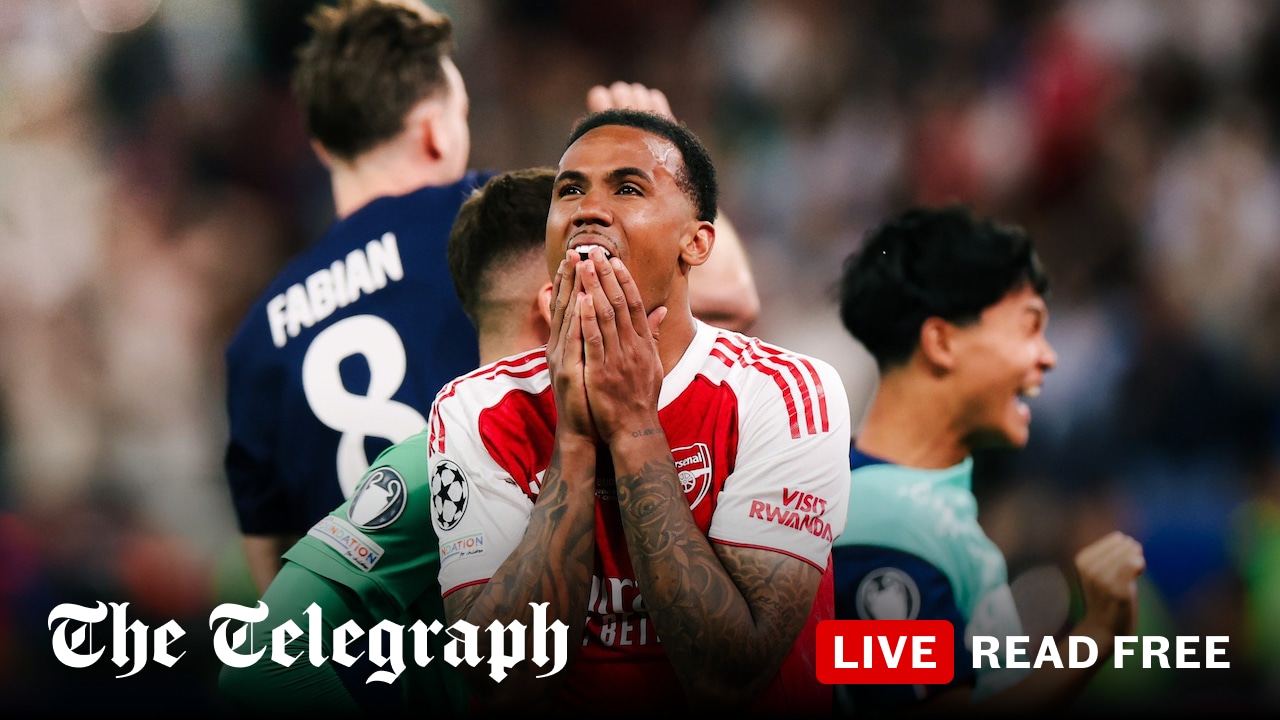
They had fought the best team in Europe all the way through around 135 minutes of exhausting football – containing, battling, thwarting – before it came down to the spot-kicks. It does, as we know, strange things to footballers. That a player as gifted as Eberechi Eze could miss the target was one thing, then David Raya saved from Nuno Mendes to offer a reprieve.
Then eventually it was 4-3 and all on Gabriel. Out of his comfort zone, he missed altogether. Arsenal remain the biggest club in Europe never to have reigned over its football, and this was the closest they have come.
Arsenal had taken the lead through Kai Havertz’s breakaway sixth-minute goal and it had always looked fragile before Ousmane Dembélé’s equaliser from the spot on 65 minutes. For long periods of the game, Arsenal were just surviving.
All six substitutes used by the start of extra-time meant that Piero Hincapié’s injury just had to be managed – and he played on through the pain. The defence that had won them the Premier League was tested to its absolute limits and beyond – the substitute Bradley Barcola had two runs on goals at the end of the 90 minutes and Arsenal were fortunate his finishing was not quite up to it.
There were other issues too: for Bukayo Saka, a very poor game by his standards. Later Viktor Gyokeres, a second-half substitute, would struggle to make anything stick. Another substitute, Noni Madueke, had a close call for a penalty 11 minutes into extra-time but German referee Daniel Siebert thought otherwise.
In the first half Mikel Arteta’s team had enjoyed just 26 per cent of the possession and at times it had been hard but a fortunate ricochet and a superb finish by Havertz had given them the lead. This had been an opening that Arteta might have planned – from the ball that Declan Rice flicked up and smashed forward at the kick-off, all the way to Havertz’s goal in the sixth minute.
The dominant performers had been Gabriel and William Saliba in the heart of the defence. They had been in control of the Arsenal penalty area on every occasion that PSG had entered it. Those two centre-halves would be more exposed as the game became stretched in the second half, but for the first they were the foundation for everything Arsenal did.
The goal from Havertz was remarkable in many ways. He ran for some distance, taking four touches before he struck the shot that climbed at a steep trajectory past the Russian-born goalkeeper Matvey Safonov, whose gloves were down anticipating a drive. The second of those three touches felt heavy, the third corrected it and yet closed the angle. The fourth was more than just a lash, it was a well-aimed smash past a goalkeeper who never really imposed himself on the game.