
A state that shelters Hamas, occupies northern Cyprus and weaponizes corridors cannot dictate the regional order. Israel and its partners are building the system that leaves Ankara outside it.
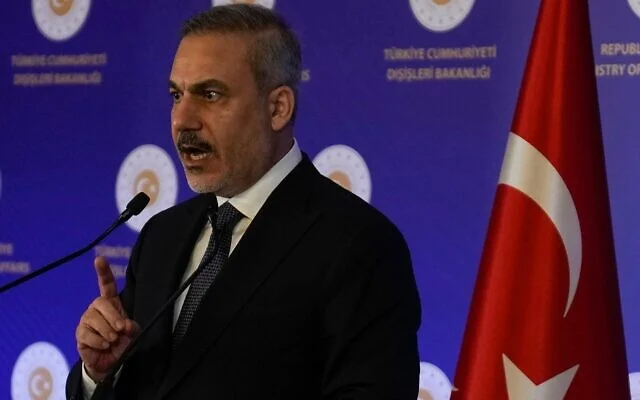
In an interview with Japan’s Nikkei Asia, published yesterday, Turkish Foreign Minister Hakan Fidan placed Gaza under Turkish guardianship and set Israel admission terms for the regional order Ankara seeks to manage.
The claim collapses on contact with the facts. Turkey is not Gaza’s gatekeeper. It is one of the instruments of its captivity. Ankara hosts Hamas leaders, gives them a political platform, enables financing networks on its soil, hands terror operatives passports and citizenship, and allows charities, companies, money routes and propaganda machines to launder support for a terrorist organization into the language of solidarity.
This is not mediation. It is sponsorship. It is not aid to the Palestinians. It is the maintenance of the force that destroyed the possibility of a Palestinian state.
Whoever strengthens Hamas sabotages the two state solution Fidan invokes.
The two state solution is not a Turkish demand. It is an Israeli interest: the condition for preserving Israel as a Jewish, democratic, secure and recognized state over time, with a stable Jewish majority and defensible borders. Political, security and territorial separation from the Palestinians is not a diplomatic slogan. It is a foundation of national existence.
Even when Israel’s political language changed, the practical foundation was not dismantled. Oslo was not annulled. Judea and Samaria were not annexed. The Palestinian Authority was not dismantled. The path to a future agreement was not closed. The framework remains. Wounded, attacked and humiliated, but it remains.
After Iran, Turkey is the most consistent saboteur of the two state solution. It strengthens Hamas, weakens the Palestinian Authority, attacks security coordination and sustains an eternal struggle: anti Israel in rhetoric, anti Palestinian in outcome. In the name of the Palestinians, Ankara works against their future.
Hamas is not a liberation movement. It is a mechanism for denying statehood, feeding on Gaza’s collapse, the Authority’s paralysis and continued bloodshed. Turkey knows. Jerusalem knows.
Fidan is in no position to preach morality. Whoever hosts Hamas is not entitled to claim authority over Gaza. Whoever allows real estate, financing, passports and propaganda to become Hamas infrastructure is not entitled to lecture on humanitarianism. Whoever speaks of sovereignty while holding occupied northern Cyprus does not build a regional order. He dismantles it.
Fidan proposes an order dependent on Ankara. The region, with Israel inside it, is building an order immune to Ankara. This is the Constantinople Protocol: every gate Turkey can turn into a veto, whether a port, airspace, pipeline, cable, corridor, trade route, insurance, documentation, consulate or financial system, is replaced before it becomes a weapon.
A regional order is not a declaration. It is routes, energy, law, insurance, intelligence and freedom of action. It is built with those who reduce dependence, not with those who weaponize it into a veto.
EastMed is the gas axis linking Israel, Cyprus, Greece and Europe: a direct connection between the gas fields of the Eastern Mediterranean and the European market without a Turkish gate. IMEC is the India, Middle East and Europe Economic Corridor: a route of sea, rail, energy, data and trade connecting India, the Gulf, Israel, Greece and Europe. The Vertical Corridor connects Greece’s liquefied natural gas facilities to Bulgaria, Romania, Moldova and Ukraine: a northern artery that removes Europe from Russian dependence and Turkish veto power. These are not technical infrastructures. This is sovereignty in motion.
Opposite them stands the Middle Corridor, formally the Trans Caspian International Transport Route. It connects China and Central Asia to Europe through Kazakhstan, the Caspian Sea, Azerbaijan, Georgia and Turkey. It is sold as an alternative to Russia and Iran, but by design it restores Ankara’s gate power: transit, customs, rail, port, insurance, pressure, delay and approval. This is the Bosphorus lesson applied inland: control renders closure unnecessary. This is not free access to Europe. This is a Turkish choke point.
Turkey is not part of the new regional architecture. It will not be part of it until it stops hosting Hamas and giving it political, financial and documentation cover; until it stops turning the Kurdish question in Turkey, Syria, Iraq and the Iranian sphere into a tool of regional coercion; until it ends the occupation of northern Cyprus; and until it respects the law of the sea in the Aegean and the Eastern Mediterranean, even as it refuses to sign the Law of the Sea Convention.
Northern Cyprus is not only a Cypriot file. It is an Israeli file. Drones, ports, intelligence, maritime grip and proximity to gas platforms, cables and trade routes turn the Turkish occupation into a forward base and operational depth against Israel, Greece and Cyprus.
The “Poseidon’s Wrath” scenario is on the table as a doctrine of the three states and their partners: if Ankara turns the occupied north into strike depth, its liberation by force will cease to be hypothetical.
A new order is not built by those who sustain terrorism and spread a belt of pressure from the Aegean Sea to Gaza.
Israel does not enter Fidan’s architecture. It makes it obsolete.
Shay Gal is a senior strategic advisor and analyst specializing in international security, defense policy, geopolitical crisis management, and strategic communications. He served as Vice President of External Relations at Israel Aerospace Industries (IAI), and previously held senior advisory roles for Israeli government ministers, focusing on crisis management, policy formulation, and strategic influence. Shay consults governments, senior military leaders, and global institutions on navigating complex geopolitical landscapes, shaping effective defense strategies, and fostering international strategic cooperation. His writing and analysis address international power dynamics, security challenges, economics, and leadership, offering practical insights and solutions to today’s global issues.